
SK hynix had one of the strangest weeks I’ve covered all year. On July 24, a Seoul court handed down the largest divorce settlement in South Korean history — $645.7 million — against the chairman of the company’s parent group. Four days later, SK hynix itself reported record quarterly earnings. The stock fell anyway.
Two events, one company, and a market that treated both as the same story. Here’s what actually happened, in order.
A $645 Million Divorce Bill, Priced Off a Chip Stock
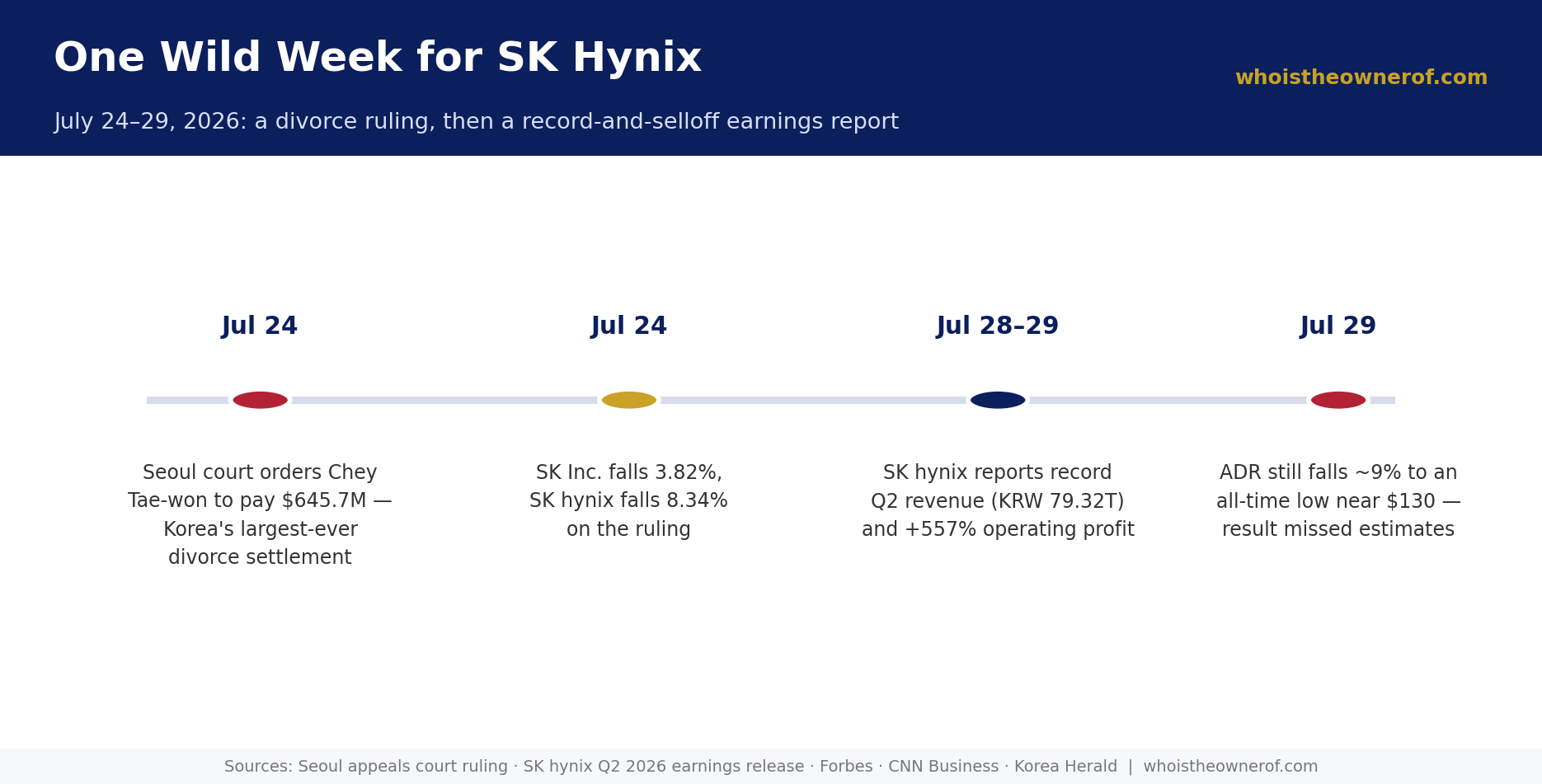
On July 24, a Seoul appeals court ordered Chey Tae-won, chairman of SK Group, to pay his ex-wife Roh Soh-yeong $645.7 million in their divorce settlement — South Korea’s largest ever. Chey had argued that his shares in SK Inc., the group’s holding company, should be excluded from the split because he inherited them. The court disagreed.
The judges ruled that the value of those shares “soared during their marriage,” and that Roh’s contributions — both running the household and supporting SK Group’s public activities — entitled her to a share of that appreciation, not just the original stake. It’s a subtle but important distinction: the court wasn’t dividing an inheritance, it was dividing a chip rally.
The market reacted like it understood that immediately. SK Inc. shares fell 3.82% and SK hynix fell 8.34% the same day, as investors treated a family court ruling in Seoul as material information about the group’s most valuable asset. I don’t cover family law, but when a divorce settlement moves a semiconductor stock 8% in a session, it’s an ownership story whether I like it or not.
Then Came the Earnings — and They Were Actually Good
Four days later, SK hynix reported second-quarter results that were records by almost any measure. Revenue came in at ₩79.32 trillion, pushing first-half 2026 revenue above ₩100 trillion for the first time in company history. Operating profit hit ₩60.54 trillion, up 557% year-over-year, at a 76% operating margin that’s rare for any hardware business, let alone a memory-chip maker.
None of it was enough. Analysts polled by LSEG had modeled operating profit closer to ₩64 trillion, and SK hynix’s own ADRs had run up roughly 122% year-to-date heading into the print on the back of the AI memory boom and an early lead shipping HBM4 chips into Nvidia’s supply chain. When you’re up that much, a record quarter that merely misses inflated expectations reads like a disappointment.
US-listed shares fell nearly 9% to an all-time low near $130. Seoul-listed shares gave back a chunk of the year’s gains too. CNBC’s coverage framed it as a paradox — record earnings, record low — and that’s about right. CNBC’s Jim Cramer took the other side, saying the results “may not be that bad” and that bears were “really trying to take apart a good story.”
Why the Two Stories Are Really One Story
I wrote a separate, full breakdown of who actually owns SK hynix this week, because this is exactly the kind of moment that makes the ownership chain worth understanding. Chey Tae-won doesn’t own a single SK hynix share directly. He owns 17.9% of SK Inc., which controls SK Square, which owns 20.5% of SK hynix — three layers removed from the chip business itself.
But three layers of holding companies don’t insulate anyone from the stock price. When SK hynix’s shares move, the value of SK Square’s stake moves, and so does the value of SK Inc.’s stake in SK Square, and so does Chey’s personal net worth. That’s how a memory-chip earnings report and a Seoul family court ruling ended up as the same financial story in the same week — his fortune, and now his ex-wife’s settlement, are downstream of a stock he doesn’t technically own.
It’s a different ownership shape than I see at most American chipmakers I cover. Intel and AMD are both widely held with no controlling family; SK hynix has one, it’s just sitting three holding companies up the chain instead of on the cap table directly.
FAQ
Why did SK Hynix’s stock price drop after record earnings?
The company beat its own prior records but missed Wall Street’s elevated consensus estimates — operating profit of ₩60.54 trillion against expectations closer to ₩64 trillion. After a roughly 122% year-to-date rally into the print, investors had priced in a bigger beat than the company delivered.
How is Chey Tae-won’s divorce connected to SK Hynix?
Chey doesn’t own SK hynix shares directly, but his 17.9% stake in SK Inc. — which controls SK Square, SK hynix’s largest shareholder — has surged in value alongside SK hynix’s stock. A Seoul court ruled that the appreciation in those SK Inc. shares during his marriage was subject to division, producing the $645.7 million settlement.
Is this South Korea’s largest-ever divorce settlement?
Yes. At $645.7 million, the ruling against Chey Tae-won is described by multiple outlets, including Forbes, as the largest divorce settlement in South Korean history.
Sources: Seoul appeals court ruling coverage, SK hynix Q2 2026 earnings release, Forbes, CNN Business, CNBC, Korea Herald, Benzinga.