
BYD is one of those companies that most people have heard of but few truly understand. The Chinese electric vehicle giant has gone from a tiny battery factory with 20 employees to the world’s largest manufacturer of new energy vehicles — all in just three decades. But the question of who actually owns BYD, and how power is structured inside this massive conglomerate, trips up a lot of people.
The short answer: BYD is a founder-led, publicly traded company. At the helm is Wang Chuanfu — the company’s founder, Chairman, and CEO — who remains the single largest individual shareholder as of early 2026. Here’s the full story.
BYD — Company Highlights
| Full Name | BYD Company Limited |
| Founded | 1995 |
| Founder | Wang Chuanfu |
| Headquarters | Shenzhen, China |
| Stock Listings | Hong Kong Stock Exchange (1211.HK) & Shenzhen Stock Exchange (002594.SZ) |
| Type | Publicly traded conglomerate |
| Known For | Electric vehicles, batteries, Blade Battery technology, electronics manufacturing |
| Employees | ~969,000 (as of end 2024) |
| Founder’s Net Worth | ~$25.7 billion (2026 estimate) |
Who Owns BYD?
BYD Company Limited is primarily controlled by its founding team. The key figures include Wang Chuanfu (Founder, Chairman and President), Lu Xiangyang (Co-founder and Vice Chairman), and Xia Zuoquan (Executive Director and Vice President). Among institutional investors, BlackRock, Baillie Gifford & Co., and FMR LLC (Fidelity) remain significant holders. Together, the founding members collectively hold more than one-third of total voting rights.
| Owner / Stakeholder | Type | Stake | Notes |
|---|---|---|---|
| Wang Chuanfu | Founder & Individual | ~17–29% | Largest individual shareholder; Chairman & CEO |
| Youngy Investment Holding Group | Institutional (Lu Xiangyang) | Significant | Co-founder’s entity; largest single institutional holder |
| BlackRock | Global Asset Manager | ~1.26–3% | Major international institutional investor |
| Vanguard Group | Global Asset Manager | ~1.42% | Long-term institutional holder |
| China Social Security Fund | State Institution | ~2–3% | Government-linked; strategic endorsement of clean energy |
| Public / Retail Investors | Public Markets | ~60% | Through HK and Shenzhen stock exchange listings |
| Berkshire Hathaway | Former Investor | 0% | Completely exited in September 2025 after 17 years |
The Founder — Wang Chuanfu
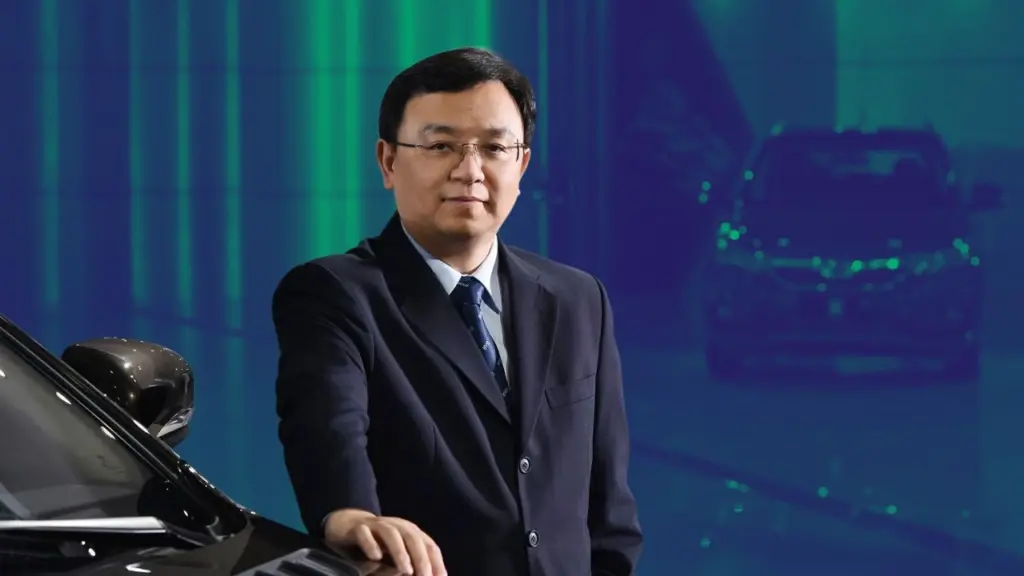
Wang Chuanfu is one of the most remarkable entrepreneurs of the twenty-first century. A Chinese chemist and engineer, he overcame orphanhood and rural poverty to found the company that has become the world’s largest manufacturer of electric vehicles.
Wang was born into a farming family in China’s Anhui province in 1966. He graduated from Central South Industrial University with a bachelor’s degree in metallurgical physical chemistry in 1987 and received a master’s degree in materials from the Beijing General Research Institute of Nonferrous Metals. He used about $400,000 that he borrowed from his cousin to found BYD as a battery maker with 20 employees in 1995.
As of 2026, Wang’s estimated net worth stands at approximately $25.7 billion, built almost entirely through his ownership stake in BYD. He spends 60 to 70 percent of his working time on technology and product development — an unusual allocation for the CEO of a company of BYD’s scale.
Key Milestones & History
| Year | Milestone |
|---|---|
| 1995 | Wang Chuanfu founds BYD as a rechargeable battery company in Shenzhen with 20 employees |
| 1997 | BYD begins making lithium-ion batteries for mobile handsets |
| 2003 | BYD enters the automotive industry via acquisition of Xi’an Qinchuan Automobile |
| 2005 | BYD F3 — the first BYD car — begins production |
| 2008 | Berkshire Hathaway invests $230 million for ~10% stake; global credibility soars |
| 2008 | BYD launches the F3DM — the world’s first mass-produced plug-in hybrid |
| 2022 | BYD Auto ends production of purely internal combustion engine cars in March 2022 |
| 2023 | BYD Auto becomes the largest automobile manufacturer in China by annual sales |
| Sept 2025 | Berkshire Hathaway sells its entire stake in BYD after a 17-year investment that generated a 3,890% return |
| 2026 | BYD raises its full-year overseas sales target to 1.5 million units |
The Berkshire Hathaway Story
No story about BYD ownership is complete without Warren Buffett.
In September 2008, MidAmerican Energy Holdings, a subsidiary of Warren Buffett’s Berkshire Hathaway, invested about $230 million for a 9.89% share of BYD at HK$8 per share. Buffett credited this investment to Charlie Munger, Berkshire’s vice chairman, who saw the potential in the company.
By September 2025, Berkshire had completely exited its BYD investment after a 17-year holding period that generated a 3,890% return. The reduced stake reflected portfolio diversification and profit-taking rather than concerns about BYD’s prospects.
What Does BYD Actually Own?
BYD is far more than just a car company. The company operates diverse subsidiaries including FinDreams Battery, BYD Electronics, BYD Semiconductor, and the luxury Yangwang brand, positioning itself as a comprehensive technology conglomerate rather than just an automaker.
BYD Company Limited holds a commanding 65.76% majority stake in BYD Electronic, which assembles smartphones, laptops, and tablets for massive global brands, including manufacturing most of Huawei’s smartphones and serving as a key assembly partner for Apple’s iPads.
Why Founder Control Matters
Unlike many legacy automakers governed by sprawling, fragmented boards, BYD is a fiercely founder-led enterprise. This concentration of power has been the ultimate catalyst for the brand’s agility and long-term strategic bets. The shift from being a “battery company” to an “auto company” to an “all-electric auto company” required aggressive pivoting — founder control allowed BYD to entirely end its profitable gas-powered vehicle line in 2022 without facing a board rebellion, purely to align the brand with the future of green energy.
My Take on BYD
BYD’s story is genuinely one of the most extraordinary in modern business history. Wang Chuanfu started with borrowed money and 20 employees, and built a company with nearly a million workers that now competes directly with Tesla on a global stage. What makes BYD different from almost every other automaker is that it owns its entire supply chain — from lithium mining to microchips to batteries to finished cars. That vertical integration, built over decades of founder-led patience, is nearly impossible to replicate quickly. Berkshire Hathaway’s exit in 2025 may have made headlines, but with a 3,890% return, it was perhaps the most successful exit in investing history — not a statement of doubt about BYD’s future. The road ahead in 2026 and beyond has challenges, including slowing domestic sales and intensifying global competition, but the foundation Wang Chuanfu built is unlike anything the auto industry has seen before.
Frequently Asked Questions
Q: Who owns BYD?
BYD is primarily owned by its founder Wang Chuanfu, who holds approximately 17–29% of the company. The rest is held by institutional investors and public shareholders through stock exchange listings.
Q: Is BYD owned by the Chinese government?
No. BYD is not owned by the Chinese government. Wang Chuanfu holds the largest stake at 17%, while state institutions like the China Social Security Fund own only 2–3%, providing strategic support without controlling interest.
Q: Did Warren Buffett own BYD?
Yes. Berkshire Hathaway invested about $230 million in BYD in 2008 for a ~10% stake, and completely exited the investment in September 2025 after generating a 3,890% return.
Q: Where is BYD headquartered?
BYD is headquartered in Shenzhen, China, where it was originally founded in 1995.
Q: What does BYD stand for?
BYD stands for “Build Your Dreams” — the company’s English brand motto.
Q: Is BYD publicly traded?
Yes. BYD trades on the Hong Kong Stock Exchange (1211.HK) and the Shenzhen Stock Exchange (002594.SZ), allowing foreign institutions to participate heavily in its growth.
Q: What is Wang Chuanfu’s net worth?
As of 2026, Wang Chuanfu’s estimated net worth stands at approximately $25.7 billion.