
When people ask “who owns Cape Verde,” they are really asking one of the most important questions in political science — not just about this small island nation, but about the nature of sovereignty itself. Cape Verde is not owned by any person, company, or foreign power. It is a fully independent, democratic republic that belongs to its own people. But understanding who governs it, how power is structured, and what shaped the country’s path to self-ownership is a story worth knowing in full — especially in 2026, a year when the islands are making global headlines both for a landmark election and a remarkable run at the FIFA World Cup.
Nashville Hospitality Ownership Stories
For a different kind of ownership story, check out who owns Whiskey River Saloon in Nashville.
What Is Cape Verde?
Cape Verde — officially known as the Republic of Cabo Verde — is an archipelago nation located approximately 385 miles (620 km) off the west coast of Africa in the central Atlantic Ocean. With a population of around 530,000 as of 2026, it is among the least populous countries in Africa.
The country became independent in 1975 and since the early 1990s has been a stable representative democracy — one of the most developed and democratic countries in Africa.
The archipelago consists of ten islands, nine of which are inhabited. The capital city is Praia, located on the largest island, Santiago. The official language is Portuguese, while the recognized national language is Cape Verdean Creole (Crioulo), spoken by the vast majority of the population.
Who Owns Cape Verde? The Direct Answer
No single person, family, or foreign country owns Cape Verde. Cape Verde is a stable semi-presidential representative democratic republic. Sovereignty belongs entirely to its people, exercised through free and fair elections.
The country is governed by two key leaders who share executive power:
President José Maria Neves serves as Chief of State, and Prime Minister José Ulisses Correia e Silva serves as Head of Government.
This power-sharing model is one of the defining features of Cape Verde’s political system — and it is currently shared between two different political parties, which is a sign of genuine democratic health rather than political weakness.
Who Governs Cape Verde — Government Structure Table
| Position | Name | Party | Role |
|---|---|---|---|
| President (Chief of State) | José Maria Neves | PAICV | Elected in 2021 with 51.7% of votes; serves as commander-in-chief |
| Prime Minister (Head of Government) | José Ulisses Correia e Silva | MpD | Leads day-to-day government; holds most executive authority |
| Government Type | Republic | — | Semi-presidential multiparty democracy |
| National Assembly | 72 seats | Multiple parties | Unicameral legislature; elects Prime Minister |
| Constitution | Adopted 1980 | — | Revised in 1992, 1995, and 1999 |
| Capital City | Praia (Santiago Island) | — | Largest city and seat of government |
| Currency | Cape Verdean Escudo (CVE) | — | Pegged to the euro |
| Independence | July 5, 1975 | — | Gained from Portugal after armed struggle led by PAIGC |
| Next Presidential Election | November 15, 2026 | — | Scheduled per constitutional two-term limit |
The Origin Story: From Portuguese Colony to Free Nation
The path to Cape Verde’s independence is one of the most inspiring stories in African history — and it explains why the question of “ownership” carries such deep meaning for its people.
The country’s official name is Cabo Verde, though both Cabo Verde and Cape Verde translate to “Green Cape.” Before gaining independence on July 5, 1975, Cape Verde was a Portuguese colonial territory.
The uninhabited islands were discovered and colonized by the Portuguese in the 15th century. Cape Verde subsequently became a trading center for African slaves and later an important coaling and resupply stop for whaling and transatlantic shipping. The fusing of European and various African cultural traditions is reflected in Cape Verde’s Crioulo language, music, and pano textiles.
The movement for independence began to gain momentum in the mid-20th century, culminating in the establishment of the African Party for the Independence of Guinea and Cape Verde (PAIGC) in 1956. Following years of political activism and armed struggle, Cape Verde finally achieved independence on July 5, 1975.
After independence, the country was governed as a one-party state for its first 15 years. Following independence in 1975, a one-party system was established and maintained until multi-party elections were held in 1990. Since that democratic transition, Cape Verde has been a model of peaceful governance — something very rare in post-colonial African history.
How Cape Verde’s Government Works
Cape Verde’s hybrid presidential and parliamentary model shares executive responsibilities. The directly elected president serves as commander-in-chief, oversees the legislative process with veto authority, and serves as a mediator in reaching consensus. The prime minister, who is selected by the National Assembly, acts as the head of government, implementing policy and leading the country’s day-to-day functions.
The president signs or vetoes proposed laws, generally in consultation with the government per the constitution, but in practice the president typically plays a limited role in policymaking. Policymaking is generally led by the government.
Currently, the two top positions are held by leaders from opposing parties — President Neves from PAICV and Prime Minister Correia e Silva from MpD — a situation called “cohabitation.” The power-sharing model depends on cooperative relations between the respective executive authorities.
President José Maria Neves — Who Is He?
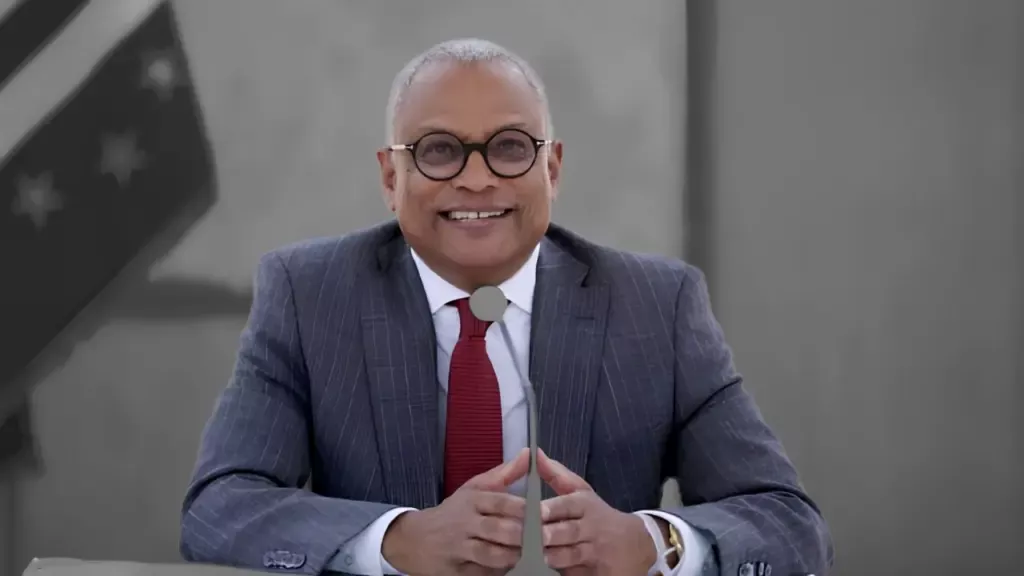
José Maria Neves is a Cape Verdean politician who is currently the president of Cape Verde, having previously served as Prime Minister of Cape Verde from 2001 to 2016. He is a member of the African Party for the Independence of Cape Verde (PAICV). In the 2021 presidential election, he was elected with 51.7% of votes, beating his nearest rival Carlos Veiga who got 42.4% of the total votes.
Neves was born on the island of Santiago in 1960. He became interested in the politics of Cape Verde as a teenager and was the leader of a nationalist youth organization during the country’s transition from Portuguese rule to independence and democracy in 1975.
He is widely respected internationally for his long record of stable, democratic governance and economic development. Under his leadership as Prime Minister, Cape Verde graduated from the United Nations’ list of Least Developed Countries — only the second African nation to achieve this transition.
The 2026 Elections: A New Chapter Begins
2026 is a pivotal year for Cape Verde’s governance story, with both parliamentary and presidential elections scheduled.
The PAICV could win at least 37 seats and secure an outright majority in parliament following the May 17, 2026 legislative elections. As a result of the MpD’s loss, Prime Minister Ulisses Correia e Silva conceded and announced his resignation from the party leadership.
Presidential elections are also scheduled to be held in Cape Verde on November 15, 2026. The outcome of these elections will determine whether the current cohabitation model continues — or whether a single party takes control of both the presidency and the government for the first time in years.
Cape Verde’s Economy: Tourism, Remittances, and Growth
Understanding who governs Cape Verde also means understanding what they are governing — and the country’s economy is one of the most interesting development stories in Africa.
Since the 1990s, the country has made significant strides, largely due to the rapid growth of tourism, which constitutes 25% of its GDP.
Growth is estimated at 5.2% in 2025, and the country is expected to see moderate growth of 4.7% in 2026 and 5.0% in 2027. In 2025, the World Bank upgraded the country to upper-middle-income status.
Expatriate Cape Verdeans contribute an amount estimated at 20% of GDP to the domestic economy through remittances. Despite having few natural resources and being semi-desert, the country has the highest living standards in the region and has attracted thousands of immigrants of different nationalities.
Cape Verde at the 2026 FIFA World Cup
In 2026, Cape Verde is making history far beyond its shores. Cape Verde’s dream run continues, with the team becoming the smallest country to reach the World Cup knockout round. The Blue Sharks (Tubarões Azuis) drew with Uruguay 2-2 and advanced past the group stage — a remarkable achievement for a nation of just 530,000 people.
This World Cup story is not just about sport. It is a symbol of what Cape Verde has become — a small island nation that punches far above its weight, both on the football pitch and in the global arena of democratic governance.
Frequently Asked Questions (FAQs)
Q1. Who owns Cape Verde?
No one “owns” Cape Verde — it is a fully sovereign democratic republic governed by its own elected leaders and belonging to its 530,000 citizens.
Q2. Who is the current President of Cape Verde in 2026?
José Maria Neves is the incumbent president of Cape Verde, having taken office on November 9, 2021.
Q3. Who is the Prime Minister of Cape Verde in 2026?
José Ulisses Correia e Silva of the MpD party serves as Prime Minister, though he announced his resignation from party leadership after the May 2026 parliamentary election loss.
Q4. When did Cape Verde gain independence?
Cape Verde gained independence from Portugal on July 5, 1975, after an armed struggle led by the PAIGC.
Q5. What type of government does Cape Verde have?
Cape Verde is a stable semi-presidential representative democratic republic with a multiparty system and a National Assembly of 72 seats.
Q6. What is Cape Verde’s economy based on?
Cape Verde’s economy is primarily driven by tourism (25% of GDP) and remittances from its large overseas diaspora, which contribute approximately 20% of GDP.
Q7. How democratic is Cape Verde compared to other African nations?
In 2026, Cape Verde ranked as the joint second most democratic nation in Africa, ranking 40th in the world on the V-Dem Democracy indices.
Q8. When is Cape Verde’s next presidential election?
Presidential elections in Cape Verde are scheduled for November 15, 2026.
Cape Verde is not owned by any person, company, or foreign power. It is a sovereign democratic republic whose people have governed themselves since gaining independence from Portugal on July 5, 1975. As of 2026, the country is led by President José Maria Neves (Chief of State) and Prime Minister José Ulisses Correia e Silva (Head of Government), operating under a semi-presidential system where both executive roles are currently shared between opposing political parties in a democratic cohabitation.
In 2026, Cape Verde was ranked a joint second most democratic nation in Africa (alongside Mauritius and South Africa), ranking 40th in the world according to the electoral democracy score of the V-Dem Democracy indices. With a World Bank upper-middle-income upgrade in 2025, a growing tourism economy, and a historic FIFA World Cup run in 2026, Cape Verde is one of Africa’s most remarkable success stories — and it belongs entirely to its own people.