
Pick up any LEGO brick and turn it over. That little circular stud on top has been exactly the same size and shape since 1958 — compatible with every LEGO brick ever made. That kind of consistency does not happen by accident. It happens when a single family controls a company for four generations, refuses to sell it to outside investors, and treats every decision like a long-term bet on the next hundred years rather than the next quarter.
LEGO is the world’s most valuable toy brand and one of the most remarkable family business stories in history. But who actually owns it? The answer involves a Danish carpenter, a wooden duck, a family holding company called KIRKBI, a charitable foundation that owns a quarter of the whole empire, and a fourth-generation heir who just completed one of the smoothest leadership transitions in European business history.
What Is LEGO?
The LEGO Group is a Danish construction toy manufacturer and media company based in Billund, Denmark. The company was founded in 1932 by Ole Kirk Christiansen, a carpenter whose primary business of producing household goods had suffered during the Great Depression.
In the first half of 2015, The LEGO Group became the world’s largest toy company by revenue, surpassing Mattel. It has held that title ever since. As of 2024, the company has approximately 31,282 employees and operates across more than 40 offices worldwide.
The name LEGO comes from the Danish phrase “leg godt” — which means “play well.” It is fitting. For over nine decades, that simple idea has driven every brick, every set, and every decision this company has ever made.
Who Owns LEGO Right Now in 2026?
The answer is precise and clean: LEGO is owned by KIRKBI A/S (75%) and The LEGO Foundation (25%).
KIRKBI is owned by the Kirk Kristiansen family, who founded the LEGO Group in 1932. Since then, the family ownership has been passed down from generation to generation — and the LEGO Group and LEGO brand is still owned by the Kirk Kristiansen family.
This is not a publicly traded company. There are no outside shareholders, no institutional investors, and no Wall Street analysts pressuring management for quarterly earnings beats. LEGO is a private company, owned by one family through a holding company, with a quarter of it dedicated to a foundation that gives money to children’s education worldwide.
Today, Thomas Kirk Kristiansen chairs KIRKBI, LEGO A/S, and the LEGO Foundation, with Agnete Kirk Kristiansen, also of the fourth generation, serving as Deputy Chair of KIRKBI and the LEGO Foundation.
LEGO Ownership and Key Stakeholders Table
| Owner / Shareholder | Type | Stake | Key Detail |
|---|---|---|---|
| KIRKBI A/S | Family Holding Company | 75% of LEGO Group | Private investment firm owned by the Kirk Kristiansen family |
| The LEGO Foundation | Charitable Foundation | 25% of LEGO Group | Independent nonprofit; funds children’s learning-through-play globally |
| Thomas Kirk Kristiansen | Chairman & Controlling Family Member | ~18.8% economic interest via KIRKBI | Great-grandson of founder; became Chairman of KIRKBI in May 2023 |
| Kjeld Kirk Kristiansen | Former Chairman & Third-Generation Owner | ~25% of KIRKBI (reduced) | Grandson of founder; ran LEGO as CEO from 1979 to 2004 |
| Agnete Kirk Kristiansen | Deputy Chair | Part of KIRKBI family stake | Fourth generation; Deputy Chair of KIRKBI and LEGO Foundation |
| Sofie Kirk Kristiansen | Family Shareholder | ~23% of KIRKBI | Fourth generation; reduced stake slightly in November 2023 |
| Niels B. Christiansen | CEO of LEGO Group | No ownership stake | Has led LEGO as CEO since October 2017 |
| Merlin Entertainments | KIRKBI Subsidiary | 47.5% owned by KIRKBI | Operates LEGOLAND parks worldwide |
The Origin Story: A Wooden Duck and a Danish Carpenter
The LEGO empire did not start with plastic bricks. It started with a wooden duck.
LEGO was founded by Ole Kirk Christiansen in 1932 in Billund, Denmark. The LEGO name was registered in 1934. Ole was a carpenter who had been making furniture and household items — but the Great Depression had devastated that business. Desperate to keep his workshop running and his workers employed, he turned to making small wooden toys.
One of those toys was a small wooden duck on wheels. It was simple, well-made, and children loved it. Ole carved toys guided by one principle that became the company’s lasting motto: “Only the best is good enough.” That phrase still hangs on the wall at LEGO headquarters in Billund today.
The plastic brick — the invention that would change everything — came later. The plastic bricks and stud-and-tube system were introduced after World War II. In 1958, the iconic stud-and-tube clutch system was patented — the design that makes every LEGO brick ever produced compatible with every other LEGO brick ever produced. That single patent is arguably the most important design decision in toy history.
Ole Kirk Christiansen passed away in 1958, the same year the iconic brick system was patented. His son Godtfred took over and ran the company through its explosive global growth in the 1960s and 1970s. Then Godtfred’s son Kjeld became CEO in 1979 and turned LEGO into a true global brand — launching Legoland theme parks and building operations across Europe, the UK, and the United States.
KIRKBI: The Family Holding Company That Controls Everything

KIRKBI A/S is a Danish investment management company headquartered in Billund, Denmark, that serves as a family office to manage the fortune of the Kristiansen family, the current owners of The LEGO Group. It owns 75% of The LEGO Group, 47.5% of Merlin Entertainments, and BrainPop.
KIRKBI was established on April 1, 1995, as a family office for the Kristiansen family, who are owners of the LEGO Group. Its primary function is safeguarding the LEGO brand and providing a creative platform for children.
Think of KIRKBI as the quiet command center behind the LEGO empire. It does not make bricks or design sets. It manages the family’s wealth, invests in adjacent businesses like Merlin Entertainments (which operates all the LEGOLAND parks), and makes sure that LEGO stays in family hands no matter what outside pressures arise.
The Fourth-Generation Handover: Thomas Takes the Wheel
One of the most significant moments in recent LEGO history happened quietly in May 2023 — and most people outside the business world barely noticed.
In May 2023, the gradual generational handover was completed as Thomas Kirk Kristiansen took over the role as Chair of the Board of Directors in KIRKBI A/S from Kjeld Kirk Kristiansen. In 2023, the Kirk Kristiansen family completed a gradual generational handover from third to fourth generation.
Thomas Kirk Kristiansen was born in 1979, the great-grandson of Ole Kirk Kristiansen, who founded toymaker LEGO in 1932. Father Kjeld ran the company for 25 years beginning in 1979 and built it into a global brand, which involved an expansion into Legoland theme parks in the 1990s and adding operations in the UK, Germany, and the US.
The majority of Kristiansen’s fortune is derived from his 18.8% economic interest in LEGO, Europe’s largest toymaker. His stake in the closely held company is controlled through KIRKBI.
The transition from Kjeld to Thomas was deliberately gradual — a years-long handover designed to maintain stability and continuity. There was no hostile boardroom drama, no contested ownership battle. Just a family quietly passing the baton from one generation to the next, exactly as they have done since 1932.
The LEGO Foundation: The 25% That Funds Children Worldwide
One of the most unusual things about LEGO’s ownership structure is the 25% stake held by The LEGO Foundation — an independent charitable organization that is not controlled by the Kristiansen family.
Rooted in the LEGO idea and a strong belief in the value of Learning-through-Play, the LEGO Foundation has three long-term ambitions: bringing the LEGO idea to children of all ages through a unified brand experience, reaching more children with LEGO play, and investing in research that proves the value of play-based learning.
Because the LEGO Foundation owns 25% of the company, every time LEGO earns a profit and pays a dividend, a quarter of that money goes directly to funding children’s education and play programs around the world. It is one of the most elegant structures in global philanthropy — a toy company literally built so that selling toys funds helping children.
Record Breaking Numbers: How LEGO Is Doing in 2025 and 2026
The financial story of LEGO in recent years is one of almost unbroken success.
The LEGO Group achieved record revenue and operating profit in 2024, outpacing the toy market with significant market share gains. The double-digit revenue growth was driven by strong demand for its large and diverse portfolio, excellent execution in markets, and a resilient supply chain.
LEGO reported revenue of 74.3 billion Danish Krone (approximately $10.8 billion USD) in 2024, with operating income of 18.7 billion DKK and net income of 13.8 billion DKK.
The growth continued strongly into 2025. In the first six months of 2025, The LEGO Group’s revenue increased by 12% to a record DKK 34.6 billion, up from DKK 31.0 billion in H1 2024. Operating profit increased 10% to DKK 9.0 billion. Net profit grew 10% to DKK 6.5 billion.
CEO Niels Christiansen attributes this double-digit growth to a rise in demand for new construction sets in the Americas, Europe, and the Middle East, leading to a 12% increase in global consumer sales. In 2024, LEGO manufactured 840 different SKUs, with 46% being new products. LEGO also opened 74 branded stores in 2024 and now operates 1,069 storefronts worldwide.
Who Is the CEO of LEGO in 2026?
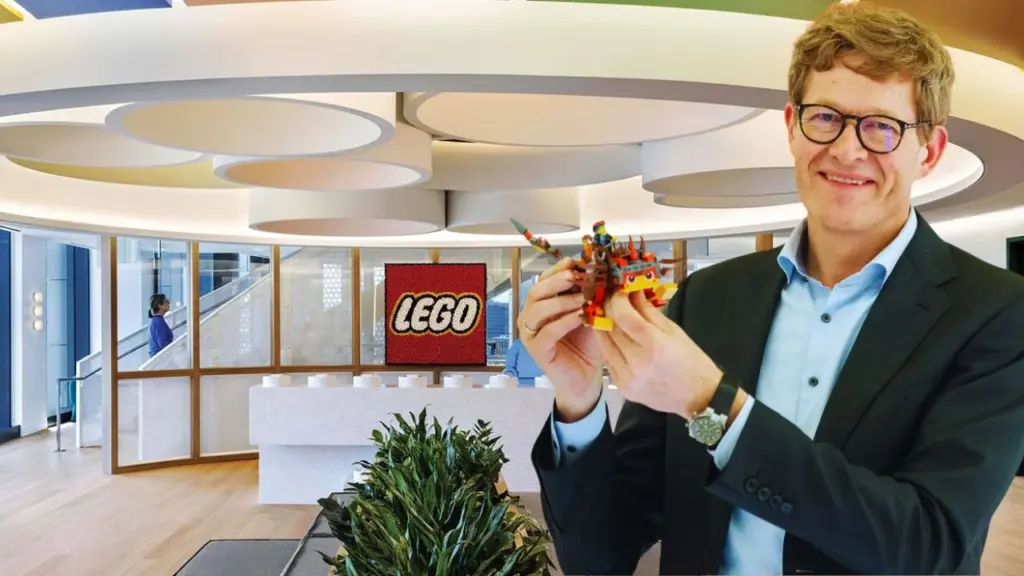
Niels B. Christiansen has been at the helm of The LEGO Group since October 2017. With a background in engineering and business, he previously served as CEO of Danfoss, a Danish engineering company. Under his leadership, LEGO has focused on sustainability, digital innovation, and global expansion.
Niels B. Christiansen is not a member of the Kristiansen family. He is a professional CEO brought in to run the day-to-day business while Thomas Kirk Kristiansen oversees the family’s ownership role as Chairman. This separation of ownership and management is deliberate — and it is one of the reasons LEGO has been able to grow so professionally while keeping its family ownership structure completely intact.
The Kristiansen Family Net Worth
As of 2022, the Kirk Kristiansen family is considered to be the richest family in Denmark, with an estimated $32.8 billion of Denmark’s $57 billion total billionaire wealth.
KIRKBI, a trust that looks after the Kirk Kristiansen family’s 75% share of Europe’s biggest toymaker, enjoyed net income of 11.3 billion kroner ($1.62 billion) in its portfolio in 2023 — a 5.9% increase from 2022 profits.
That wealth has been built over four generations on a foundation of wooden toys, plastic bricks, and an unshakeable belief that children deserve the very best.
Frequently Asked Questions (FAQs)
Q1. Who owns LEGO in 2026?
LEGO is owned 75% by KIRKBI A/S — the Kirk Kristiansen family’s private holding company — and 25% by The LEGO Foundation.
Q2. Is LEGO publicly traded?
No. LEGO is a fully private company and has never been listed on any stock exchange.
Q3. Who founded LEGO and when?
LEGO was founded by Ole Kirk Christiansen, a Danish carpenter, on August 10, 1932, in Billund, Denmark.
Q4. Who is the current Chairman of LEGO?
Thomas Kirk Kristiansen, great-grandson of founder Ole, serves as Chairman of KIRKBI, LEGO A/S, and The LEGO Foundation since May 2023.
Q5. Who is the CEO of LEGO in 2026?
Niels B. Christiansen is the CEO of The LEGO Group, a role he has held since October 2017.
Q6. How much revenue did LEGO make in 2024?
LEGO reported record revenue of 74.3 billion Danish Krone — approximately $10.8 billion USD — in 2024.
Q7. What is KIRKBI and what does it own?
KIRKBI A/S is the Kristiansen family’s private investment firm that owns 75% of LEGO, 47.5% of Merlin Entertainments (which operates LEGOLAND parks), and BrainPop.
Q8. Is the Kristiansen family the richest family in Denmark?
Yes. As of 2022, the Kirk Kristiansen family is the wealthiest family in Denmark, with an estimated net worth of $32.8 billion.
LEGO is owned 75% by KIRKBI A/S and 25% by The LEGO Foundation. KIRKBI is the private family holding company of the Kirk Kristiansen family — the same family that has owned LEGO since its founding in 1932. Fourth-generation family member Thomas Kirk Kristiansen serves as Chairman of both KIRKBI and LEGO, following the completion of a smooth generational handover from his father Kjeld in May 2023.
LEGO is not publicly traded. It has never been sold to outside investors. And despite being the world’s most valuable toy brand — generating over $10.8 billion in revenue in 2024 and posting record results again in 2025 — it remains exactly what it has always been: a family company, in a small Danish town, run by people who genuinely believe that play makes the world a better place.