
Who owns Nissan is a question with a surprisingly complicated answer — and it’s gotten even more complicated in the last few years. On the surface, Nissan is a Japanese automaker. But the real ownership story involves a French car company, a controversial CEO who was arrested in Japan, and one of the most dramatic corporate rescues in automotive history.
I’ve been fascinated by the Renault-Nissan relationship for years. It’s the kind of business alliance that should not work on paper — a French state-backed company owning a Japanese automaker — yet it produced some of the most important vehicles of the 21st century, including the Nissan Leaf, the world’s best-selling electric car.
Here’s the complete, real story of who owns Nissan in 2026.
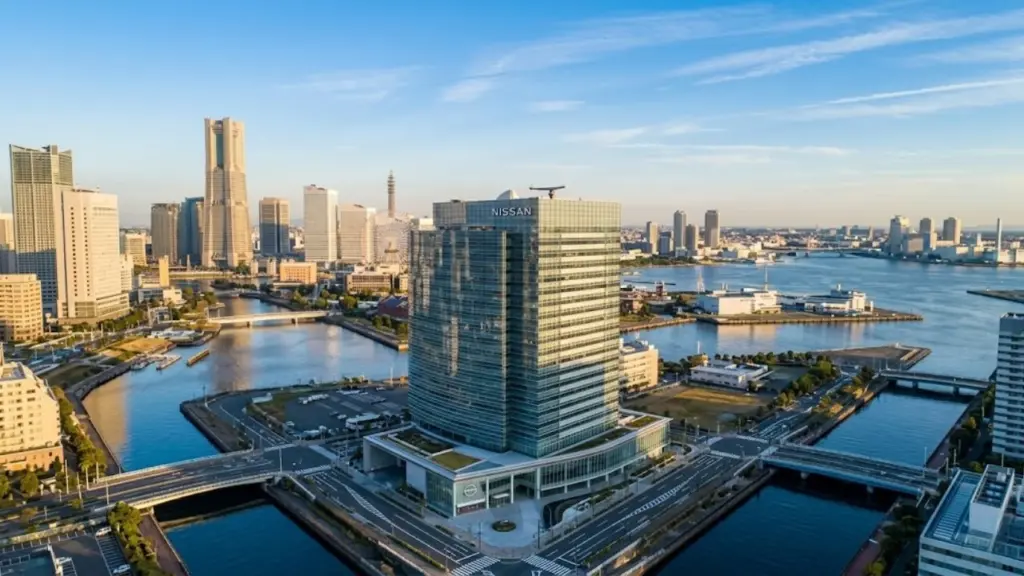
Who Owns Nissan in 2026?
Nissan Motor Co., Ltd. is a publicly traded Japanese automobile manufacturer listed on the Tokyo Stock Exchange (ticker: 7201). No single entity owns Nissan outright — ownership is spread across several major shareholders, with Renault SA being the largest single stakeholder, Renault also owned Jeep, and Mahindra.
Following a landmark 2023 restructuring of the Renault-Nissan-Mitsubishi Alliance, here is how Nissan’s ownership is structured in 2026:
| Shareholder | Approximate Stake | Notes |
|---|---|---|
| Renault SA | ~36% | Largest single shareholder; voting rights capped at ~15% under 2023 restructuring terms |
| Nissan Motor (Treasury Shares) | ~8% | Shares held by Nissan itself (non-voting) |
| Japanese Institutional Investors | ~20% | Banks, pension funds, domestic institutional investors |
| Foreign Institutional Investors | ~25% | International funds, global asset managers |
| Individual Retail Investors | ~11% | Retail shareholders globally |
The key point: while Renault holds the largest economic stake (~36%), the 2023 restructuring agreement capped Renault’s voting rights to approximately 15% — making the alliance more equal and giving Nissan far greater operational independence than it had before.
🚗 Nissan Motor Co. — Company Highlights
| Full Legal Name | Nissan Motor Co., Ltd. |
| Founded | December 26, 1933 (Yokohama, Japan) |
| Founder | Yoshisuke Aikawa (modern Nissan Motor Co.) |
| Headquarters | Nishi-ku, Yokohama, Kanagawa, Japan |
| Stock Exchange | Tokyo Stock Exchange (TYO: 7201) |
| Largest Shareholder | Renault SA (~36%) |
| Alliance Partners | Renault (France), Mitsubishi Motors (Japan) |
| Annual Revenue | ~¥12.7 trillion (~$84 billion USD, FY2024) |
| Employees | ~133,000 worldwide |
| Vehicles Sold (Annual) | ~3.4 million (FY2024) |
| Key Brands | Nissan, Infiniti, Nismo |
The Renault-Nissan-Mitsubishi Alliance
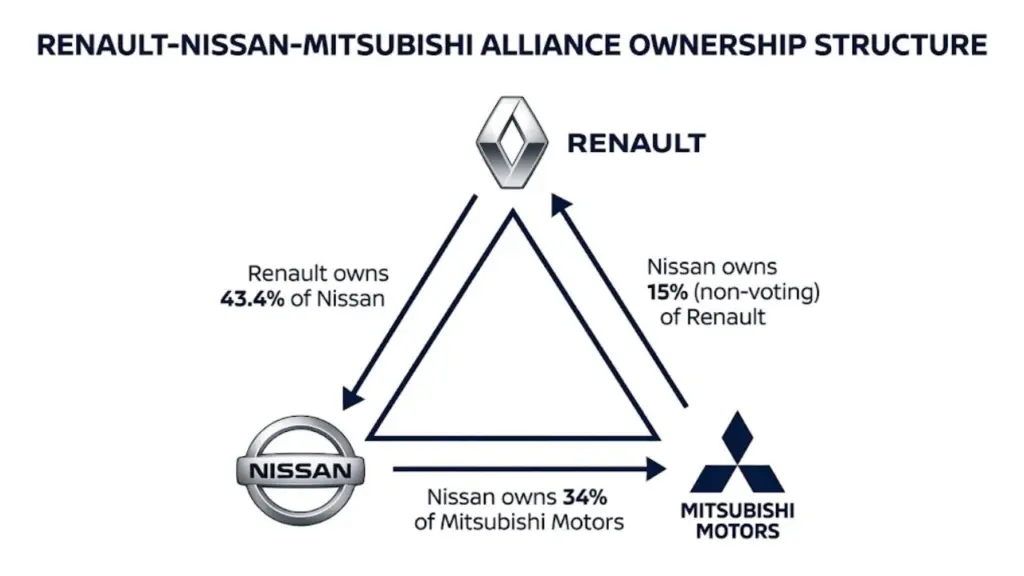
The Renault-Nissan-Mitsubishi Alliance is one of the largest automotive alliances in the world. Together, the three companies sell vehicles across more than 200 countries and produce over 10 million vehicles per year in strong years. Here’s how the cross-ownership structure works:
| Entity | Stake in Nissan | Stake in Renault | Stake in Mitsubishi |
|---|---|---|---|
| Renault | ~36% (votes ~15%) | — | No direct stake |
| Nissan | — | ~15% (non-voting) | ~34% (controlling) |
| Mitsubishi Motors | No direct stake | No direct stake | — |
Nissan is effectively the “middle child” of the alliance — owned by Renault, but itself owning a controlling stake in Mitsubishi Motors. This creates a fascinating chain of corporate control that has no real parallel in the global auto industry.
How Did Renault Come to Own Nissan? The 1999 Rescue
In 1999, Nissan was on the verge of collapse. The company was drowning in ¥2 trillion (roughly $20 billion) of debt. Japanese banks, which had traditionally come to the rescue of major corporations, weren’t willing or able to bail Nissan out. Several potential Japanese partners looked at Nissan’s books and walked away.
Then came Renault. The French automaker acquired a 36.8% stake in Nissan for $5.4 billion — a massive bet on a company many analysts considered finished. Renault sent a Brazilian-born, Lebanese-raised executive named Carlos Ghosn to Yokohama as Chief Operating Officer. What happened next became a Harvard Business School case study.
Ghosn implemented the brutal “Nissan Revival Plan” — closing five factories in Japan, cutting 21,000 jobs, and slashing purchasing costs. By 2001, Nissan was profitable again. By 2002, all debt was cleared. Ghosn was celebrated as a corporate hero in Japan, even becoming the subject of a manga comic book.
Carlos Ghosn: The Fall of Nissan’s Most Famous Leader
No story about who owns Nissan is complete without Carlos Ghosn’s arrest. In November 2018, Ghosn — who was by then Chairman of Nissan, Renault, and Mitsubishi Motors simultaneously — was arrested at Tokyo’s Haneda Airport. Japanese prosecutors charged him with underreporting his compensation to Japanese financial regulators and with misuse of company funds.
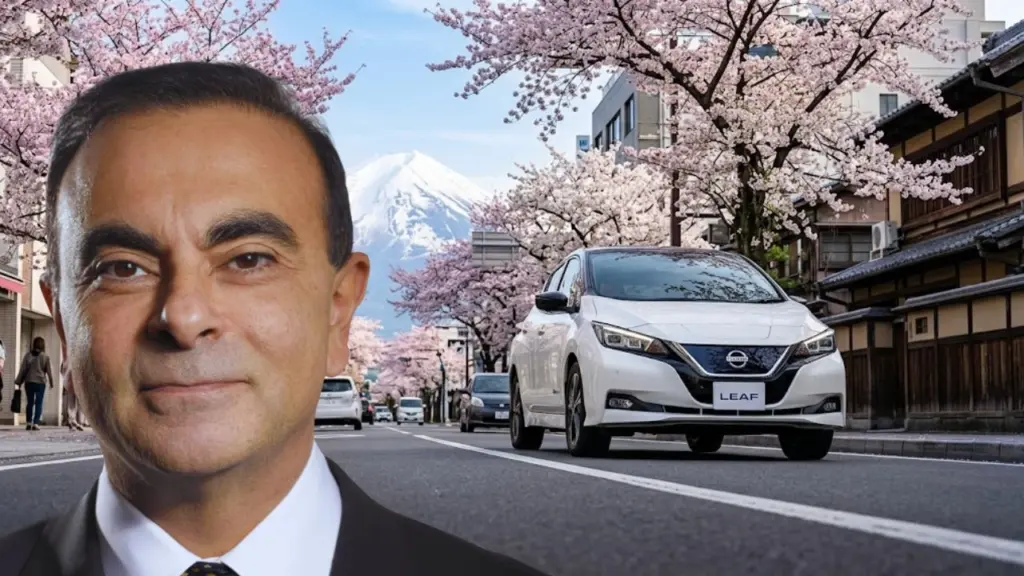
In December 2019, Ghosn dramatically escaped Japan in what became one of the most bizarre corporate stories in modern history. Hidden in a box on a private jet, he fled to Lebanon, where he remains to this day, beyond the reach of Japanese law. His departure left Nissan with a leadership vacuum and triggered a formal review of the alliance structure with Renault.
The 2023 Alliance Restructuring: A More Equal Partnership
For years, the Renault-Nissan Alliance was structurally lopsided. Renault held ~43% of Nissan and had full voting rights on those shares. Nissan, in turn, held ~15% of Renault but with no voting rights — a deeply asymmetrical arrangement that many Nissan executives resented.
In February 2023, the two companies announced a landmark restructuring. The key terms:
- Renault would transfer approximately 28.4% of its Nissan shares into a French trust (managed independently), reducing its active voting stake to ~15%
- Nissan would gain the ability to buy up to 15% of Renault’s new EV subsidiary, Ampere
- Both companies would hold equivalent voting stakes in each other (~15%), creating a more balanced partnership
- The trust’s shares would be monetized over time through market sales
The restructuring was widely seen as a victory for Nissan’s Japanese leadership, who had long chafed at French oversight. It represented a fundamental shift in who holds real power over Nissan’s direction.
Nissan Ownership and Key Events Timeline
| Year | Event |
|---|---|
| 1911 | Kaishinsha Motorcar Works founded by Masujiro Hashimoto — the earliest predecessor to Nissan |
| 1933 | Nissan Motor Co., Ltd. formally established by Yoshisuke Aikawa in Yokohama |
| 1958 | Nissan exports its first vehicles to the United States (Datsun brand) |
| 1981 | Datsun brand name phased out; all vehicles rebranded as Nissan globally |
| 1999 | Renault acquires 36.8% stake for $5.4 billion; Carlos Ghosn arrives as COO |
| 2000 | Nissan Revival Plan eliminates ¥2 trillion in debt within 2 years |
| 2016 | Nissan acquires 34% controlling stake in Mitsubishi Motors for ¥237 billion |
| 2018 | Carlos Ghosn arrested at Tokyo airport; charged with financial misconduct |
| 2019 | Ghosn flees Japan; Makoto Uchida named CEO of Nissan |
| 2023 | Landmark alliance restructuring: Renault voting stake capped at ~15%; partnership rebalanced |
| 2024 | Nissan announces major restructuring; Ivan Espinosa named acting president and CEO |
Related Ownership Profiles
For another iconic car brand’s ownership story, see who owns Ferrari.
Nissan’s Current Leadership (2026)
| Role | Person | Notes |
|---|---|---|
| President & CEO | Ivan Espinosa | Named acting CEO in November 2024 amid restructuring; overseeing turnaround plan |
| Chairman | Yasushi Kimura | Non-executive Chairman of the Board |
| CFO | Jérémie Papin | French-born executive, reflects alliance financial oversight |
| Chief of Renault | Luca de Meo | Renault’s CEO; key player in 2023 alliance restructuring |
My Honest Take on Nissan’s Ownership
The Renault-Nissan story is one of the most interesting in global business — and I say that having followed it closely for years. The 1999 rescue genuinely saved Nissan. Without Renault’s billions and Ghosn’s ruthless restructuring, Nissan almost certainly goes bankrupt or gets absorbed into Toyota or Honda at fire-sale prices.
But the relationship became deeply dysfunctional over time. By 2018, Ghosn was effectively running three major automakers simultaneously while reportedly drawing compensation that Nissan’s board felt was being hidden. The arrest — and especially the escape — made the whole situation feel more like a geopolitical thriller than a corporate governance dispute.
The 2023 restructuring was necessary and probably overdue. Nissan needed to stop being a semi-controlled subsidiary of a French company and become a genuine partner. Whether the new structure gives Nissan enough independence to thrive — especially as it navigates an expensive transition to EVs — is the real question for the next decade.
Frequently Asked Questions: Who Owns Nissan
Is Nissan owned by Renault?
Renault is Nissan’s largest single shareholder, holding approximately 36% of Nissan’s shares. However, following the 2023 alliance restructuring, Renault’s voting rights are capped at roughly 15%, and Nissan operates with significant independence. Nissan is not a wholly owned subsidiary of Renault.
Is Nissan a Japanese company?
Yes. Nissan Motor Co., Ltd. is a Japanese corporation, headquartered in Yokohama, Japan, and listed on the Tokyo Stock Exchange. While Renault (a French company) is its largest shareholder, Nissan is a Japanese legal entity with Japanese management.
Does Nissan own Mitsubishi?
Yes. Nissan acquired a 34% controlling stake in Mitsubishi Motors in October 2016 for approximately ¥237 billion ($2.2 billion). This made Nissan the largest shareholder of Mitsubishi Motors, bringing Mitsubishi into the Renault-Nissan-Mitsubishi Alliance.
Who is the CEO of Nissan in 2026?
Ivan Espinosa serves as Nissan’s President and CEO. He was named acting CEO in November 2024, following the departure of Makoto Uchida amid a major corporate restructuring and cost-cutting program.
What happened to Carlos Ghosn?
Carlos Ghosn, the CEO who rescued Nissan in 1999, was arrested in Japan in November 2018 on charges of financial misconduct, including underreporting of compensation. In December 2019, he dramatically escaped Japan hidden in a box on a private jet and fled to Lebanon, where he remains. He has never stood trial in Japan.
Is Nissan publicly traded?
Yes. Nissan Motor Co., Ltd. trades on the Tokyo Stock Exchange under ticker symbol 7201. Its shares are also available to international investors through the Tokyo exchange.