
There is a very good chance that the last meal you ate at a restaurant, hospital cafeteria, or sports stadium was delivered there by Sysco. Most people have never heard of the company — but they eat its products every single day. Sysco is the invisible backbone of America’s food service industry, the company that quietly makes sure the steak on your plate got from a farm to a kitchen on time, cold, and in perfect condition. And right now, in 2026, Sysco just made the biggest bet in its entire 57-year history — a jaw-dropping $29.1 billion acquisition announced just days ago that is already reshaping the entire food distribution industry.
So who actually owns this quiet giant? The answer involves a publicly traded company, the world’s biggest institutional investors, a CEO who has combined the chairman and CEO roles under one roof, and a founding story that started with nine small companies, a visionary from Houston, and a dream of feeding America.
What Is Sysco?
Sysco is an American multinational corporation that sells, markets, and distributes food products to restaurants, healthcare and educational facilities, sports stadiums, and other venues that serve food. It also sells foodservice supplies and equipment. The company is headquartered in the Energy Corridor district of Houston, Texas.
Sysco is the global leader in selling, marketing, and distributing food and related products to customers who prepare meals away from home. This includes restaurants, healthcare and educational facilities, lodging establishments, entertainment venues, and more. Sysco operates 337 distribution centers in 10 countries, with 75,000 colleagues serving approximately 730,000 customer locations. The company generated sales of more than $81 billion in fiscal year 2025.
To put that in perspective — Sysco generates more revenue than companies like Nike, Goldman Sachs, and American Express. It is one of the most important companies in America that most Americans cannot name.
Who Owns Sysco Right Now in 2026?
Sysco Corporation is a publicly traded company, listed on the New York Stock Exchange under the ticker symbol SYY. This means there is no single private owner, no founding family still holding controlling shares, and no private equity firm calling the shots. Sysco is owned by its shareholders — and the dominant shareholders are some of the largest institutional investment firms in the world.
The largest shareholder of Sysco is The Vanguard Group, which owns approximately 12–13% of shares outstanding. BlackRock, Inc. is the second largest shareholder with approximately 7.9–8%, and State Street Global Advisors holds the third largest position at approximately 5.5%.
Institutional investors collectively own more than half the company, so they can collectively wield significant power. Looking at the shareholder registry, 50% of the ownership is controlled by the top 16 shareholders, meaning no single shareholder has a majority interest in the ownership.
The current CEO and President of Sysco is Kevin Hourican, who has also served as Chairman of the Board since April 2024 — combining both roles under a single unified leadership structure.
Sysco Ownership and Key Stakeholders Table
| Shareholder / Party | Type | Ownership Stake | Key Detail |
|---|---|---|---|
| The Vanguard Group | Largest Institutional Shareholder | ~12.61–13% of SYY | World’s largest mutual fund company; passive index investor |
| BlackRock, Inc. | Second Largest Institutional Shareholder | ~7.9–8% of SYY | World’s largest asset manager; major index fund holder |
| State Street Global Advisors | Third Largest Institutional Shareholder | ~5.5% of SYY | Manages SPDR ETFs; major passive institutional investor |
| Capital Research Global Investors | Institutional Investor | Significant SYY stake | Active fund manager; long-term Sysco holder |
| Wellington Management Group | Institutional Investor | ~6.4% of SYY | One of the largest active asset managers in the world |
| Invesco Ltd. | Institutional Investor | Significant SYY stake | Global investment management firm |
| Norges Bank | Sovereign Wealth Fund | Significant SYY stake | Norway’s Government Pension Fund; global equity investor |
| Morgan Stanley | Institutional Investor | Significant SYY stake | Major Wall Street institutional holder |
| Kevin Hourican | CEO, President & Board Chairman | Less than 1% (insider) | Leads Sysco since 2020; became Chairman April 2024 |
| Public / Retail Shareholders | Individual Investors | ~10% of SYY | Anyone can buy SYY stock on the NYSE |
The Origin Story: Nine Companies, One Big Idea
The story of Sysco begins not in a Silicon Valley garage or a Wall Street boardroom, but in Houston, Texas, with a man who grew up on a ranch near Waco and got his first job at an A&P grocery store in high school.
Sysco — an acronym for Systems and Services Company — was the brainchild of John Baugh, a man who envisioned a national food distribution network at a time when the industry was fragmented into thousands of small, local operators. Founded in 1969 alongside Herbert Irving and Harry Rosenthal, Sysco went public in 1970 (NYSE: SYY) and immediately embarked on an aggressive acquisition strategy that would define its corporate DNA for the next half-century.
In 1966, Zero Foods owner John Baugh initiated discussions with the leaders of eight other food distribution companies about the prospect of forming one large corporation. The nine companies agreed to terms and formed Sysco in May 1969. At the time of the merger, the total sales of the nine companies were approximately $115 million.
The nine companies that merged to form Sysco included Frost-Pack Distributing Company (Michigan), Global Frozen Foods (New York), Houston’s Food Service Company (Houston), Louisville Grocery Company (Kentucky), Plantation Foods (Florida), Texas Wholesale Grocery Corporation (Dallas), Thomas Foods, Wicker Inc. (Dallas), and Baugh’s own Zero Foods Company of Houston.
The company became public on March 3, 1970. From that moment forward, Sysco has never looked back. It acquired 25 small food distributors between 1970 and 1980 alone, building the refrigerated warehouses, trucking fleets, and distribution networks that today reach nearly every corner of America and 10 countries worldwide.
From $115 Million to $81 Billion: The Growth Story
The numbers behind Sysco’s growth over 57 years are almost impossible to wrap your head around.
The nine founding companies had combined sales of $115 million in 1969. By 1979 — just 10 years later — annual revenues surpassed $1 billion. By 1981, Sysco had become the largest food service distribution company in the United States. Sysco Corporation has reported fiscal year 2025 sales of $81.4 billion, making it the dominant player controlling a commanding 17% share of the fragmented U.S. domestic market.
Sysco is a “Dividend Aristocrat” — having increased its dividend for over 50 consecutive years. Long-term investors have seen a 128.7% total return over the past 10 years.
That dividend track record is one of the reasons institutional giants like Vanguard and BlackRock hold such massive positions in SYY stock. Sysco is not a high-growth tech company chasing moonshots. It is a reliable, cash-generating machine that feeds 730,000 customer locations every single day and has not cut its dividend in half a century.
The $29.1 Billion Bombshell: Sysco Buys Restaurant Depot
Just two days ago — on March 30, 2026 — Sysco dropped the biggest news in its entire history.
Sysco Corporation (NYSE: SYY) announced on March 30, 2026, a definitive agreement to acquire Jetro Restaurant Depot for $29.1 billion. The deal, the largest in Sysco’s history, represents a massive strategic pivot toward the high-margin “Cash & Carry” wholesale market.
Family-owned Jetro Restaurant Depot operates a wholesale cash-and-carry model, where customers pay upfront for goods such as food, beverages, and takeaway containers, complementing Sysco’s delivery network serving restaurants, hospitals, and hotels.
Under the terms of the agreement, Jetro Restaurant Depot shareholders will receive $21.6 billion in cash and 91.5 million Sysco shares. Based on Sysco’s closing share price of $81.80 as of March 27, 2026, this represents a total enterprise value of approximately $29.1 billion, or 14.6x Jetro Restaurant Depot’s operating income.
Jetro Restaurant Depot operates 166 large-format warehouse stores across 35 states that serve more than 725,000 independent restaurants and foodservice operators.
Sysco CEO Kevin Hourican told investors on a conference call: “The acquisition creates a powerful multichannel foodservice platform, strengthens our financial profile, unlocks synergy while delivering more value, choice and convenience to customers nationwide.” He called Restaurant Depot “a gem of a company.”
The market reaction was brutal. Sysco’s stock plummeted 16% in the 24 hours following the announcement as investors reacted to a ballooning debt load and a wave of analyst downgrades. But Hourican remains confident: the combined company generated nearly $100 billion in revenue in its last fiscal year and $6.4 billion in adjusted EBITDA.
What Makes Sysco’s Business Model So Powerful?
Understanding Sysco means understanding a business model that most people never think about — but which is essential to how modern food service actually works.
Sysco does not grow food, cook food, or serve food. It moves food — at extraordinary scale, with extraordinary precision. Every morning, thousands of refrigerated trucks leave Sysco distribution centers and fan out across cities and towns, delivering exactly what each restaurant, hospital, and school needs for that day’s service.
Sysco controls a commanding 17% share of the fragmented U.S. domestic market. Its strategy — the “Sysco Playbook” — focuses on market share growth and operational efficiency. The company is steered by a seasoned executive team overseeing over 75,000 colleagues globally.
The $29.1 billion Jetro acquisition is designed to extend that reach into a completely new customer segment — the cash-and-carry market where smaller, independent restaurants prefer to pick up their own supplies rather than rely on scheduled delivery. “Cash-and-carry and specifically Restaurant Depot is an extremely recession-resilient business. Every time there’s an economic downturn, cash-and-carry and specifically Restaurant Depot takes share,” Sysco CEO Kevin Hourican told Reuters in an interview.
Who Is Kevin Hourican? The Man Running Sysco
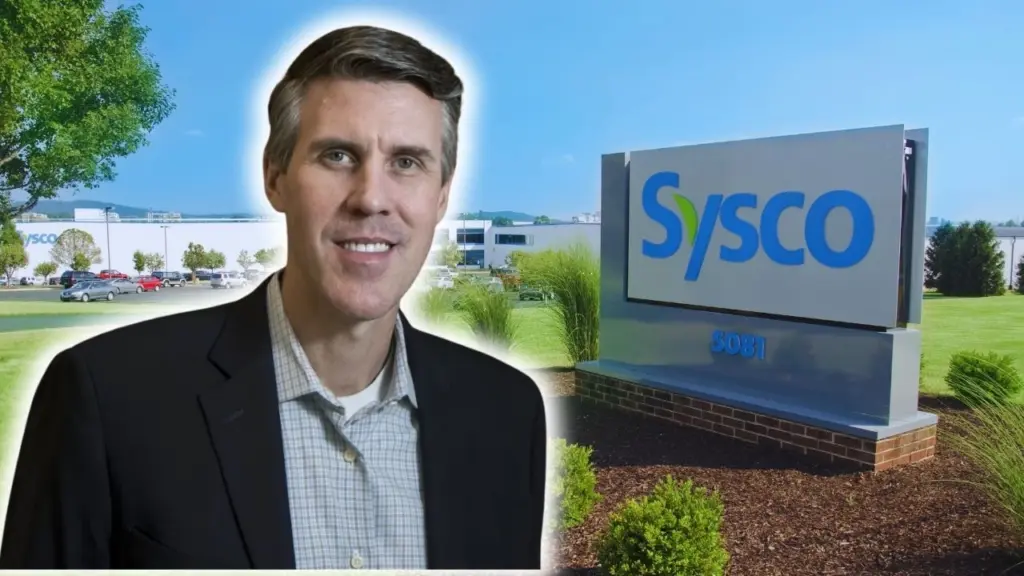
Kevin Hourican became Sysco’s President and CEO in 2020, taking over at arguably the most difficult moment in the company’s history — the start of the COVID-19 pandemic, which devastated the restaurant industry that Sysco depends on. The company’s leadership structure, with Kevin Hourican serving as President, CEO, and Chair of the Board since April 2024, reflects a unified approach to governance.
Before Sysco, Hourican served as President of US Foods — the company’s primary competitor. He was brought in specifically to modernize Sysco’s go-to-market strategy, drive sales growth, and position the company for the next decade. The $29.1 billion Jetro acquisition is the defining move of his tenure — and it will determine his legacy.
Is Sysco a Fortune 500 Company?
Yes — consistently and prominently. Fortune magazine has consistently included Sysco in its annual Fortune 500 rankings of the largest companies in the United States based on total revenue. In 2024, Sysco placed 54th in these rankings.
That ranking places Sysco ahead of household names like Goldman Sachs, Nike, Netflix, and American Express by revenue. For a company that most consumers have never heard of, it is a remarkable testament to the scale of what it does every single day.
Sysco Corporation is a publicly traded company on the NYSE (ticker: SYY), owned by its shareholders with no single private or founding family holding majority control. The three largest shareholders are The Vanguard Group (~12.61–13%), BlackRock, Inc. (~7.9–8%), and State Street Global Advisors (~5.5%) — the same institutional titans that dominate the shareholder registries of most of America’s largest public companies.
Sysco was founded in 1969 by John F. Baugh, Herbert Irving, and Harry Rosenthal, who merged nine small food distributors into a single national distribution company with $115 million in combined sales. Today, under CEO Kevin Hourican, Sysco generates over $81 billion in annual revenue and just announced the largest deal in its history — a $29.1 billion acquisition of Jetro Restaurant Depot on March 30, 2026 — which will push the combined company toward $100 billion in annual revenue.
Frequently Asked Questions (FAQs)
Q1. Who owns Sysco Corporation in 2026?
Sysco is publicly traded (NYSE: SYY), with The Vanguard Group (~13%) as the largest shareholder, followed by BlackRock (~8%) and State Street (~5.5%).
Q2. Is Sysco privately owned?
No. Sysco has been a publicly traded company on the New York Stock Exchange since March 3, 1970, under the ticker symbol SYY.
Q3. Who founded Sysco and when? Sysco was founded on March 19, 1969 in Houston, Texas by John F. Baugh, Herbert Irving, and Harry Rosenthal, through the merger of nine regional food distributors.
Q4. Who is the CEO of Sysco in 2026?
Kevin Hourican serves as President, CEO, and Chairman of the Board of Sysco Corporation — a combined role he has held since April 2024.
Q5. How much revenue does Sysco generate?
Sysco reported over $81.4 billion in fiscal year 2025 sales, making it one of the largest companies in the United States by revenue.
Q6. What is Sysco’s biggest acquisition ever?
On March 30, 2026, Sysco announced the acquisition of Jetro Restaurant Depot for $29.1 billion — the largest deal in the company’s entire 57-year history.
Q7. How many locations does Sysco serve?
Sysco serves approximately 730,000 customer locations across 10 countries, operating 337 distribution centers with around 75,000 employees worldwide.
Q8. Is Sysco a Fortune 500 company?
Yes. Sysco ranked 54th on the Fortune 500 list in 2024, placing it among the largest companies in America by revenue.