
The Strait of Hormuz is just 21 miles wide at its narrowest point. But every single day, one-fifth of all the oil in the entire world passes through it. That makes this tiny strip of water one of the most powerful places on Earth.
The strait connects the Persian Gulf — where countries like Saudi Arabia, Iran, Iraq, and the UAE produce most of their oil — to the Gulf of Oman and the Arabian Sea. From there, oil tankers carry that fuel to countries all over the world.
In simple terms: if this waterway gets blocked, the whole world feels the pain. Gas prices go up. Everyday goods become more expensive. Entire economies can go into crisis.
Who Owns the Strait of Hormuz, Actually?
Here is the short answer: No single country is the Owner of the Strait of Hormuz.
The strait sits between two countries — Iran to the north and Oman to the south. Both have coastlines along the strait. But under international maritime law, no country can “own” a waterway used for global trade.
According to the United Nations Convention on the Law of the Sea (UNCLOS), ships from all countries have the right of “transit passage” through the strait. This means any ship — from any nation — has the legal right to pass through peacefully.
However, Iran has long claimed that it holds special authority over the strait. Since the 1979 Iranian Revolution, Iran has said it has the power to control — or even close — the strait if it feels threatened. The rest of the world strongly disagrees with this claim.
Understanding the Geography
The strait is located at the entrance to the Persian Gulf. Iran sits on the northern side. Oman (along with a small part of the UAE) sits on the southern side. The shipping lanes inside the strait are just 2 miles wide in each direction — one lane for ships going in, one lane for ships coming out.
This narrowness is exactly what makes the Strait of Hormuz a “chokepoint.” A chokepoint is a narrow passage that, if blocked, stops all the traffic going through it — like a doorway. If someone stands in the doorway, no one can pass.
Why Does the Strait of Hormuz Matter So Much?
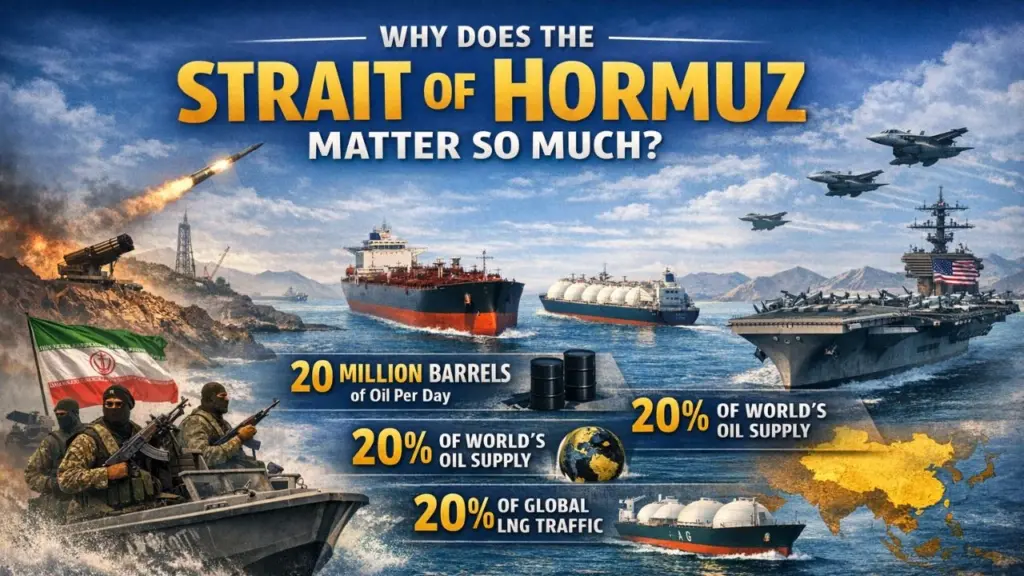
The strait matters because of oil and gas — the two fuels that power most of the world today. Here are some key facts:
- About 20 million barrels of oil pass through the strait every single day.
- That equals roughly 20% of all the oil used by the entire world.
- About 20% of the world’s liquefied natural gas (LNG) also travels through the strait.
- In 2024, about 84% of the oil passing through the strait was headed to Asian countries.
- China alone gets nearly 40% of all its oil through this waterway.
- Saudi Arabia sends about 40% of its total oil exports through the strait.
If this waterway is ever blocked for a long time, energy prices around the world shoot up. Gas, electricity, heating, and even food become more expensive everywhere.
Key Countries and Their Stake in the Strait of Hormuz
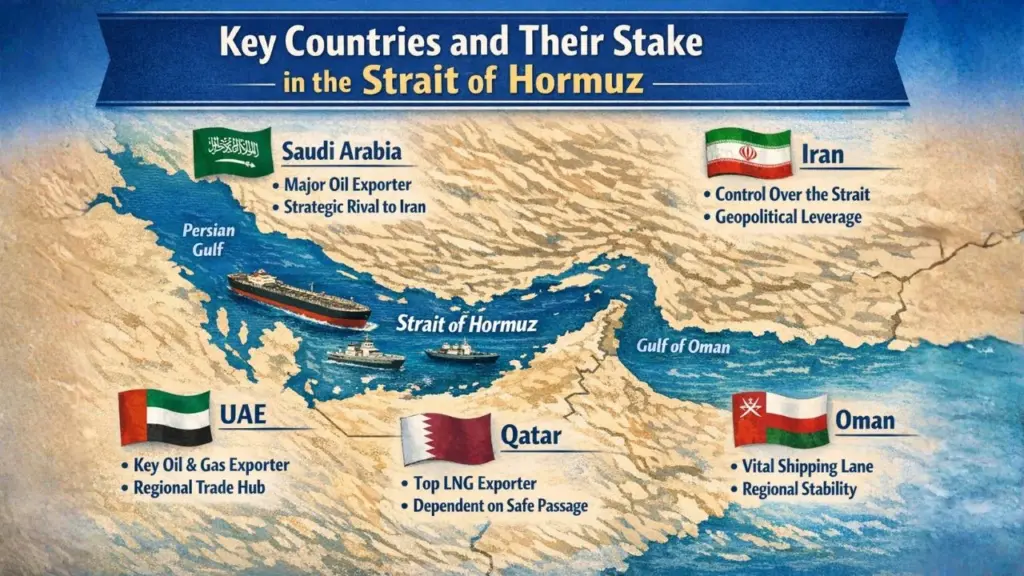
| Country | Role / Stake | Daily Oil (Approx.) | Key Concern |
|---|---|---|---|
| Iran | North coast — claims control, can threaten closure | 1.5M barrels/day export | Sanctions, military pressure |
| Oman | South coast — shares the strait border | N/A (non-OPEC) | Neutral stability, trade access |
| Saudi Arabia | Largest oil exporter through the strait | ~40% of strait oil flow | Revenue, global oil prices |
| UAE | Major oil & LNG exporter, key shipping hub | ~1M barrels/day | Trade disruption risk |
| United States | Naval presence (5th Fleet in Bahrain) | Indirect — allies depend on it | Global energy stability |
| China | Top buyer — 40% of its oil passes through here | ~6M barrels/day via strait | Energy security for economy |
| India | Second largest Asian buyer through strait | ~2M barrels/day via strait | Oil price spikes, economy |
Iran’s Role — The Country That Can Threaten the Strait
Iran is the most talked-about country when it comes to the Strait of Hormuz. Why? Because Iran sits right along the northern edge of the strait and has the military power to cause serious problems for ships trying to pass through.
Iran has threatened to close the Strait of Hormuz many times over the past few decades. These threats usually come when Iran is under economic pressure — like when the US puts heavy sanctions (trade penalties) on Iran because of its nuclear program or other actions.
Iran has a special military force called the Islamic Revolutionary Guard Corps (IRGC). This force has patrol boats, anti-ship missiles, submarines, and drones. The IRGC has harassed, attacked, or seized nearly 20 internationally flagged ships since 2021 alone.
In early 2026, after military strikes by the US and Israel on Iran, the IRGC declared the strait “closed” to ships from the US, Israel, and their Western allies. This caused one of the biggest global energy crises in decades, with oil prices spiking worldwide.
The United States and the Strait — Why America Cares
The United States does not get much of its own oil from the Persian Gulf anymore. America produces a lot of oil at home. So why does the US care so much about the Strait of Hormuz?
Because America’s closest allies — like Japan, South Korea, India, and many European nations — depend heavily on Gulf oil. If their energy supplies get cut off, their economies suffer, and that affects the whole world including the US.
The US Navy keeps its 5th Fleet in Bahrain, just inside the Persian Gulf, specifically to protect shipping lanes in this region. For decades, the United States has acted as the main military protector of free passage through the strait.
Oman — The Quiet But Important Partner
While Iran gets most of the attention, Oman is the other country that shares the strait. Oman sits on the southern side and is known for being a neutral, peaceful nation that tries to stay out of conflicts between Iran and the West.
Oman has actually played a key role in secret diplomatic talks between the US and Iran over the years. Its geographic position also matters — technically, the southern edge of the strait falls within Omani and UAE territorial waters. But experts note that this alternative route is very limited and cannot handle large amounts of tanker traffic.
China, India, and Asia — The Biggest Dependents
When we talk about who has the most to lose if the Strait of Hormuz gets blocked, the answer is clear: Asian countries.
China imports roughly 40% of its oil through the strait. India imports a large share this way too. Japan and South Korea are also heavily dependent on Gulf oil flowing through this waterway. Over 80% of all the oil and gas passing through the strait is headed to Asian markets.
This creates an interesting situation. The countries most affected by any disruption in the strait are the same countries that have the least military presence there.
Related Ownership Profiles
For another closely-watched private business, see who owns Magic City.
Are There Any Alternatives to the Strait?
Yes, there are a few — but none of them are large enough to replace the strait.
Saudi Arabia has a pipeline called the East-West Pipeline (Petroline) that carries oil to the Red Sea without going through the strait — but it can only handle about 5 million barrels per day. The UAE has built a pipeline to Fujairah on the Gulf of Oman, with a capacity of about 1.5 million barrels per day. Together, these handle only a fraction of what flows through Hormuz daily.
The world simply has no easy backup plan if the Strait of Hormuz is blocked for a long time.
The Strait of Hormuz does not officially belong to any one country. Under international law, it is a shared passage that all nations have the right to use. Iran and Oman share its coastlines, but the world’s oceans belong to everyone.
The real-world power over the strait, however, lies mostly with Iran — simply because of geography and military strength. Iran has the ability to threaten, slow down, or disrupt shipping through the strait, and it has used this as a bargaining chip in international politics for decades.
For the rest of the world — especially the oil-dependent economies of Asia — the Strait of Hormuz remains the most important 21 miles of water on the planet. Keeping it open is not just an energy issue. It is a matter of global economic survival.
Frequently Asked Questions (FAQs)
1. Does Iran own the Strait of Hormuz?
No. Iran does not own the Strait of Hormuz. The strait lies between Iran (to the north) and Oman (to the south). Under international maritime law, no single country owns it. All ships have the legal right to pass through it. However, Iran has claimed special authority over the strait and has the military capability to disrupt shipping.
2. Can Iran really close the Strait of Hormuz?
Iran has the military power to significantly disrupt shipping through the strait using its navy, missiles, drones, and speed boats. A full, long-term closure is very difficult to maintain because the US Navy and allied forces would likely intervene. But even a partial disruption causes massive spikes in global oil prices, as seen in early 2026.
3. Why is the Strait of Hormuz so important for oil prices?
About 20 million barrels of oil — roughly 20% of the world’s daily supply — travel through the strait every day. If this flow is cut off or reduced, less oil is available worldwide. Less supply with the same demand means prices go up. Higher oil prices lead to higher costs for gas, heating, electricity, and everyday goods.
4. Which country is most affected if the Strait of Hormuz is blocked?
Asian countries are the most affected. China imports about 40% of its oil through the strait. India, Japan, and South Korea also depend heavily on this route. Over 80% of the oil passing through the strait goes to Asia. A blockage would hit these economies the hardest in terms of energy costs and supply shortages.
5. Is there an alternative route if the Strait of Hormuz is blocked?
There are limited alternatives. Saudi Arabia has a pipeline that bypasses the strait, and the UAE has another. Together, they can carry about 6 to 7 million barrels per day — far less than the 20 million barrels per day that normally flow through Hormuz. So while alternatives exist, they are nowhere near enough to replace the strait if it is closed for a long period.
Sources: U.S. Energy Information Administration (EIA), CSIS, Geopolitical Monitor, Modern Diplomacy