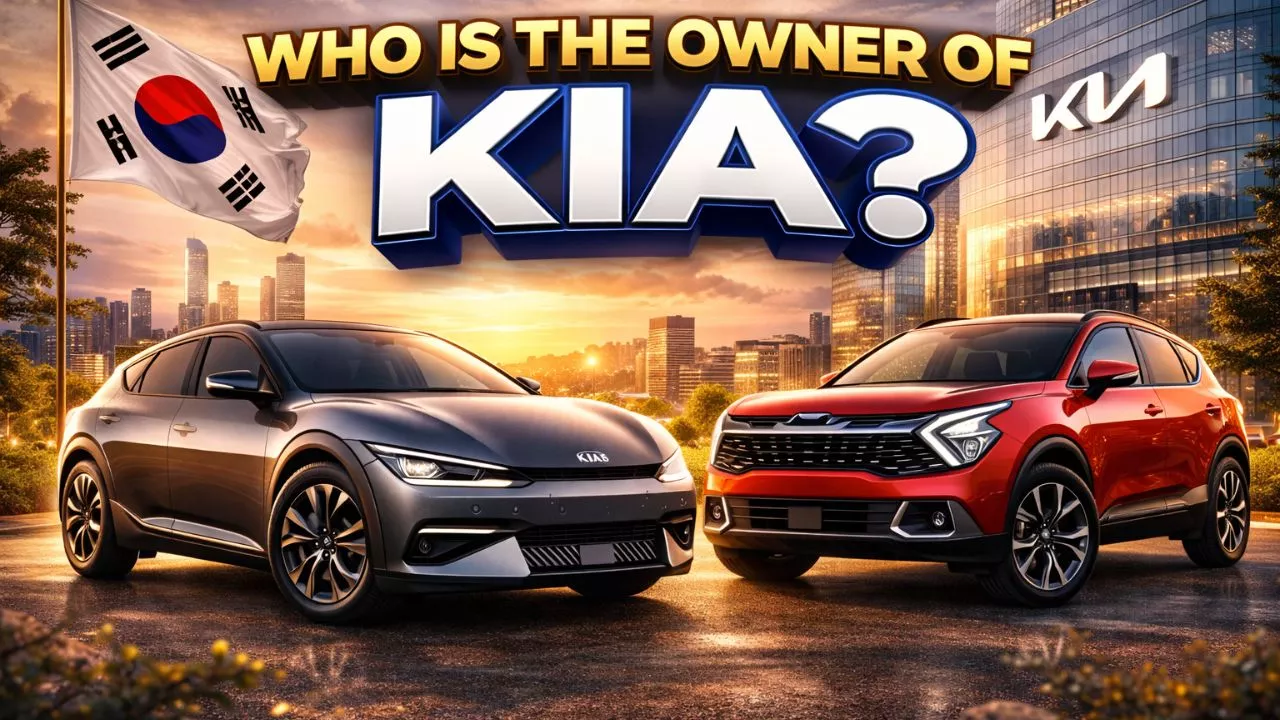
If you have driven a Kia recently, you already know the brand has completely transformed itself. The affordable, slightly forgettable cars of the 1990s have given way to bold designs, award-winning EVs, and a reputation that regularly competes with BMW and Audi in quality rankings.
But behind the sleek EV6, the beloved Telluride, and the sharp Stinger is a corporate ownership story that few people know — one that involves a bankruptcy, a rescue deal, a South Korean family dynasty, and a web of cross-shareholdings that defines one of the most powerful automotive groups on earth.
Kia Corporation is a South Korean multinational automobile manufacturer headquartered in Seoul, South Korea. It is South Korea’s second-largest automobile manufacturer, after its parent company, Hyundai Motor Company.
Kia America, Inc. was incorporated in California on October 21, 1992, and became the American sales, marketing, and distribution arm of Kia Corporation. Kia America is based in Irvine, California, and offers a complete line of vehicles through more than 755 dealers throughout the United States.
Kia sells millions of vehicles annually across more than 190 countries. In 2026, Kia targets global sales of 3.35 million units.
Who Owns Kia Right Now in 2026?
The direct answer: Kia is majority-controlled by Hyundai Motor Company, which is the largest single shareholder.

Kia is owned by Hyundai, which holds a 33.88% stake valued at just over US$6 billion. Kia in turn is a minority owner of more than twenty Hyundai subsidiaries ranging from 4.9% up to 45.37%, totaling more than US$8.3 billion.
Kia is also a publicly listed company on the Korea Stock Exchange, meaning no one entity owns it outright. Hyundai controls the largest stake. The Chung family sits at the top of the broader conglomerate. And Kia runs its own operations independently day to day.
This is not a typical parent-subsidiary relationship. It is a deeply intertwined web of cross-shareholdings — the hallmark of South Korean chaebol corporate architecture — where Hyundai and Kia each hold pieces of each other’s affiliated businesses.
Ownership and Key Stakeholders Table

| Owner / Shareholder | Type | Stake | Key Detail |
|---|---|---|---|
| Hyundai Motor Company | Largest Shareholder & Parent | ~33.88% of Kia | Effective controlling shareholder; rescued Kia from bankruptcy in 1998 |
| Chung Eui-sun (Euisun Chung) | Executive Chairman | Controlling stake via Hyundai Motor Group | Chairman of Hyundai Motor Group; net worth ~$3.3 billion (Forbes 2024) |
| Hyundai Motor Group Co., Ltd. | Group Holding Company | Controls Kia via Hyundai stake | Established in 2023 to formalize governance across both brands |
| Korean Institutional Investors | Domestic Institutions | Significant stake | National Pension Service of Korea and other domestic funds |
| Foreign Institutional Investors | International Funds | Significant stake | Global asset managers holding KRX-listed Kia shares |
| Public Shareholders | Retail Investors | Remaining shares | Kia trades on the Korea Stock Exchange (KRX: 000270) |
| Ho-Sung Song | CEO & President of Kia Corp | Minimal executive stake | Current CEO; previously headed Global Operations Division |
The Origin Story: From Bicycle Tubes to Global Automaker
Kia’s story begins far earlier than most people realize — and it starts not with a car, but with a bicycle.
Kia was founded in 1944 in Seoul under the name Kyungsung Precision Industry, producing steel tubing for bicycle frames. The name changed to Kia Industries in 1952 — with “Kia” meaning “rising out of Asia” in Korean. By the 1950s, the company was making complete bicycles. By the 1960s, it had moved into motorcycles. And by 1974, Kia produced its first complete car — the Kia Brisa — assembled using Mazda technology under a licensing agreement.
Throughout the 1980s and early 1990s, Kia expanded aggressively, entering the American market in 1993 with the Sephia and Sportage. For a brief period, Ford Motor Company held a strategic stake in Kia. The future looked promising.
Then came the crisis.
The 1997 Bankruptcy and the Hyundai Rescue
Kia declared bankruptcy in 1997, during the Asian financial crisis, and in 1998 reached an agreement with Hyundai Motor Company to diversify by exchanging ownership between the two companies. Hyundai Motor Company acquired 51% of the company, outbidding Ford Motor Company, which had owned an interest in Kia Motors since 1986.
The Asian Financial Crisis of 1997 was one of the most devastating economic collapses in modern Asian history. Currency values crashed, credit dried up, and companies that had seemed unassailable suddenly found themselves unable to pay their debts. Kia was one of the most prominent casualties.
Hyundai’s bid to acquire Kia was not simply a charitable rescue. It was a strategic calculation — that by combining two of South Korea’s largest automakers under one group, the combined entity could achieve the scale, platform sharing, and global reach needed to compete with Toyota, Volkswagen, and General Motors. The calculation proved correct.
After subsequent divestments, Hyundai Motor Company owns about one third of Kia Motor Corporation. The stake dropped from 51% as Hyundai sold portions over the years, but at roughly 33.88%, it remains comfortably the largest single shareholder by a wide margin.
The Chung Family: The Dynasty Behind Both Brands
Understanding who owns Kia ultimately means understanding the Chung family — the Korean billionaire dynasty that controls the entire Hyundai Motor Group.
Chung Eui-sun (also spelled Euisun Chung), born October 18, 1970, is the Executive Chairman and CEO of Hyundai Motor Group and the only son of Hyundai Motor Group honorary chairman Chung Mong-koo. In December 2024, Forbes estimated his net worth as US$3.3 billion and ranked him 10th richest in South Korea.
From 2005 to 2009, Chung was the President of Kia Motors Corp, a subsidiary of Hyundai Motor, which owns 34% of Kia. He became Chairman of Hyundai Motor Group in October 2020.
Chung Eui-sun is widely credited with transforming Kia’s image from a budget automaker into a genuine global premium brand. His decision to hire German designer Peter Schreyer — who created Kia’s iconic “tiger nose” grille — was one of the most impactful brand decisions in automotive history. Under his influence, Kia’s global market share grew from 1.6% to nearly 4%, and annual vehicle sales more than doubled.
The Cross-Shareholding Web: How Hyundai and Kia Are Intertwined
Kia doesn’t just have Hyundai as a shareholder. Kia itself owns minority stakes in more than 20 Hyundai subsidiaries with ownership percentages ranging from under 5% to over 45% depending on the specific entity. This isn’t a simple parent-child structure. It is a cross-shareholding web where each company holds parts of the other’s affiliated businesses.
This kind of architecture is a hallmark of South Korean chaebols — large conglomerates where control is maintained through interlocking stakes rather than a single majority holding company.
In 2023, Hyundai Motor Group formalized this structure by establishing Hyundai Motor Group Co., Ltd. as a unified holding company — giving the group a cleaner governance framework while preserving the cross-shareholding relationships that have long defined its corporate culture.
Kia’s Business Today: Records, EVs, and a $26 Billion U.S. Bet
Kia in 2026 is not the same company that crawled out of bankruptcy in 1998. Kia posted record-high annual revenue and global unit sales in 2025, with Q4 2025 global sales of 763,200 units.
In August 2025, Kia announced a landmark USD 26 billion investment in the United States, underscoring its long-term dedication to technological innovation, job creation, and sustainable economic growth across strategic industries.
In January 2025, Kia partnered with NVIDIA to accelerate the integration of artificial intelligence technologies aimed at advancing next-generation mobility and intelligent vehicle systems. In December 2024, the company collaborated with Google to develop next-generation infotainment and navigation platforms, enhancing the in-car digital experience.
The current CEO of Kia Corporation is Ho-Sung Song, who has led the company since June 2020 and is executing Kia’s ambitious electric vehicle strategy — with the goal of making Kia one of the world’s leading EV brands by 2030.
Frequently Asked Questions (FAQs)
Q1. Who owns Kia in 2026?
Hyundai Motor Company is Kia’s largest shareholder, holding approximately 33.88% of Kia Corporation, making it the effective controlling parent company.
Q2. Is Kia fully owned by Hyundai?
No. Kia is publicly traded on the Korea Stock Exchange (KRX: 000270); Hyundai holds roughly one-third of shares, not full ownership.
Q3. Why did Hyundai acquire Kia?
Kia declared bankruptcy in 1997 during the Asian Financial Crisis, and Hyundai acquired a 51% stake in 1998, outbidding Ford, to rescue and integrate it into its automotive group.
Q4. Who is the CEO of Kia in 2026?
Ho-Sung Song serves as CEO and President of Kia Corporation, a position he has held since June 2020.
Q5. Who is the Chung family and how are they connected to Kia?
The Chung family controls Hyundai Motor Group. Chung Eui-sun is the Executive Chairman, with a net worth of ~$3.3 billion, and previously served as President of Kia from 2005 to 2009.
Q6. Is Kia the same company as Hyundai?
No. Kia and Hyundai are separate brands with their own designs, lineups, and identities — but they share an engineering platform, R&D resources, and a common parent group.
Q7. How much does Kia sell annually?
Kia posted record revenue and sales in 2025 and is targeting 3.35 million global vehicle sales in 2026.
Q8. Where is Kia headquartered?
Kia Corporation is headquartered in Seoul, South Korea. Its American arm, Kia America, is based in Irvine, California.
Discover more from Who Is The Owner Of
Subscribe to get the latest posts sent to your email.