
Most people think BlackBerry is dead. They picture that iconic physical keyboard gathering dust somewhere in a drawer, a relic of the early 2000s when every CEO, celebrity, and president carried one. But here is the thing — BlackBerry never actually disappeared. It quietly reinvented itself, shed the hardware, and became something far more powerful and far less visible. And the question of who owns it today is a lot more interesting than most people expect.
What Is BlackBerry in 2026?
Before we talk about who owns BlackBerry, it helps to understand what BlackBerry actually is today — because it is almost nothing like what most people remember.
BlackBerry Limited, formerly known as Research In Motion (RIM), is a Canadian software company specializing in secure communications and the Internet of Things (IoT). Founded in 1984, it developed the BlackBerry brand of two-way pagers, smartphones, and tablets. The company later transitioned to providing software and services and holds critical software application patents.
Today, BlackBerry delivers operational resiliency with a certified platform for mobile fortification, mission-critical communications, and critical events management. It operates in three segments: Secure Communications, IoT, and Licensing.
In simple terms, BlackBerry today is a cybersecurity and software company. It protects governments, militaries, hospitals, banks, and car manufacturers — not your personal inbox. The phones are gone. The software is very much alive.
Who Currently Owns BlackBerry?
This is the key question, and the answer has a few layers to it.
BlackBerry is a publicly traded company, listed on both the New York Stock Exchange (NYSE) and the Toronto Stock Exchange (TSX) under the ticker symbol BB. That means no single person or company owns all of it. Instead, ownership is spread across thousands of investors — institutions, funds, and everyday retail investors.
BlackBerry (NYSE: BB) is owned by 46.10% institutional shareholders, 9.94% BlackBerry insiders, and 43.96% retail investors. V. Prem Et Al Watsa is the largest individual BlackBerry shareholder, owning 47.02 million shares representing 7.97% of the company. Watsa’s BlackBerry shares are currently valued at approximately $155.17 million.
So the biggest single name in BlackBerry’s ownership story right now is Prem Watsa, the billionaire founder of Fairfax Financial Holdings — and his connection to BlackBerry goes back more than a decade, through some very turbulent times.
Who Founded BlackBerry? The Research In Motion Story
To truly understand who owns BlackBerry today, you have to go back to where it all started — a university campus in Waterloo, Ontario, Canada.
Mike Lazaridis is a Canadian businessman who co-founded Research In Motion (RIM), the company that created and manufactured the BlackBerry wireless handheld device. He dropped out of university, and with the support of a small government grant and a loan from his parents, Mike Lazaridis, Mike Barnstijn, and Douglas Fregin launched Research in Motion — the company whose assets are now managed as BlackBerry Limited.
One of RIM’s first achievements was the development of barcode technology for film. It reinvested the profits from that product into wireless data transmission research, eventually leading to the introduction of the BlackBerry wireless mobile device in 1999, and its better-known version in 2002. Lazaridis served as co-chairman and co-CEO of BlackBerry from 1984 to 2012.
At its peak, BlackBerry was the most powerful smartphone brand in the world. Presidents used it. Wall Street ran on it. It was practically a status symbol. BlackBerry led the smartphone market in many countries, particularly the United States, until the announcement of the iPhone 4 in 2010, and in Indonesia throughout the early 2010s. The company withered against the rapid rise of both Apple and Google.
The Fairfax Financial Rescue — Prem Watsa Steps In
When BlackBerry started collapsing under the pressure of Apple and Android, one man stepped up with his wallet when almost everyone else stepped back. That man was Prem Watsa.
Fairfax Financial Holdings is a Canadian financial and insurance conglomerate led by legendary investor Prem Watsa. Watsa has often been called the “Warren Buffett of Canada.” In 2012, Fairfax accumulated a 10% stake in BlackBerry, then still called Research in Motion. In 2013, Fairfax unsuccessfully attempted to acquire the entire company for $4.7 billion. The deal was abandoned and instead, the company invested $1 billion cash into the company in return for convertible debentures.
In 2013, as the once-dominant smartphone company teetered near collapse, Watsa helped engineer a lifeline by investing $500 million in convertible debentures and supporting John Chen’s appointment as CEO. By early 2014, Fairfax’s total investment had ballooned to $1.375 billion, including $787 million in common shares.
That investment kept BlackBerry alive. And Prem Watsa, despite years of financial pain from this bet, has remained the single largest individual shareholder in the company to this day.
Ownership and Key Shareholders Table
| Shareholder / Owner | Type | Estimated Stake | Key Detail |
|---|---|---|---|
| Prem Watsa / Fairfax Financial Holdings | Largest Individual Shareholder | ~7.97% (47.02M shares) | Canadian billionaire investor; called the “Warren Buffett of Canada”; backed BlackBerry since 2012 |
| Institutional Shareholders (combined) | Institutional Investors | ~46.10% | Includes mutual funds, pension funds, ETFs, and investment firms |
| Retail Investors (public) | Individual Shareholders | ~43.96% | Anyone who buys BB stock on NYSE or TSX |
| BlackBerry Insiders | Company Executives & Board | ~9.94% | Includes CEO, CFO, and board members holding company shares |
| Legal & General Group | Institutional Investor | ~5.09% (30.22M shares) | Major UK-based investment firm; second largest institutional holder |
| Voya Investment Management | Institutional Investor | ~4.41% (26.18M shares) | U.S.-based asset management firm |
| L&G Cyber Security ETF | Mutual Fund | Top mutual fund holder | Holds 5.90% of its assets in BlackBerry shares |
| Mike Lazaridis | Co-Founder (former) | No significant stake | Left the board in 2013; no longer a major shareholder |
Who Runs BlackBerry Today? Meet John Giamatteo
Owning a company and running a company are two different things. The person actually in charge of BlackBerry’s day-to-day operations is its current CEO, John Giamatteo.
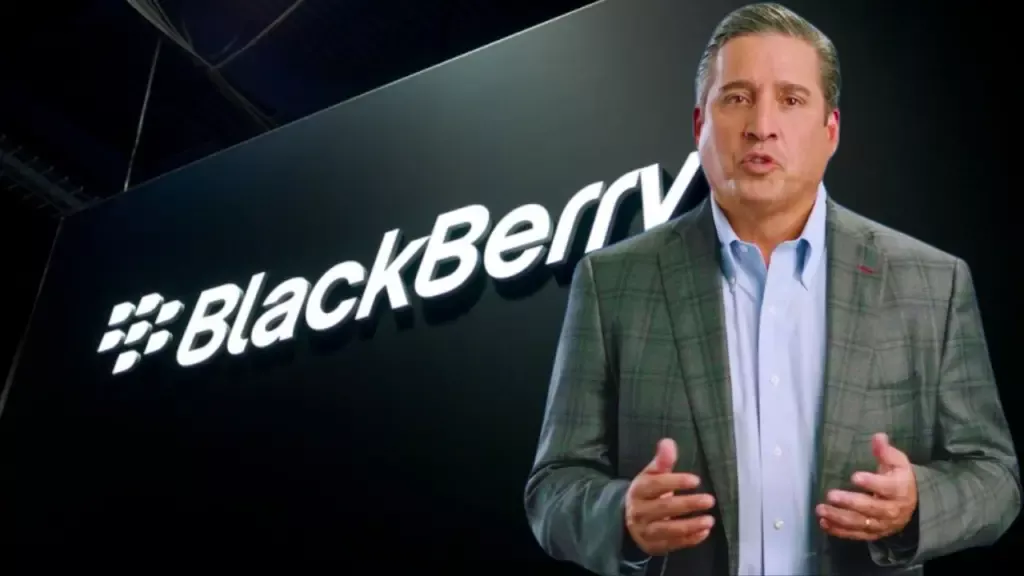
In 2023, the company chose John Giamatteo, president of its cybersecurity business unit, to succeed John Chen as CEO following his retirement. The Ontario, Canada-based company also made the decision to separate its IoT and cybersecurity businesses in the same year to enhance the focus of both divisions.
John Giamatteo is BlackBerry’s Chief Executive Officer and President of its Secure Communications division. He brings to BlackBerry over 30 years of experience in go-to-market strategy, marketing, customer relationships, and customer success with global high-technology companies. He came to BlackBerry from McAfee, where he was President and Chief Revenue Officer for over six years.
Under Giamatteo, BlackBerry has become sharply focused on two core businesses. According to the CEO, the company now focuses on two main areas: QNX and secure communication services. QNX is a real-time operating system that is widely used in vehicles, powering software that runs everything from infotainment systems to safety-critical functions such as braking and steering.
What Is QNX and Why Does It Matter?
If you have never heard of QNX, you have almost certainly used it without knowing. It is one of the most important pieces of software in the world — and it is owned entirely by BlackBerry.
In fiscal 2025 (ended February 28), QNX generated revenue of $236 million, up from $130 million in 2021. The long-term fundamentals remain sound, despite some automaker delays and industry uncertainty.
Giamatteo stated that BlackBerry’s fastest-growing part of QNX is the next generation of cars — autonomous vehicles, self-driving cars, and robo-taxis. The entire ecosystem, whether it is Qualcomm, NVIDIA, or NXP, is building their architecture on top of the QNX platform.
QNX high-performance embedded solutions are trusted by OEMs and Tier 1 automakers, currently powering 275 million+ vehicles worldwide.
That is not a small number. BlackBerry’s software is sitting inside more than a quarter of a billion cars on the road right now. Most of the people driving those cars have no idea.
BlackBerry’s Pivot From Phones to Cybersecurity
The transformation of BlackBerry from a dying phone company to a serious cybersecurity player is one of the more remarkable business comebacks in tech history — even if it did not get the attention it deserved.
During his decade at the helm, John Chen transformed BlackBerry from a smartphone company on the brink of bankruptcy to a cybersecurity software firm. The board then transitioned leadership and appointed John Giamatteo as CEO to execute a separation strategy for the IoT and cybersecurity units.
CEO John Giamatteo highlighted that BlackBerry’s focus on NATO-certified encrypted voice, data, and video systems for government and defense represents a core competency and a key growth area. The company is actively discussing the introduction of its secure government communications technology with authorities in multiple countries, driven by increased global demand for military-grade, sovereign systems.
In other words, when a government or a military needs a phone call or a message that absolutely cannot be intercepted, they turn to BlackBerry. That is a very different business from selling consumer smartphones — and it is a much more stable one.
The Bottom Line
BlackBerry is a publicly traded company with no single majority owner. The largest individual shareholder is Prem Watsa of Fairfax Financial Holdings, holding approximately 7.97% of the company. Institutional investors collectively own around 46%, retail investors hold about 44%, and company insiders account for the remaining roughly 10%.
The company was founded by Mike Lazaridis and Douglas Fregin in 1984 as Research In Motion, became the most powerful smartphone brand in the world, collapsed in the face of Apple and Google, was rescued in large part by Prem Watsa’s billion-dollar bet, and has since reinvented itself as a cybersecurity and IoT software giant under CEO John Giamatteo.
Today, BlackBerry’s software powers 275 million vehicles, protects governments and militaries around the world, and quietly runs some of the most critical communications infrastructure on the planet. The phones are gone. The company is not.
Frequently Asked Questions (FAQs)
Q1. Who is the current owner of BlackBerry in 2026?
BlackBerry does not have a single owner because it is a publicly traded company listed on the NYSE and TSX under the ticker BB. The largest individual shareholder is Prem Watsa of Fairfax Financial Holdings, who owns approximately 7.97% of the company — around 47 million shares currently valued at about $155 million. Institutional investors collectively own about 46% of the company, while retail investors hold close to 44%.
Q2. Who founded BlackBerry and is he still involved?
BlackBerry was co-founded by Mike Lazaridis and Douglas Fregin in 1984 under the name Research In Motion (RIM). Lazaridis served as co-CEO until 2012 and stepped down from the board in 2013. He is no longer involved in the company’s operations and does not hold any significant ownership stake. Today’s BlackBerry is led by CEO John Giamatteo, who took over in late 2023.
Q3. Does BlackBerry still make phones?
No. BlackBerry officially stopped designing its own smartphones in 2016 and licensed the brand to third-party manufacturers. The last BlackBerry-branded Android device was produced in 2020, and the final American licensee that planned a new device shut down in 2022 without ever releasing a product. Today, BlackBerry is purely a software and cybersecurity company — it makes no phones, tablets, or hardware of any kind.
Q4. What does BlackBerry actually do today?
BlackBerry today operates two main business divisions. The first is Secure Communications, which provides cybersecurity software, endpoint management, and NATO-certified encrypted communications for governments, militaries, and enterprises around the world. The second is IoT (Internet of Things), centered around BlackBerry QNX — a real-time operating system that currently powers more than 275 million vehicles globally, including systems for autonomous and self-driving cars.
Q5. Is Prem Watsa’s investment in BlackBerry profitable?
Honestly, not really — at least not so far. In his 2023 Shareholder Letter, Prem Watsa issued a rare and candid admission, laying bare his investment in BlackBerry — a bet that spanned over a decade and cost Fairfax Financial dearly. By early 2014, Fairfax’s total investment had reached $1.375 billion, including $787 million in common shares. Given that BlackBerry’s stock price remains far below the levels at which Fairfax invested, the position has been a painful one. However, Watsa has consistently described himself as a long-term investor who believes in BlackBerry’s transformation into a software company — and that bet on the future is still very much open.