
Honestly, the first time I picked up a Lenovo ThinkPad, I had no idea who was actually behind the brand. I just knew it felt solid, reliable — like the kind of laptop that wouldn’t quit on you in the middle of a tight deadline. But somewhere between my second cup of coffee and a deep rabbit hole of tech history, I found myself genuinely curious: who actually owns Lenovo? Is it a Chinese government company? A private family empire? Something more complicated?
If you’ve searched “who is the owner of Lenovo” and come back more confused than when you started — trust me, you’re not alone. The ownership structure of Lenovo is layered, historically rich, and honestly far more interesting than you’d expect from a PC brand. Let me walk you through the whole story.
The Short Answer: Who Owns Lenovo in 2026?
Lenovo Group Limited is a publicly listed company trading on the Hong Kong Stock Exchange (HKEX: 992). That means no single individual “owns” it in the traditional sense — thousands of shareholders do. But if you want to know who holds real influence and the biggest stake, here’s a clear snapshot:
| Shareholder | Approximate Ownership | Shareholder Type |
|---|---|---|
| Legend Holdings Corporation | ~33% | Parent / Institutional |
| Yang Yuanqing (CEO & Chairman) | ~8% | Individual Executive |
| Public Institutional Investors | ~45% | Open Market |
| Retail & Other Shareholders | ~14% | Open Market |
The dominant force behind Lenovo is Legend Holdings Corporation, which is itself partially backed by the Chinese Academy of Sciences. And the public face — and operational heart — of the company is its Chairman and CEO, Yang Yuanqing.
Yang Yuanqing — The Man Who Really Runs Lenovo

Yang Yuanqing is the kind of executive who makes you rethink what corporate leadership looks like. He joined Lenovo straight out of graduate school in 1992 and has essentially grown up alongside the company. He became CEO in 2009 and has served as Chairman since 2011 — making him one of the longest-serving tech CEOs anywhere in the world.
What genuinely stands out about Yang isn’t just his longevity — it’s his decisions. He reportedly waived his own annual bonus during difficult years and redistributed millions of dollars among frontline employees. Whether that was a calculated PR move or genuine conviction, it’s the kind of thing you don’t see often at the top of Fortune 500 companies. For what it’s worth, I tend to think it says something real about how he views the business.
| Detail | Information |
|---|---|
| Full Name | Yang Yuanqing (杨元庆) |
| Date of Birth | November 12, 1964 |
| Education | University of Science and Technology of China |
| Role at Lenovo | Chairman & CEO |
| Year Joined Lenovo | 1992 |
| Became CEO | 2009 |
| Became Chairman | 2011 |
| Personal Stake in Lenovo | ~8% |
His compensation has been a point of debate — he consistently ranks among the highest-paid executives in Asia — but the numbers the company has put up under his leadership are hard to argue with. Lenovo went from a China-centric brand to the world’s largest PC manufacturer by volume. That doesn’t happen without focused, long-term leadership.
Legend Holdings: The Parent Company Behind Lenovo
If Lenovo is the engine, Legend Holdings Corporation (HKEX: 3396) is the chassis it’s built on. Legend Holdings is a diversified investment conglomerate — it has interests in financial services, agriculture, and technology — but Lenovo is by far its most valuable and recognized asset.
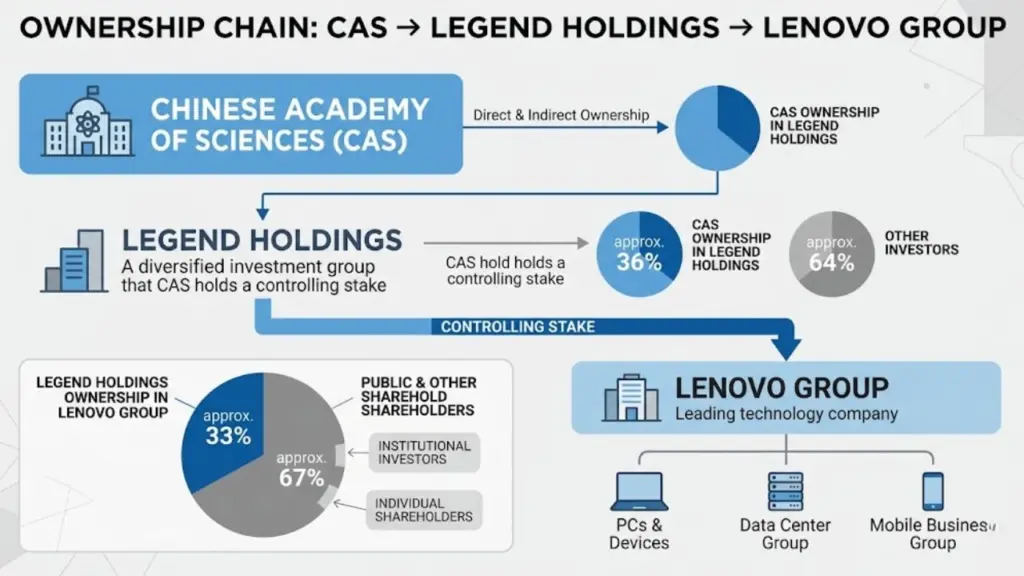
Legend Holdings was founded in 1984 by Liu Chuanzhi along with ten colleagues at the Institute of Computing Technology, under the Chinese Academy of Sciences. That last part matters — it means the company has always had a government-adjacent origin, even though it now operates as an independent commercial entity.
| Detail | Information |
|---|---|
| Company Name | Legend Holdings Corporation |
| Founded | 1984 |
| Founder | Liu Chuanzhi |
| Listed On | Hong Kong Stock Exchange (HKEX: 3396) |
| Stake in Lenovo Group | ~33% |
| CAS Stake in Legend Holdings | ~36% (via CAS Holdings) |
Is Lenovo Owned by the Chinese Government?
This is the question that comes up constantly — especially in conversations about national security, government procurement, and data privacy in the US and Europe.
The honest answer is: indirectly, partially — yes. But the full picture is considerably more nuanced than a yes or no.
Here’s the ownership chain in plain terms: The Chinese Academy of Sciences — a state institution — owns approximately 36% of Legend Holdings. Legend Holdings in turn owns approximately 33% of Lenovo Group. So the Chinese government has an indirect stake in Lenovo through this chain. However, it does not directly control the company’s daily operations, board appointments, or product strategy.
Lenovo operates as a globally listed company with independent board members, international executives across every major market, and publicly traded shares that anyone in the world can buy. But — and this is a significant but — that CAS link is precisely why multiple Western governments have been cautious about Lenovo in sensitive procurement decisions, particularly in defence and intelligence contexts.
My personal view? The security concerns, while not entirely without basis, have often been overstated in public discourse. Lenovo supplies laptops to millions of hospitals, universities, SMEs, and everyday consumers worldwide without any documented issue. But I also understand why governments stay cautious — in China’s regulatory environment, the line between “commercial company” and “state-influenced entity” can shift in ways that are difficult to track from the outside.
Who Founded Lenovo? The Liu Chuanzhi Story
You cannot tell Lenovo’s ownership story without talking about Liu Chuanzhi — the man who started everything.
Liu founded the company in 1984 with just ¥200,000 in seed funding (roughly $25,000 USD at the time) and ten colleagues, working out of a small room in Beijing provided by the Chinese Academy of Sciences. His ambition was not modest: he wanted to build a Chinese technology company capable of competing on the global stage. For most of the world, that seemed like a fantasy at the time.
Then it wasn’t.
Liu stepped back from day-to-day operations years ago and now serves in an advisory role through Legend Holdings. He is widely regarded as one of China’s most consequential entrepreneurs and is often referred to as the “godfather of Chinese tech.” The values he built into the early company — long-term thinking, quality over shortcuts, global ambition — are arguably still visible in how Lenovo operates today.
How Lenovo Became a Global Giant: Key Milestones
| Year | Milestone |
|---|---|
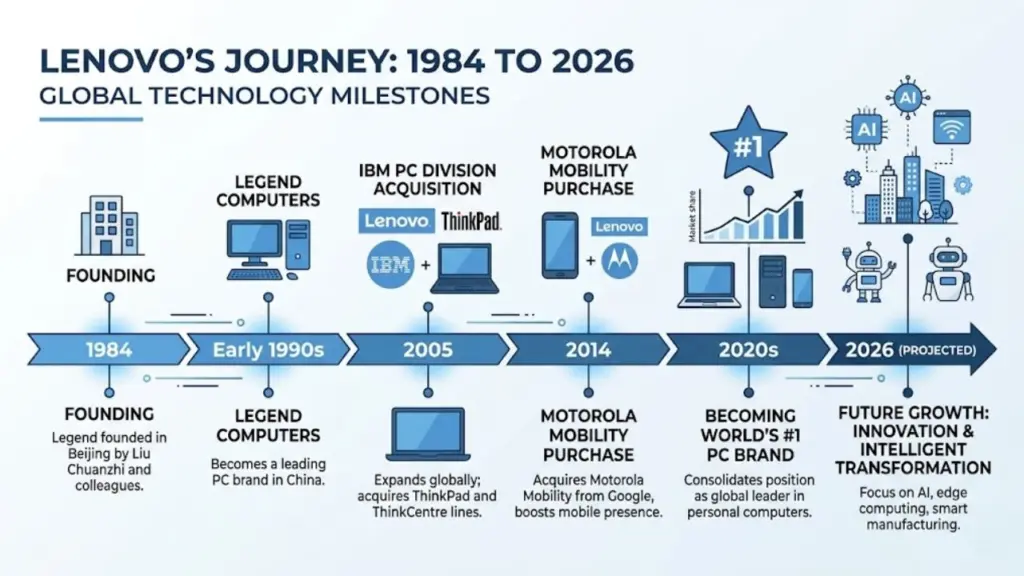
| 1984 | Founded as “Legend” by Liu Chuanzhi under the Chinese Academy of Sciences in Beijing |
| 1994 | Listed on the Hong Kong Stock Exchange |
| 2003 | Rebranded globally as “Lenovo” |
| 2005 | Acquired IBM’s Personal Computing Division for $1.75 billion — including the iconic ThinkPad brand |
| 2009 | Yang Yuanqing appointed CEO |
| 2014 | Acquired Motorola Mobility from Google for $2.91 billion |
| 2015 | Became the world’s largest PC manufacturer by global shipments |
| 2020 | Secondary listing on Shanghai’s STAR Market |
| 2026 | Continues as global PC leader, expanding in AI infrastructure and smart devices |
The IBM Deal That Changed Everything
When Lenovo announced it was buying IBM’s PC division in 2004 (completed in 2005), a lot of people thought it was a mistake — on both sides. IBM had been struggling to make PCs profitable, and many analysts doubted whether a Chinese company could manage a globally recognized premium brand without gutting it.
What happened next is the part that doesn’t get talked about enough: Lenovo kept the ThinkPad DNA intact. They kept the keyboard layout, the build quality, the enterprise-grade reliability that IBM engineers had spent decades developing. Rather than stripping the product line down to cut costs, they doubled down on quality. That single decision probably explains more about ThinkPad’s continued relevance today than anything else.
The deal also transformed Lenovo overnight from a China-only brand into a global player. Before 2005, most people outside China had never heard of them. Two years later, they were everywhere.
Lenovo’s Market Position and Revenue in 2026
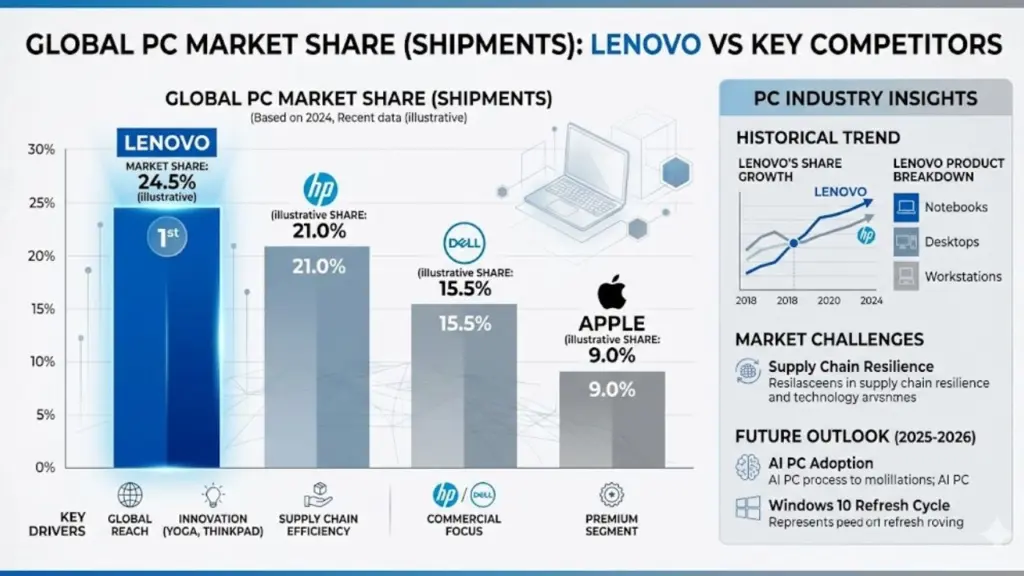
| Metric | Details (2026) |
|---|---|
| Headquarters | Hong Kong (Operational HQ: Beijing, China) |
| Global PC Market Share | ~24% — world’s largest |
| Annual Revenue | ~$57 billion USD (FY2024/25) |
| Global Employees | 77,000+ |
| Product Categories | PCs, Laptops, Tablets, Servers, Smartphones, Smart Devices, AI Infrastructure |
| Operational Countries | 180+ |
| Stock Exchange | HKEX (992) + Shanghai STAR Market |
My Honest Take on Lenovo’s Ownership
When I first started digging into this, I expected a clean answer — a family name, a single fund, something tidy. What I found instead was a genuinely layered structure: public markets, government-adjacent institutions, individual leadership, and four decades of corporate evolution all woven together.
And honestly? That complexity is part of what makes Lenovo one of the more interesting companies to study. It’s not a Silicon Valley startup with a single charismatic founder. It’s not a state-owned enterprise with top-down government direction. It’s something in between — a commercially driven global company with deep roots in China’s institutional landscape, navigating international markets while carefully managing that dual identity.
As someone who has used ThinkPad laptops for years, I find that history kind of remarkable. The laptop I’m writing on right now carries engineering DNA from IBM labs in the early 1990s, filtered through a Beijing startup that bet everything on global ambition — and quietly, steadily, won.
Frequently Asked Questions About Lenovo’s Ownership
Who is the current owner of Lenovo?
Lenovo Group Limited is a publicly traded company. Its largest shareholder is Legend Holdings Corporation with approximately 33% ownership. Yang Yuanqing, as Chairman and CEO, holds roughly 8% personally. The remaining shares are held by institutional and retail investors on public markets.
Who is the CEO of Lenovo in 2026?
Yang Yuanqing is the Chairman and CEO of Lenovo. He has led the company since 2009, making him one of the longest-tenured tech CEOs in the world.
Is Lenovo a Chinese government company?
Not directly. The Chinese Academy of Sciences (a state body) holds roughly 36% of Legend Holdings, which in turn owns about 33% of Lenovo. This creates an indirect government link, but Lenovo operates as an independent publicly listed commercial company.
Who founded Lenovo?
Lenovo was founded in 1984 by Liu Chuanzhi and ten colleagues at the Chinese Academy of Sciences’ Institute of Computing Technology in Beijing. It was originally called “Legend.”
When did Lenovo buy IBM’s PC division?
Lenovo completed its acquisition of IBM’s Personal Computing Division in May 2005 for approximately $1.75 billion. The deal included the iconic ThinkPad laptop brand.
Is Lenovo publicly traded?
Yes. Lenovo Group Limited is listed on the Hong Kong Stock Exchange under the ticker symbol 992. It is also listed on the Shanghai STAR Market as of 2020.
What country does Lenovo belong to?
Lenovo is incorporated in Hong Kong and its operational headquarters are in Beijing, China. It was founded in China in 1984 and is considered a Chinese multinational technology company, though it operates in over 180 countries worldwide.
Discover more from Who Is The Owner Of
Subscribe to get the latest posts sent to your email.