
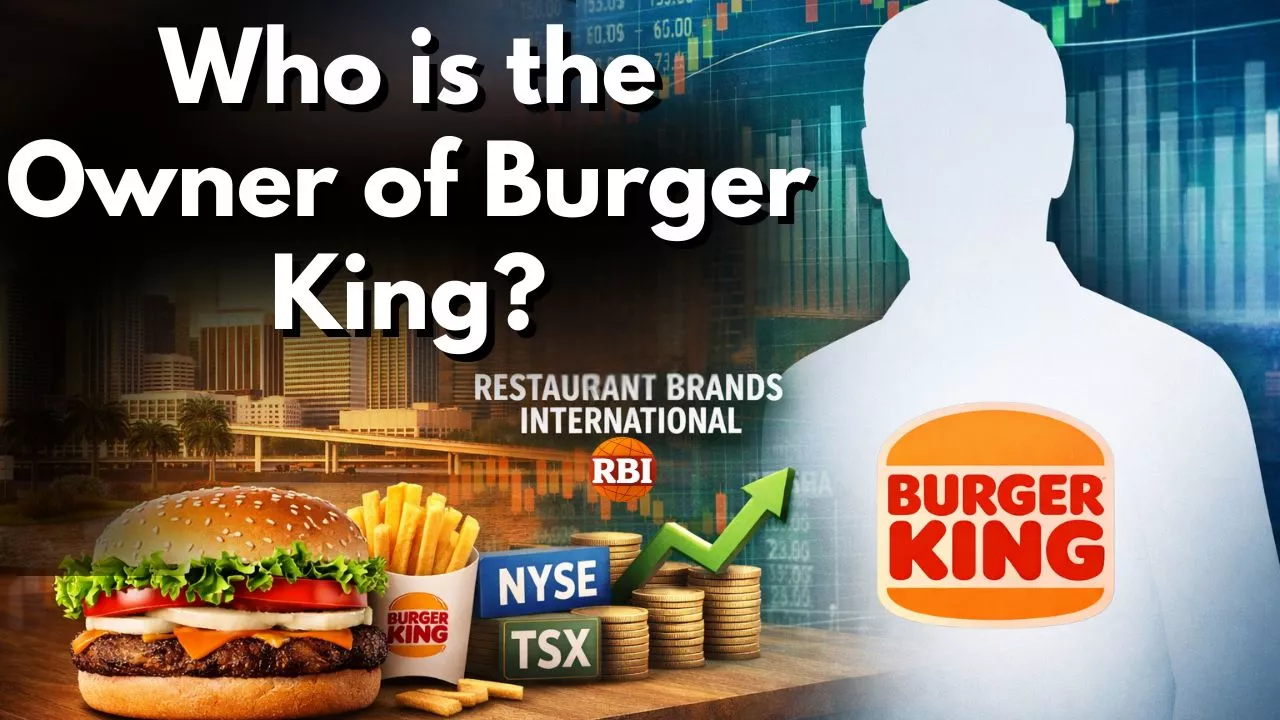
Quick Facts: Burger King
| Owner | Restaurant Brands International (RBI) |
| CEO | Josh Kobza (RBI CEO) |
| Founded | 1953 (as Insta-Burger King); renamed Burger King 1954 |
| Headquarters | Miami, Florida, USA |
| Ownership Type | Public |
| Stock Ticker | NYSE: QSR / TSX: QSR |
| Publicly Traded | Yes |
Who Owns Burger King?
Burger King is owned by Restaurant Brands International (RBI), a publicly traded Canadian-American fast food holding company. RBI trades on both the New York Stock Exchange and the Toronto Stock Exchange under the ticker symbol QSR. RBI was formed in 2014 through the merger of Burger King (which had been taken private by 3G Capital in 2010 for approximately $4 billion) and Tim Hortons, the iconic Canadian coffee and fast food chain, creating one of the world’s largest quick-service restaurant companies. Today RBI’s portfolio includes Burger King, Tim Hortons, Popeyes Louisiana Kitchen, and Firehouse Subs.
3G Capital, the Brazilian private equity firm known for its aggressive cost-cutting management philosophy, was instrumental in Burger King’s transformation. Led by Jorge Paulo Lemann and other Brazilian investment figures, 3G Capital took Burger King private in 2010, streamlined operations, and then merged the brand with Tim Hortons in 2014 (with financial support from Berkshire Hathaway‘s Warren Buffett). The combined entity went public as Restaurant Brands International. Josh Kobza has served as RBI’s CEO since early 2023, having previously served as the company’s Chief Financial Officer. Under his leadership, Burger King has pursued a major “Reclaim the Flame” investment strategy to renovate restaurants and improve operations across the United States.
Burger King was founded in 1953 by Keith Cramer and his stepfather Matthew Burns in Jacksonville, Florida, initially as “Insta-Burger King” using an “Insta-Broiler” cooking machine. After early financial difficulties, the company was purchased by James McLamore and David Edgerton, who stabilized it and ultimately franchised the concept nationwide. Burger King was responsible for introducing the flame-broiled method of cooking burgers — a distinguishing feature versus McDonald’s griddle-cooked patties — and the famous Whopper sandwich in 1957. The brand has passed through several corporate owners including Pillsbury, Grand Metropolitan, Diageo, and Texas Pacific Group (TPG) before 3G Capital’s 2010 acquisition.
About Restaurant Brands International
RBI is one of the world’s largest quick-service restaurant companies, operating more than 30,000 restaurants globally in over 100 countries. Its four brands — Burger King, Tim Hortons, Popeyes, and Firehouse Subs — collectively serve millions of customers daily across North America, Europe, Asia, and beyond. RBI’s business model is predominantly franchising: the company earns fees and royalties from independent franchisee operators who own and run individual locations. RBI’s headquarters are split between Toronto (Tim Hortons operations) and Miami (Burger King and Popeyes operations).
Key Ownership Highlights
- Restaurant Brands International owns Burger King: RBI (NYSE/TSX: QSR) is the publicly traded parent company of Burger King. The conglomerate was created in 2014 through the merger of Burger King and Tim Hortons, engineered by 3G Capital with Berkshire Hathaway providing financing.
- 3G Capital was key to Burger King’s transformation: Brazilian private equity firm 3G Capital took Burger King private in 2010 for approximately $4 billion, applied its cost-management philosophy, and merged it with Tim Hortons in 2014 to create RBI. 3G Capital remains a significant RBI shareholder.
- Burger King’s “Reclaim the Flame” strategy: Under Josh Kobza’s leadership, RBI launched a major multi-year investment program called “Reclaim the Flame” to renovate US Burger King restaurants, improve food quality and speed of service, and close underperforming locations, with hundreds of millions of dollars committed to the effort.
- The Whopper has been Burger King’s signature since 1957: Introduced in 1957 at 37 cents, the Whopper became one of the most iconic fast food sandwiches in history. Its flame-broiled beef patty and customizable toppings remain Burger King’s defining product more than 65 years after its introduction.
- RBI operates more than 30,000 restaurants globally: Across its four brands (Burger King, Tim Hortons, Popeyes, Firehouse Subs), Restaurant Brands International operates more than 30,000 restaurants in over 100 countries, generating tens of billions of dollars in system-wide sales annually.
Related Ownership Profiles
For another burger-themed brand with an unconventional ownership story, see who owns Trump Burger.
Frequently Asked Questions
Who owns Burger King?
Burger King is owned by Restaurant Brands International (NYSE/TSX: QSR), a publicly traded fast food holding company. RBI was formed in 2014 through the merger of Burger King and Tim Hortons, engineered by 3G Capital. Josh Kobza is RBI’s CEO.
Is Burger King publicly traded?
Burger King itself is not separately traded. Its parent company, Restaurant Brands International, is publicly traded on the New York Stock Exchange (NYSE: QSR) and the Toronto Stock Exchange (TSX: QSR).
Who founded Burger King?
Burger King was founded in 1953 in Jacksonville, Florida by Keith Cramer and Matthew Burns, initially as “Insta-Burger King.” The business was stabilized and expanded by subsequent owners James McLamore and David Edgerton, who introduced the Whopper in 1957 and franchised the brand nationally.
How many Burger King locations are there worldwide?
Burger King operates approximately 18,000+ locations worldwide across over 100 countries, making it one of the most globally distributed fast food chains. It is the second-largest hamburger fast food chain in the world after McDonald’s.
Related Reading
Curious about Burger King promotions? See which VIP card can get you free Burger King for life.




i have one word for an ad that will blow away your ad people surprised it has never been thought of goes directly to your brand just get back to me