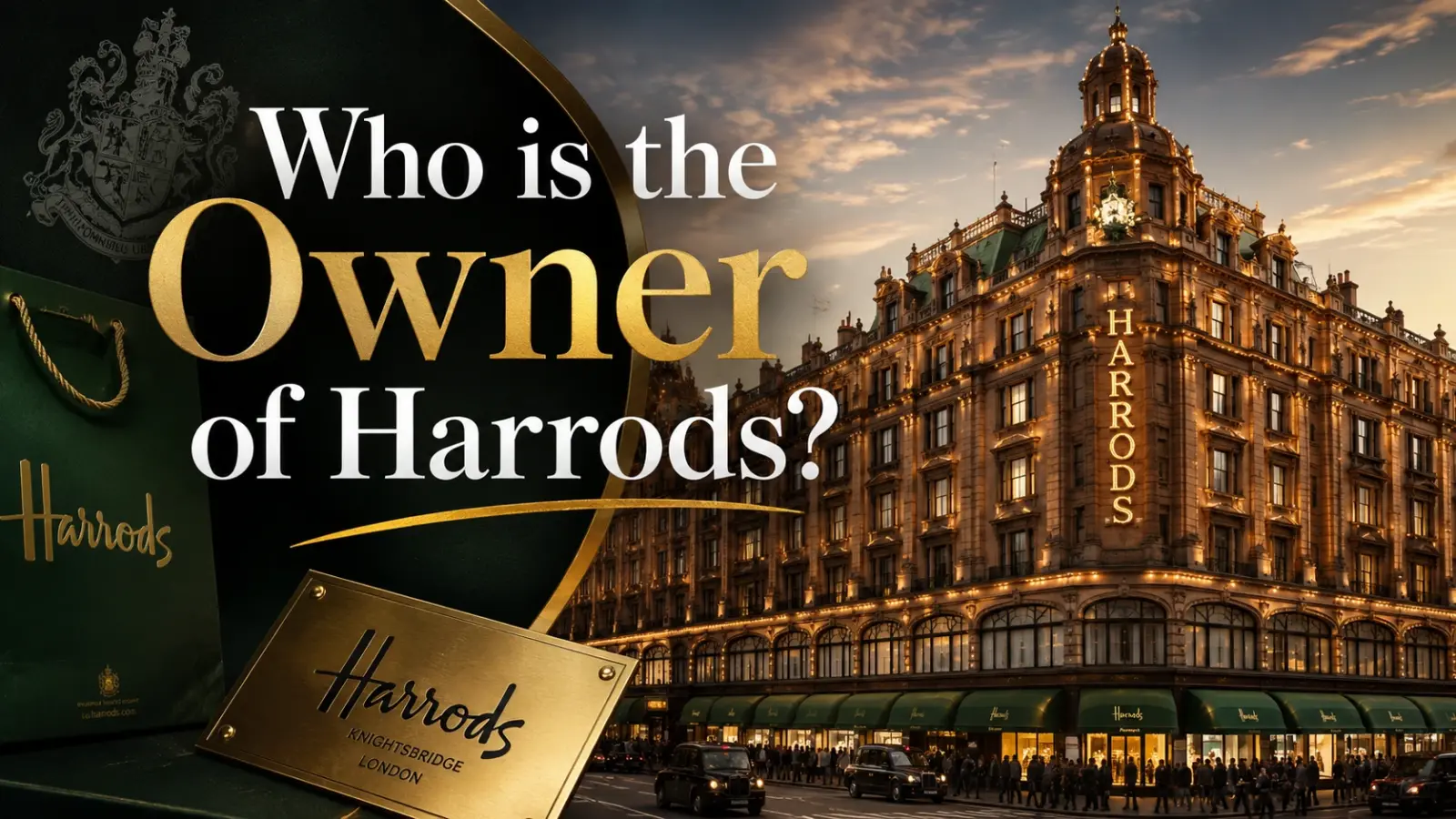
Walk through the bronze doors of Harrods on Brompton Road in Knightsbridge, and you step into what many consider the most famous shop on Earth. Harrods is an iconic luxury department store in Knightsbridge, London — a symbol of British retail excellence since 1849. Seven floors. Over 330 departments. A food hall that makes grown adults emotional. A motto — Omnia Omnibus Ubique — that translates as “all things for all people, everywhere.” And a list of former customers that includes royalty, celebrities, and heads of state from every corner of the planet.
But who actually owns this extraordinary place? The answer lies not in London, not in Britain, but in a small peninsula nation in the Arabian Gulf — the State of Qatar.
Who Owns Harrods Right Now in 2026?
Harrods is currently owned by the Qatar Investment Authority. They purchased the famous department store for £1.5 billion in 2010 from Mohamed Al-Fayed.
Harrods is owned by Harrods Ltd, a company currently owned by the State of Qatar via its sovereign wealth fund, the Qatar Investment Authority. It is a fully private company — not listed on any stock exchange, not open to outside investors, and not required to publish its financial details to the public. Qatar owns it completely and exclusively.
The man running Harrods on a day-to-day basis is Managing Director Michael Ward, who has led the store since 2005 and oversaw the transition from Al-Fayed’s ownership to Qatari control. During his time at Harrods, Ward has overseen programmes of huge growth and expansion both in the UK and globally within the brand, as well as the transition to new ownership by the Qatar Investment Authority in 2010.
Ownership and Key Stakeholders Table
| Owner / Party | Role | Stake | Key Detail |
|---|---|---|---|
| Qatar Investment Authority (QIA) | Current Owner | 100% | Purchased Harrods for £1.5 billion in 2010; owned via Qatar Holding subsidiary |
| State of Qatar | Ultimate Owner | 100% (via QIA) | QIA is Qatar’s sovereign wealth fund; established 2005 |
| Mohammed Saif Al-Sowaidi | QIA CEO | Government appointee | Holds board roles at Harrods, Qatar Airways, Volkswagen, and others |
| Michael Ward | Managing Director of Harrods | No ownership stake | Running Harrods since 2005; oversaw the 2010 ownership transition |
| Mohamed Al-Fayed (deceased) | Former Owner (1985–2010) | Sold in 2010 | Bought Harrods for £615 million in 1985; sold to QIA for £1.5 billion |
| House of Fraser / Lonrho | Historical Owners | N/A | Owned Harrods before Al-Fayed’s 1985 acquisition |
The Founding Story: A Grocer in East London, 1849
The Harrods story does not begin in Knightsbridge. It begins in a much humbler location — a single-room grocery shop in the East End of London.
Henry Charles Harrod founded it as a grocery store in 1849. The enterprise expanded in the late 1800s, and many new departments were added. The store’s owners expanded customer service to provide for every need and once boasted that Harrods had “the best circulating library in London.” Using the store’s services, customers could buy theatre tickets, make travel reservations, and arrange funerals.
Henry Charles Harrod started as a tea merchant and wholesale grocer. He moved his shop to Knightsbridge in 1853 — a then-unfashionable part of town on the outskirts of London. His timing turned out to be perfect. The Great Exhibition of 1851 had drawn millions of visitors to the area, and Knightsbridge was beginning its transformation into one of the most prestigious addresses in the world.
By the time his son Charles Digby Harrod took over in 1861, the business had grown into a thriving retail operation. By 1880, the store employed 100 staff and was generating £1,000 a week in sales. In 1898, Harrods installed what is widely considered the world’s first moving staircase — a “travelling staircase” — and stationed a staff member at the top offering brandy to shaken customers who had never experienced anything like it before.
Mohamed Al-Fayed: The Owner Who Made Harrods World-Famous
Before Qatar, there was Mohamed Al-Fayed — the Egyptian billionaire whose 25-year ownership of Harrods made it one of the most talked-about retail destinations on the planet.
Harrods was most notably owned by Mohamed Al-Fayed, who acquired the store in 1985. Al-Fayed’s ownership brought both prestige and controversy to the Grade II listed luxury department store.
Al-Fayed built a massive shipping empire in the Middle East after starting out as a street hawker in Alexandria, Egypt, and in the 1960s became a personal adviser to some of the richest men in the world, including the Sultan of Brunei and Rashid bin Saeed, the former prime minister of the United Arab Emirates.
Al-Fayed purchased Harrods for approximately £615 million in 1985 as part of his takeover of the House of Fraser retail group. He transformed the store dramatically — expanding the food halls, creating the famous Egyptian Escalator adorned with pharaonic imagery, and turning Harrods into a global tourist destination as much as a shopping destination.
In 1997, his son Dodi Al-Fayed died in a car crash in Paris alongside Princess Diana — an event that cast a long, painful shadow over Al-Fayed’s remaining years and ownership of the store.
Harrods, which Al-Fayed sold to Qatar Investment Authority in 2010, has strenuously distanced itself from its former owner. A statement on the Harrods website describes its current owners as “utterly appalled” and states that it is a “very different organisation to the one owned and controlled by Al-Fayed between 1985 and 2010.”
Mohamed Al-Fayed died in 2023 at the age of 94.
The 2010 Qatar Acquisition: £1.5 Billion for a British Icon
The sale of Harrods to Qatar in 2010 was one of the most talked-about business deals in British retail history.
The Qatar Investment Authority’s purchase of Harrods for £1.5 billion in 2010 raised concerns at the time. The transition from Mohamed Al-Fayed’s ownership to the Gulf state of Qatar brought its own set of legal complexities.
For Al-Fayed, the sale represented a clean exit at a remarkable profit — he had paid approximately £615 million for Harrods in 1985 and sold it for £1.5 billion just 25 years later, roughly doubling his money in one of the most prestigious retail assets in the world.
For Qatar, it was a statement of global ambition. In the UK, QIA owns the Shard skyscraper and Harrods in London and has stakes in Heathrow Airport and the Canary Wharf Group. It also owns the Paris Saint-Germain football club.
Harrods fits perfectly within QIA’s strategy of owning iconic, globally recognized assets that generate both financial returns and prestige. A British department store that royal families have shopped at for over 170 years is exactly the kind of trophy asset a sovereign wealth fund wants in its portfolio.
What Is the Qatar Investment Authority?
Understanding who owns Harrods requires understanding QIA — because QIA is the direct owner, and QIA is ultimately the State of Qatar itself.
The Qatar Investment Authority (QIA) is Qatar’s sovereign wealth fund, founded by the State of Qatar in 2005 to strengthen the country’s economy by diversifying into new asset classes. As of 2026, QIA manages assets under management of approximately $600 billion.
QIA’s subsidiaries include QNB Group, Qatari Diar, Qatar Holding, Hassad Food, Katara Hospitality, Harrods Group, Ooredoo, Qatar Airways, and the Qatar Stock Exchange.
The current CEO of QIA is Mohammed Saif Al-Sowaidi. He currently holds several board roles both globally and in Qatar, including at Qatar National Bank, Qatar Airways Group, Ooredoo, Volkswagen, and Harrods.
In simple terms: Harrods is owned by Qatar Holding — a subsidiary of QIA — which is itself wholly owned by the State of Qatar. When you shop at Harrods, your money ultimately flows to the government of Qatar.
The Al-Fayed Abuse Scandal and Harrods’ Response
No honest account of Harrods’ ownership story can avoid the serious allegations that have emerged against Mohamed Al-Fayed since his death in 2023.
In a BBC documentary, more than 20 female former Harrods employees accused the Egyptian billionaire of sexually assaulting them. A police investigation into Al-Fayed, opened in the wake of the documentary, was ongoing. London’s Metropolitan Police stated that the force was investigating the claims of more than 140 alleged victims.
The store has been settling claims by current and former employees and has applied to Kensington and Chelsea council to remove the famous Egyptian Escalator — which “explicitly celebrates Mr. Al-Fayed, including sixteen huge sculptures of his face.”
The current QIA ownership has been emphatic in separating itself from Al-Fayed’s legacy. The message from today’s Harrods is clear: the store under Qatari ownership is a fundamentally different organization from the one that existed before 2010.
Related Ownership Profiles
For another famous British estate, see who owns Longleat.
Qatar’s sovereign wealth fund extends well beyond British retail: the QIA’s hospitality investment arm, Katara Hospitality, also owns New York’s iconic Plaza Hotel, which it acquired for roughly $600 million in 2018.
Harrods Today: What the Business Looks Like in 2026
Harrods today is far more than a department store. Under QIA ownership, it has grown into a full luxury group with multiple revenue streams.
Harrods Group’s subsidiaries include Harrods Estates, Harrods Interior Design, and Harrods Aviation. The store occupies a site with 330 departments covering extensive retail space and is one of the largest and most famous department stores in the world. The Harrods motto is Omnia Omnibus Ubique, which is Latin for “all things for all people, everywhere.”
The store serves millions of visitors every year from around the globe — a significant portion of them tourists who come to Knightsbridge specifically to experience Harrods, not just to shop. The Food Halls alone draw enormous crowds. The Seasonal Christmas department is legendary. And the Personal Shopping suites serve some of the wealthiest clients on the planet.
Under QIA ownership, Harrods has also subtly expanded its Qatari identity within the store — with a dedicated Qatar Airways agency, a cultural café, and merchandise celebrating Qatari heritage. It is, quietly but unmistakably, an ambassador for Qatar in the heart of London.
Frequently Asked Questions (FAQs)
Q1. Who owns Harrods in 2026?
Harrods is owned by the Qatar Investment Authority (QIA), the sovereign wealth fund of the State of Qatar, which bought it for £1.5 billion in 2010.
Q2. Did Qatar buy Harrods?
Yes. Qatar Holding, a subsidiary of QIA, purchased Harrods from Mohamed Al-Fayed in 2010 for £1.5 billion.
Q3. Who owned Harrods before Qatar?
Mohamed Al-Fayed, an Egyptian billionaire, owned Harrods from 1985 to 2010, purchasing it for approximately £615 million.
Q4. Who founded Harrods and when?
Henry Charles Harrod founded Harrods as a grocery shop in 1849 in Knightsbridge, London.
Q5. Is Harrods a publicly traded company?
No. Harrods is a fully private company, owned entirely by QIA and not listed on any stock exchange.
Q6. Who is the current Managing Director of Harrods?
Michael Ward has served as Managing Director of Harrods since 2005 and oversaw the transition to Qatari ownership in 2010.
Q7. How much is Harrods worth in 2026?
Harrods has never been independently valued publicly, but QIA paid £1.5 billion in 2010 — and with 16 years of growth under Qatari ownership, its current value is widely estimated to be significantly higher.
Q8. What other assets does Harrods’ owner QIA hold in the UK?
Beyond Harrods, QIA owns The Shard skyscraper, holds stakes in Heathrow Airport and Canary Wharf Group, and owns Paris Saint-Germain football club internationally.
Harrods is fully and exclusively owned by the Qatar Investment Authority (QIA) — the sovereign wealth fund of the State of Qatar — which purchased it for £1.5 billion in 2010 from the late Mohamed Al-Fayed. QIA manages approximately $600 billion in assets and also owns The Shard, stakes in Heathrow Airport, Canary Wharf, and Paris Saint-Germain football club. Harrods itself has been a Knightsbridge institution since Henry Charles Harrod opened a grocery shop there in 1849 — making it one of the oldest and most enduring luxury retail brands in the world.