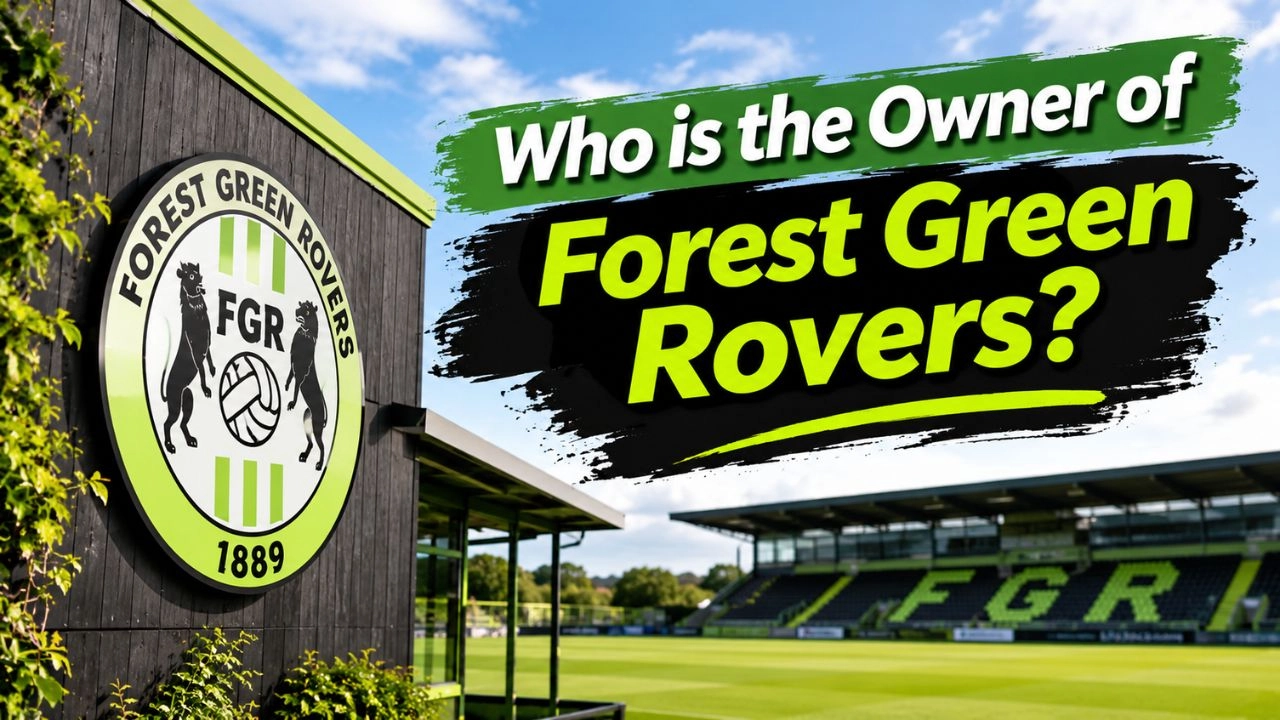
Forest Green Rovers is the small Gloucestershire club that became famous around the world for what it stands for, not just how it plays.
It was the first football club to go fully vegan and carbon neutral, and one man is behind all of it. This guide explains who owns the club in 2026, how he got there, and what is happening at the club right now.
Who Owns Forest Green Rovers in 2026?
Dale Vince is the owner and chairman of Forest Green Rovers. He controls the club through his green energy business, and the club’s own website has named Ecotricity New Ventures Group as the holder of 95.72% of Forest Green Rovers Ltd. Vince is listed as the ultimate beneficial owner of that majority shareholder, so in practice the club is his.
That percentage is the last figure the club published, so treat it as a guide rather than a live number. The remaining stake of roughly 4.28% sits with smaller shareholders.
Ownership and Key Stakeholders Table
| Owner / Party | Role | Stake | Key Detail |
|---|---|---|---|
| Dale Vince | Owner and Chairman | Ultimate beneficial owner of the majority shareholder | Chairman since 2010; founder of Ecotricity |
| Ecotricity New Ventures Group | Majority Shareholder | 95.72% of Forest Green Rovers Ltd (last published figure) | The vehicle through which Vince holds the club |
| Green Britain Group | Parent Group | Holds Vince’s green businesses | Created in a 2020 restructure; subsidiaries include Ecotricity and the football club |
| Kate Vince | Director | No stake disclosed | Listed alongside Dale Vince as a director of Green Britain Group |
| Smaller Shareholders | Minority Holders | About 4.28% | Calculated from the last published majority figure |
| Jonathan Gould, Josh Bowen and Yan Klukowski | First-Team Coaching Trio | No ownership | Running the team without a manager since October 2026 |
Who Is Dale Vince?
Dale Vince was born on 29 August 1961 in Great Yarmouth, Norfolk, and spent years living on the road as a New Age traveller. He started Ecotricity in 1995, building wind and solar parks and selling green electricity to homes and businesses.
A 2020 restructure created Green Britain Group, which now sits above both Ecotricity and the football club. In April 2022 Vince said he planned to sell Ecotricity and move into politics, but he remains in control of the group.
In 2012 he founded the Green Britain Foundation, a charity that backs environmental education. His other ventures have included Skydiamond, which makes lab-grown diamonds from wind, rain and sunlight, and Devil’s Kitchen, which supplies vegan school dinners.
He was also an executive producer of the Netflix documentary Seaspiracy and has donated to both the Labour and Green parties. His net worth was reported at around £107 million in 2015, which is an old figure.
How Dale Vince Took Over in 2010
Before Vince arrived, Forest Green were a modest club in the Conference National. They had been reprieved from relegation twice, only because other clubs were demoted.
In 2010 Vince invested in the club and became a major shareholder. About three months later he was named chairman. His plan was simple: make Forest Green the greenest club in the sport. Sixteen years later he is still in charge.
The World’s First Vegan and Carbon-Neutral Club
Under Vince, The New Lawn gained an organic pitch, a solar-powered mower, rainwater harvesting and an all-vegan matchday menu. What is believed to be the world’s first vegan football match was played there on 1 November 2014. The club’s kit is made from recycled and sustainable materials too.
FIFA has described Forest Green as the world’s greenest football club, and it became a United Nations Climate Champion in 2018.
Promotion, Relegation and Life in the National League
Forest Green won promotion to the English Football League in 2017. They then won League Two in 2021–22 under Rob Edwards with 84 points.
Their first season in League One ended badly, with a 24th place finish in 2022–23 and relegation. The next season was worse. Five different managers or interim bosses took charge, and the club dropped into the National League after finishing 24th in League Two in 2023–24.
In 2025–26 they finished 7th under Robbie Savage, with an average home crowd of 2,026. They are now in a third straight season at the fifth tier.
A Club Without a Manager
At the start of October 2026, Savage left to take the Peterborough United job in League One after a little over a year at Forest Green. Vince said there was no vacancy and that the club wanted to try something new, according to Yahoo Sports.
The team is now run by a coaching trio of Jonathan Gould, Josh Bowen and Yan Klukowski. Sky Sports reported that Vince simply wants to see what happens, which is rare in English football.
The £100 Million Eco Park Stadium
Vince’s biggest project is Eco Park, a planned wooden stadium near Junction 13 of the M5. Detailed designs were approved in December 2024. By late 2025 no construction had started, because Gloucestershire County Council asked for a new dual carriageway to handle matchday traffic, as the Stroud Times reported.
For now the club still plays at The New Lawn in Nailsworth, which holds around 5,000 fans. The plan is to leave it eventually.
How Forest Green’s Ownership Compares With Other English Clubs
English football has every kind of owner, from celebrities to private equity. Wrexham was bought by Ryan Reynolds and Rob McElhenney in 2021 as a National League club and has since reached the Championship. Swansea City now has its own celebrity-backed group, and Salford City climbed from the eighth tier to the EFL under Gary Neville and his partners.
Coventry City won the 2025–26 Championship and reached the Premier League under local owner Doug King. At the top level, Fulham is owned by Shahid Khan, who also owns the Jacksonville Jaguars. Manchester United is split between the Glazer family, who also run the Tampa Bay Buccaneers, and INEOS.
Vince is different from all of them. He uses the club as a platform for his green message, which makes it one of the most distinctive stories in sports ownership today.
Frequently Asked Questions (FAQs)
Q1. Who owns Forest Green Rovers?
Dale Vince, who is also the chairman, controls the club through his green energy group.
Q2. What stake does Ecotricity hold in the club?
Ecotricity New Ventures Group was listed as holding 95.72% of Forest Green Rovers Ltd in the club’s last published figure.
Q3. When did Dale Vince take over?
He invested in 2010 and became chairman about three months later.
Q4. Is Forest Green Rovers really all vegan?
Yes, the club serves only vegan food on matchdays and is widely called the world’s first all-vegan football club.
Q5. What league does Forest Green play in?
The National League, the fifth tier of English football, in 2026–27.
Q6. Who manages Forest Green Rovers now?
Nobody at the moment; since Robbie Savage left for Peterborough United in October 2026, a coaching trio has run the team.
Q7. Where does Forest Green play home games?
At The New Lawn in Nailsworth, Gloucestershire, which holds around 5,000 fans.
Q8. What is the Eco Park?
A planned £100 million wooden stadium near Junction 13 of the M5 that has planning approval but had not started construction by late 2025.
Forest Green Rovers is owned by Dale Vince, who controls it through Ecotricity New Ventures Group and his wider Green Britain Group. He took over in 2010 and turned a struggling non-league side into the world’s first vegan, carbon-neutral football club.
The club is now back in the National League, running without a manager and still waiting to break ground on its £100 million Eco Park. There is no sign that Vince plans to hand over control.
Official Website: fgr.co.uk