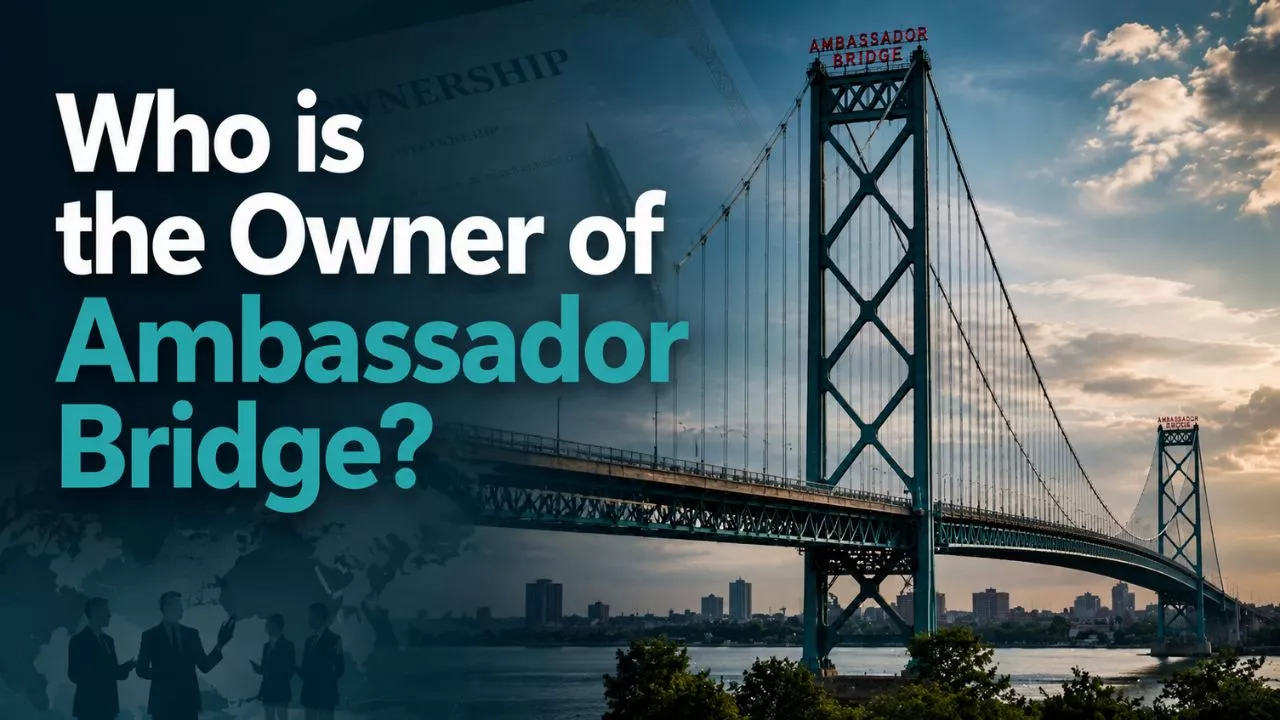
Every single day, more than 10,000 trucks and 4,000 cars cross a 96-year-old suspension bridge spanning the Detroit River between Detroit, Michigan and Windsor, Ontario. That bridge — the Ambassador Bridge — carries more than 25% of all merchandise trade between the United States and Canada by value. CNN once called it “the most economically important one-and-a-half miles of roadway in the Western Hemisphere.”
And for most of its modern history, this extraordinary piece of infrastructure has been owned not by a government, not by a public authority, but by a single private family from Michigan — the Morouns. That ownership has made them billionaires, made them powerful, and made them one of the most controversial families in Detroit business history.
Here is the complete, verified story of who owns the Ambassador Bridge — including the dramatic political battle that erupted in February 2026 and is still unfolding today.
What Is the Ambassador Bridge?
The Ambassador Bridge is an international suspension bridge across the Detroit River that connects Detroit, Michigan, in the United States, with Windsor, Ontario, in Canada. Opened on November 15, 1929, the toll bridge is the busiest international border crossing in North America in terms of trade volume, carrying more than 25% of all merchandise trade between the United States and Canada by value.
A 2004 Border Transportation Partnership study showed that 150,000 jobs in the Detroit–Windsor region and $13 billion in annual production depend on the Detroit–Windsor international border crossing.
The bridge carries 60 to 70 percent of commercial truck traffic in the region. Its total length is 7,500 feet, it stands 386 feet tall, and its longest span stretches 1,850 feet across the river. It is, by almost any measure, one of the most strategically important pieces of private infrastructure in all of North America.
Who Owns the Ambassador Bridge Right Now in 2026?
The current owner of the Ambassador Bridge is Matthew T. Moroun — a 52-year-old American billionaire businessman from Michigan who inherited control of the bridge from his father, Manuel “Matty” Moroun, after his death in July 2020.
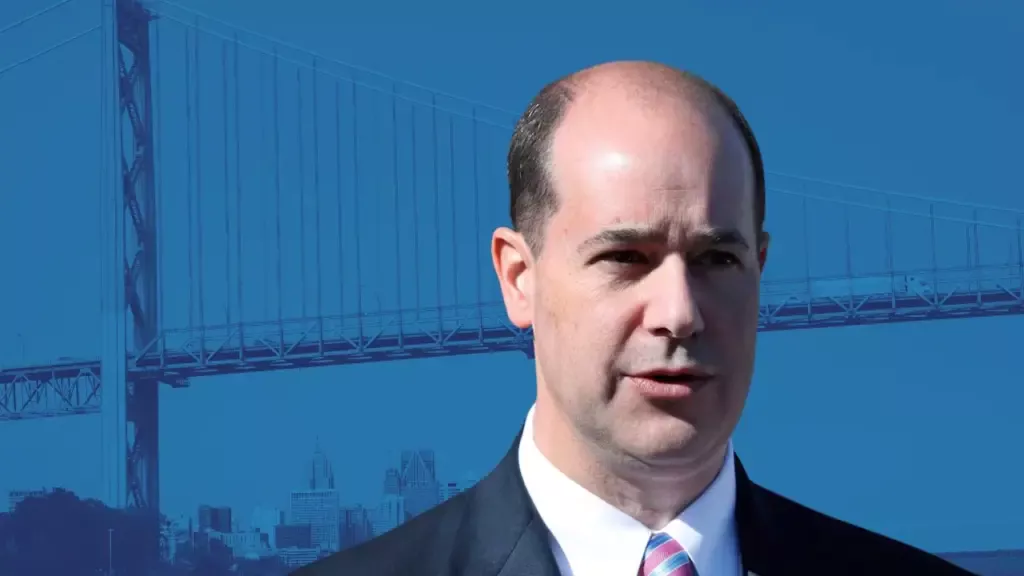
Matthew T. Moroun is the owner of the Moroun family transportation empire and the Ambassador Bridge, connecting Detroit, Michigan and Windsor, Ontario, after inheriting control from his father Manuel Moroun in 2020. Forbes put the Moroun family net worth at $1.5 billion in 2020.
The Ambassador Bridge’s U.S. owner is the Detroit International Bridge Company, and its Canadian subsidiary is The Canadian Transit Company. The Moroun family owns and controls both entities.
The Canadian Transit Company (CTC) owns the Canadian half of the bridge, and that company is then owned by the Detroit International Bridge Company, owned by the Moroun family.
In plain terms: one family, two companies, one bridge — split down the middle of the Detroit River between two countries, but controlled entirely by the Morouns.
Ownership and Key Stakeholders Table
| Party | Role | Ownership | Key Detail |
|---|---|---|---|
| Matthew T. Moroun | Current Owner & Chairman | Controlling interest | Inherited from father Manuel Moroun in 2020; net worth ~$1.5B |
| Detroit International Bridge Company (DIBC) | U.S. Operating Entity | Owns U.S. side of bridge | Moroun family-controlled private company; collects U.S. tolls |
| Canadian Transit Company (CTC) | Canadian Operating Entity | Owns Canadian side of bridge | Wholly owned subsidiary of DIBC; collects Canadian tolls |
| Manuel “Matty” Moroun | Previous Owner (Historical) | Held full control 1979–2020 | Acquired bridge in 1979; died July 2020 at age 93 |
| U.S. Federal Government (GSA) | Customs Facility Owner | Owns U.S. customs building only | Does not own the bridge; only the U.S. customs inspection facility |
| Government of Canada / Michigan | None — competitor | 0% of Ambassador Bridge | Own the competing Gordie Howe International Bridge instead |
The Origin Story: How the Morouns Came to Own a Bridge
The Ambassador Bridge was not always in private hands. When it was built, it was a private investment — but one owned by shareholders, not a single family.
In 1979, when the previous owners put the bridge on the New York Stock Exchange and shares were traded, Manuel Moroun was able to buy shares, eventually acquiring the bridge.
Matty Moroun started working in his father’s garage after college and tenaciously grew that into a local trucking empire. He had a sharp eye for undervalued infrastructure assets and recognized immediately that a bridge carrying the majority of U.S.-Canada trade traffic was one of the most powerful revenue-generating assets in America. He bought shares quietly, accumulated a controlling position, and eventually took full ownership.
Matthew Moroun is a third-generation businessman, son of a self-made billionaire who started off pumping gas and cleaning buses at his own father’s Detroit gas stations and became a trucking tycoon and real estate investor who in 1979 bought the then-50-year-old Ambassador Bridge.
The acquisition gave the Moroun family something almost no private family in America has ever held: a near-monopoly on the busiest international land trade crossing on the continent. Every truck carrying auto parts, produce, manufactured goods, or consumer products between Michigan and Ontario had virtually no alternative — and the Morouns collected a toll from every single one.
Manuel “Matty” Moroun: The Man Who Built the Empire
To understand who owns the Ambassador Bridge today, you need to understand the man who made it possible — Manuel “Matty” Moroun.
Manuel Moroun, known as Matty, died on July 13, 2020 at the age of 93 due to congestive heart failure, according to a letter sent from his son Matthew. He is best known for his private ownership of the Ambassador Bridge, the busiest border crossing between Canada and the United States, handling commercial traffic and travellers between Detroit and Windsor, Ont. He owned the Ambassador Bridge since 1979.
“His basic biography ought to be that of rags to riches, American hero,” said John Gallagher, a retired Detroit Free Press journalist. “[But] instead he’s probably the most disliked businessman in Detroit, by far, in a couple of generations.”
Matty Moroun was a deeply polarizing figure. On one side, he was a brilliant self-made businessman who turned a garage job into a billion-dollar empire spanning trucking, real estate, and infrastructure. On the other side, he fought governments, neighbors, and regulators for decades to protect his monopoly — often using aggressive legal tactics and political influence that left deep wounds on both sides of the border.
Matthew Moroun Takes Over: A New Generation, A New Style
When Matthew T. Moroun inherited the bridge in 2020, he made it clear from the start that he wanted to change the tone — while protecting every dollar of the family’s business interests.
Matthew Moroun says that after the protests against vaccine mandates that shut down the bridge for six days in 2022, delaying the transport of billions of dollars in goods, he wants to cooperate with Canadians to renovate the aging bridge and protect cross-border trade. “Whatever olive branch I can extend, whatever hard work I can guarantee,” said Moroun in an interview with CBC News.
But that cooperative tone has been tested repeatedly — and nowhere more dramatically than in February 2026, when Matthew Moroun found himself at the center of an international political firestorm.
The 2026 White House Controversy: A Bridge Owner and a Presidential Post
In February 2026, the ownership of the Ambassador Bridge suddenly became front-page news around the world — and the story involved the White House, a competing bridge, and a social media post from President Donald Trump.
A report from The New York Times revealed that Matthew Moroun, whose family has owned the Ambassador Bridge for decades, met with U.S. Secretary of Commerce Howard Lutnick on Monday, February 9, 2026 — just hours before Trump’s social media post threatening to block the opening of the newly constructed Gordie Howe International Bridge.
Trump took to Truth Social, slamming Canada for what he called unfair trade deals, and threatened to block the opening of the bridge until “the United States is fully compensated for everything we have given” Canada. “We will start negotiations, IMMEDIATELY. With all that we have given them, we should own, perhaps, at least one half of this asset,” Trump said.
The implication was explosive: had Matthew Moroun — a donor to President Trump — used his access to the White House to torpedo a competing bridge that threatened his family’s revenue?
On February 18, 2026, U.S. House Democrats sent a letter directly to Matthew Moroun, stating: “It appears that you may have used your influence as a donor to President Donald Trump to jeopardize American commerce to protect your company’s bottom line.”
Since the initial planning for the Gordie Howe Bridge, dating back to 2012, the Moroun family has been against the building of a new bridge, a push that included legal action. The Gordie Howe is owned by Michigan and Canada, but is being paid for almost entirely by Canada.
The Gordie Howe Bridge: The Biggest Threat to the Morouns’ Monopoly
The Gordie Howe International Bridge is the first serious competition the Ambassador Bridge has faced in its entire 96-year history — and it threatens the Moroun family’s revenue in ways that cannot be overstated.
The Gordie Howe International Bridge is designed with six traffic lanes, 16 toll lanes, and 60 Canada and U.S. inspection lanes. The bridge began construction in 2018 and connects Ontario and Detroit. Its construction was majority funded by Canada’s federal government.
Drivers of passenger vehicles will pay a standard toll of $5.75 US and $8 Canadian per crossing at the Gordie Howe — roughly half the cost of the Ambassador Bridge’s current toll of $10 US / $14 CAD.
Economists at the University of Michigan-Flint and Michigan State University estimated that the Morouns might lose roughly $30 million annually in toll revenue once the competing span opens.
That is a significant blow — and it explains why the Moroun family has spent over a decade fighting the Gordie Howe Bridge through every available legal, political, and lobbying channel.
Related Ownership Profiles
For one of the most mysterious properties in America, see who owns Blind Frog Ranch.
The Bottom Line
Frequently Asked Questions (FAQs)
Q1. Who owns the Ambassador Bridge in 2026? The Ambassador Bridge is owned by Matthew T. Moroun through the Detroit International Bridge Company (DIBC) on the U.S. side and the Canadian Transit Company on the Canadian side.
Q2. Is the Ambassador Bridge privately owned? Yes. The Ambassador Bridge is one of the few privately owned U.S.–Canada crossings — it is not a government-owned public asset.
Q3. When was the Ambassador Bridge built? The Ambassador Bridge opened on November 15, 1929, making it 96 years old as of 2026.
Q4. How much trade passes through the Ambassador Bridge? The bridge carries more than 25% of all merchandise trade between the United States and Canada by value every year.
Q5. Who was Matty Moroun? Manuel “Matty” Moroun was the original private owner of the Ambassador Bridge since 1979, who died at age 93 in July 2020 and passed ownership to his son Matthew.
Q6. What is the current toll on the Ambassador Bridge? As of 2026, the standard toll is US$10.00 / CA$14.00 for passenger vehicles, with commercial trucks paying $15 per axle with an E-ZPass account.
Q7. What is the Gordie Howe Bridge and how does it affect Ambassador Bridge ownership? The Gordie Howe International Bridge is a new publicly owned competing bridge that opened in 2026, charging roughly half the Ambassador’s toll rates — threatening to cost the Moroun family an estimated $30 million annually in lost revenue.
Q8. Did Matthew Moroun lobby the Trump White House against the Gordie Howe Bridge? The New York Times reported that Matthew Moroun met with Commerce Secretary Howard Lutnick on February 9, 2026, hours before President Trump threatened to block the Gordie Howe Bridge’s opening — an allegation that triggered a formal Congressional inquiry.
The Ambassador Bridge is privately owned by Matthew T. Moroun and his family through two corporate entities — the Detroit International Bridge Company on the U.S. side and the Canadian Transit Company on the Canadian side. Matty Moroun originally acquired the bridge by buying shares on the NYSE in 1979, and full control passed to his son Matthew after Matty’s death in July 2020.
The Moroun family built one of the most powerful private infrastructure monopolies in North American history — collecting tolls from 25% of all U.S.-Canada merchandise trade for over 40 years. But that era is now being challenged directly by the publicly owned Gordie Howe International Bridge, which opened in 2026 with toll rates roughly half those of the Ambassador — and by a Congressional investigation into whether Matthew Moroun used his access to the Trump White House to block his competitor.