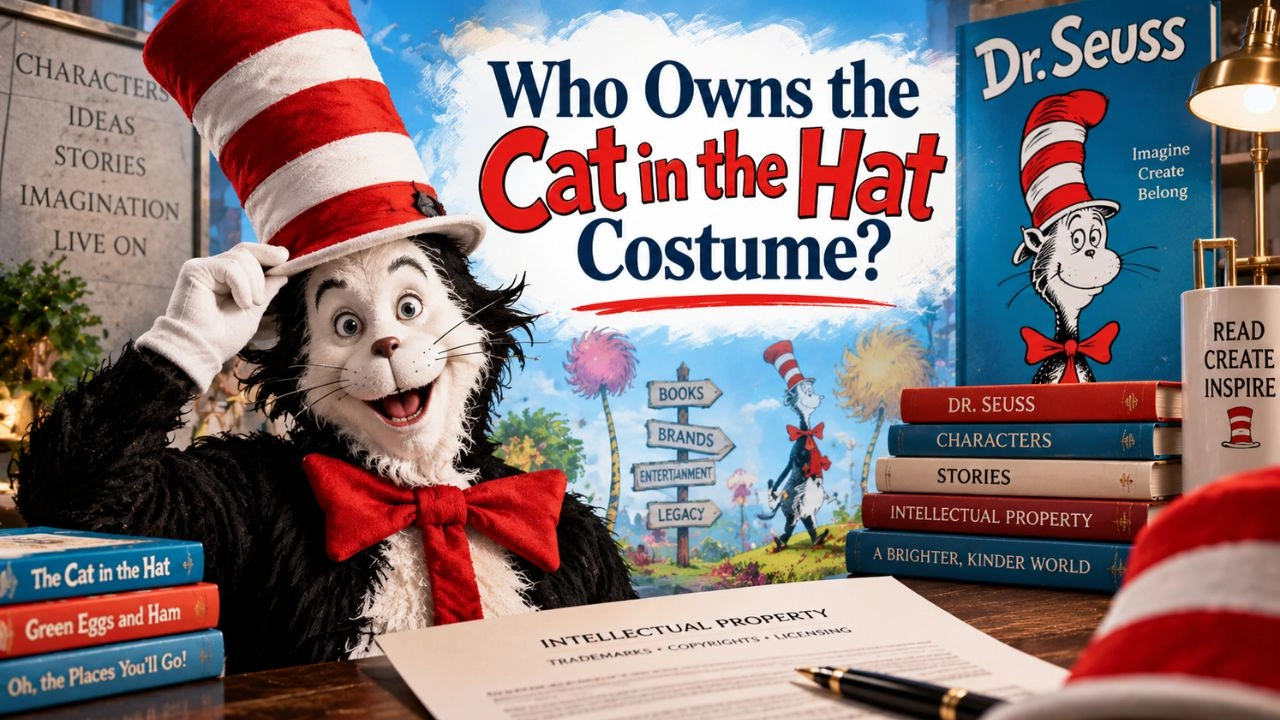
Every Halloween, millions of people slip on a tall red-and-white striped hat and call themselves the Cat in the Hat. It is one of the most recognized costumes in the world — instantly identifiable, endlessly fun, and deceptively simple. But behind that iconic hat sits one of the most carefully protected intellectual properties in the history of children’s entertainment. So who actually owns the Cat in the Hat costume — and what can you legally do with it?
The answer involves a beloved author, his protective widow, a nonprofit foundation, and a company that has turned a children’s book into a billion-dollar global empire.
What Is the Cat in the Hat?
The Cat in the Hat is a children’s book written and illustrated by Theodor Seuss Geisel — better known to the world as Dr. Seuss — and first published on March 12, 1957. The title character is a tall, mischievous anthropomorphic cat best known for his signature red-and-white striped stovepipe hat and his red bow tie. The book sold over one million copies in its first year alone and launched one of the most recognized characters in the history of children’s literature.
The Cat in the Hat is not just a book. It is a trademark, a copyright, a trade dress, and a carefully licensed brand that touches everything from theme parks and animated films to apparel, jewelry, and yes — costumes. Every single one of those commercial uses is controlled by one entity: Dr. Seuss Enterprises, L.P.
Who Owns the Cat in the Hat Intellectual Property?
Dr. Seuss Enterprises, L.P. is the company that owns and controls all intellectual property connected to The Cat in the Hat — including its characters, visual designs, trademarks, and copyrights. This means Dr. Seuss Enterprises is the legal owner of the Cat in the Hat character, the iconic striped hat design, the name, and every commercial use of the image — including officially licensed Cat in the Hat costumes.
Dr. Seuss Enterprises, L.P. is a California limited partnership founded in 1993 by Audrey S. Geisel, the widow of Theodor Seuss Geisel. It was created two years after Dr. Seuss died in 1991, to centralize and protect all of his characters, stories, and brand. The company holds the copyrights to his literary and artistic works, manages trademarks on character names and visual designs, and licenses the Dr. Seuss brand for everything from animated films to theme park attractions, stage productions, and merchandise.
Ownership and Key Stakeholders Table
| Party | Role | Ownership / Interest | Key Detail |
|---|---|---|---|
| Dr. Seuss Enterprises, L.P. | Ultimate IP Owner | Virtually all copyrights & trademarks | California limited partnership; owns Cat in the Hat brand globally |
| Geisel-Seuss Enterprises, Inc. (GSE) | General Partner | 1% interest; controls day-to-day ops | S-corporation acting as managing general partner of the LP |
| Dr. Seuss Foundation | Nonprofit Partner | 4.40% interest (since January 2020) | Nonprofit that funnels profits into literacy programs |
| Susan Brandt | President & CEO | No disclosed ownership | Leads Dr. Seuss Enterprises since 1998; manages all licensing |
| Audrey S. Geisel (deceased) | Founder | Founded in 1993; died December 19, 2018 | Dr. Seuss’s widow; built the company; entire business transferred to foundation at her death |
| Warner Bros. Pictures | Film Licensing Partner | No ownership; licensee for film rights | Co-producing 2026 animated Cat in the Hat film with Dr. Seuss Enterprises |
| WildBrain CPLG | Global Licensing Agent | No ownership; licensing partner | Managing Cat in the Hat licensing across UK, Europe, and Asia-Pacific |
| Licensed costume manufacturers | Commercial Producers | No ownership; pay royalties | Must obtain formal license from Dr. Seuss Enterprises to produce Cat in the Hat costumes |
The Story Behind the Ownership: Audrey Geisel’s Big Bet
Theodor Seuss Geisel died on September 24, 1991, at the age of 87, leaving behind no biological children. His second wife Audrey Geisel inherited an estate worth approximately $75 million through marital trusts. But Audrey was not content to simply collect royalties and let the brand coast on its own legacy.
In 1993, she founded Dr. Seuss Enterprises, L.P. — transforming a loose collection of literary rights into a professionally managed corporate entity. She created Geisel-Seuss Enterprises, Inc. as the general partner to handle day-to-day operations, giving the structure both liability protection and long-term estate planning flexibility. Under her leadership, the Dr. Seuss brand expanded from books into films, television, theme parks, digital games, licensed products, and international markets.
Audrey famously served as the fierce “gatekeeper” of the brand. She is said to have rejected any licensing request that felt off-brand, reportedly saying: “I don’t want the Cat in the Hat in a bad part of town.” She scrutinized every deal personally — rejecting cheap merchandise, fast-food tie-ins, and anything she felt would embarrass her late husband’s legacy.
Audrey Geisel died on December 19, 2018, at age 97. At her death, the entire business transferred to the Dr. Seuss Foundation — a nonprofit dedicated to literacy programs. Today, the enterprise generates an estimated $33–35 million annually and is run by Susan Brandt, who has served as President and CEO since 1998.
So Who Owns Cat in the Hat Costumes Specifically?
This is the question most people actually want answered — and the legal answer is precise and important.
Dr. Seuss Enterprises owns the copyright to the Cat in the Hat character, the trademark on the name “Cat in the Hat,” and the trade dress of the character’s distinctive visual appearance — including the red-and-white striped stovepipe hat, the red bow tie, and the character’s overall look. Courts have confirmed that these rights are fully enforceable. A 1997 Ninth Circuit ruling in Dr. Seuss Enterprises v. Penguin Books USA affirmed that Dr. Seuss Enterprises owns both the common law trademark rights to the words “Cat in the Hat” and the character illustration of the Cat’s stovepipe hat.
This means: any manufacturer who wants to legally produce and sell a Cat in the Hat costume must obtain a formal license from Dr. Seuss Enterprises and pay royalties on every unit sold. Major costume companies including Rubies Costume Co. hold such licenses. If you buy an officially licensed Cat in the Hat costume at a major retailer, that product has been approved by and generates revenue for Dr. Seuss Enterprises.
For personal, non-commercial use — making a costume for yourself, for a school play, or for a private Halloween party — you do not need a license. Copyright law allows individuals to make personal costume items for private, non-commercial purposes. The moment you start selling that costume, however, you cross into territory that requires permission from Dr. Seuss Enterprises.
Is the Cat in the Hat Public Domain?
No — and this is one of the most common misconceptions people have. The Cat in the Hat, first published in 1957, is not in the public domain in the United States. Under current U.S. copyright law, works published after 1928 are protected for the life of the author plus 70 years. Since Theodor Geisel died in 1991, the copyright on The Cat in the Hat will not expire until at least 2061 — meaning it will remain fully protected for decades to come.
Until that date, Dr. Seuss Enterprises maintains full control over all commercial uses of the character and costume — including film adaptations, merchandise, and officially licensed dress-up products.
Does Disney Own the Cat in the Hat?
No — and this rumor needs to be put to rest permanently. Disney does not own The Cat in the Hat or Dr. Seuss Enterprises. The confusion largely stems from comedian Katt Williams, who revealed in an interview that he received a cease and desist letter from Disney when he was performing as “Katt in the Hat.” Legal experts believe Disney may have had a temporary or exploratory deal with Dr. Seuss Enterprises at that time — but no permanent rights were ever transferred. Disney has never owned the Cat in the Hat at any point in its history.
The current film partner for The Cat in the Hat is Warner Bros. Pictures, which picked up the rights in January 2018 and is releasing an animated feature film on November 6, 2026 — co-produced with Dr. Seuss Enterprises, directed by Alessandro Carloni and Erica Rivinoja, and starring Bill Hader as the voice of the Cat.
What Is Happening With the Cat in the Hat in 2026?
The Cat in the Hat brand is currently experiencing one of its biggest moments in decades — driven by the upcoming Warner Bros. animated film and a massive global licensing expansion.
Dr. Seuss Enterprises and WildBrain CPLG are expanding their licensing programs for The Cat in the Hat across the UK, Europe, and Asia-Pacific in anticipation of the film’s November 2026 debut and the character’s 70th anniversary celebrations in 2027. New licensees include apparel companies in Turkey and France, kitchen textile brands in the Gulf region, pet product companies in Spain, and a jewelry collection through Singapore-based Gnoce Trading — the first Dr. Seuss licensee in the Asia-Pacific region. Every single one of these partnerships requires formal licensing approval from Dr. Seuss Enterprises.
Frequently Asked Questions (FAQs)
Q1. Who owns the Cat in the Hat costume rights?
Dr. Seuss Enterprises, L.P. owns all copyright, trademark, and trade dress rights to the Cat in the Hat character and its iconic costume design.
Q2. Can I legally make a Cat in the Hat costume for personal use?
Yes — making a costume for personal, non-commercial use such as Halloween or a school play is permitted under copyright law without a license.
Q3. Do I need a license to sell Cat in the Hat costumes?
Yes. Any commercial manufacturing or selling of Cat in the Hat costumes requires a formal license and royalty agreement with Dr. Seuss Enterprises.
Q4. Is the Cat in the Hat in the public domain?
No. The Cat in the Hat (1957) is protected by copyright until at least 2061 — 70 years after Dr. Seuss died in 1991.
Q5. Does Disney own the Cat in the Hat?
No. Disney has never owned The Cat in the Hat. The current film partner is Warner Bros. Pictures, which is releasing an animated Cat in the Hat film on November 6, 2026.
Q6. Who founded Dr. Seuss Enterprises?
Audrey S. Geisel, the widow of Dr. Seuss, founded Dr. Seuss Enterprises, L.P. in 1993, two years after her husband’s death in 1991.
Q7. Who runs Dr. Seuss Enterprises today?
Susan Brandt has served as President and CEO of Dr. Seuss Enterprises since 1998, managing the brand’s global licensing and partnerships.
Q8. Who is making the 2026 Cat in the Hat movie?
The 2026 Cat in the Hat animated film is a joint production between Warner Bros. Pictures Animation and Dr. Seuss Enterprises, releasing on November 6, 2026, with Bill Hader voicing the Cat.
The Cat in the Hat costume — and every commercial use of the character — is owned and controlled by Dr. Seuss Enterprises, L.P., a California limited partnership founded in 1993 by Audrey Geisel and currently run by CEO Susan Brandt. The company holds full copyright, trademark, and trade dress rights over the Cat in the Hat character and its iconic striped hat — rights that will not expire until at least 2061 under current U.S. copyright law.
Officially licensed costumes are manufactured by companies that pay royalties to Dr. Seuss Enterprises. Personal non-commercial costume use is permitted. Commercial manufacturing or selling of unlicensed costumes is a copyright and trademark infringement. And the brand itself — far from coasting on nostalgia — is actively expanding globally, with a major Warner Bros. animated film arriving in November 2026 and new licensing deals across four continents.