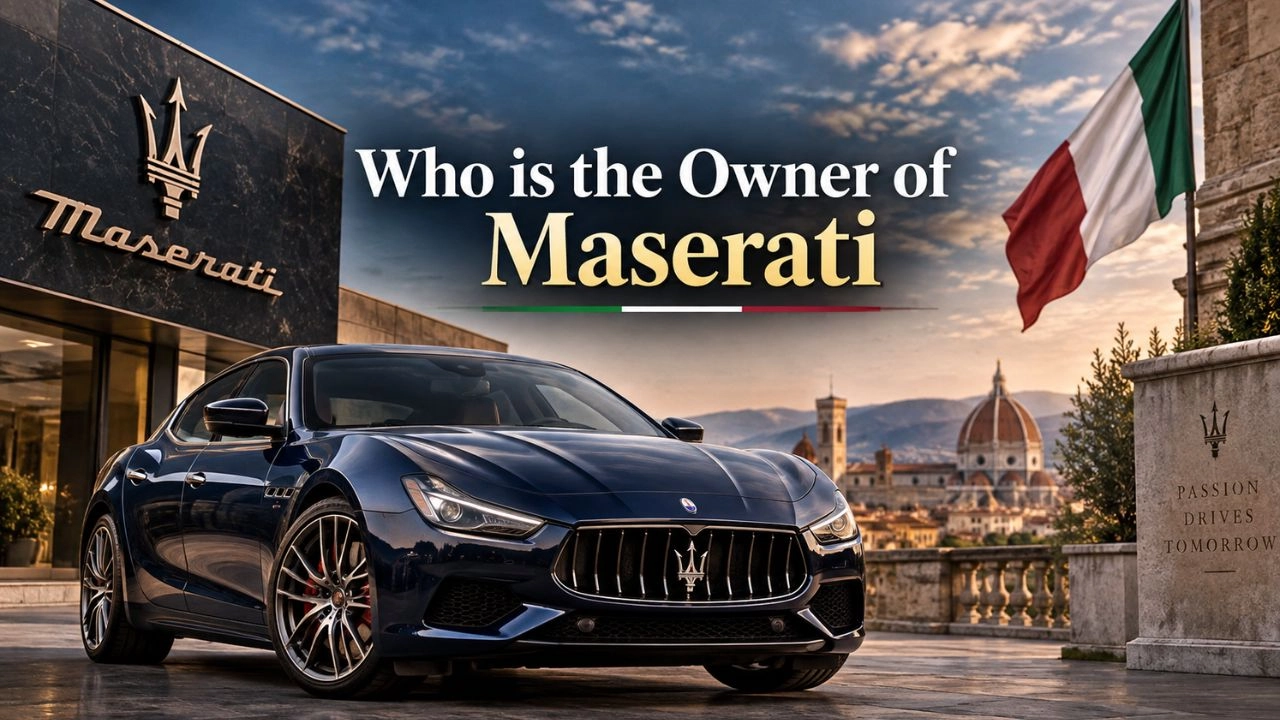
The Maserati trident is one of the most recognizable symbols in the entire automotive world — a badge that carries more than a century of Italian craftsmanship, racing heritage, and pure mechanical drama.
But behind every GranTurismo, every Quattroporte, and every Levante is an ownership structure that has changed hands more times than almost any other luxury brand in history. Today, in 2026, the story of who owns Maserati runs through one of the most powerful automotive conglomerates on the planet — and two of Europe’s most famous industrial dynasties.
Who Owns Maserati in 2026?
Maserati is 100% owned by Stellantis N.V. — one of the world’s largest automotive companies, publicly traded on the New York Stock Exchange (NYSE: STLA), Euronext Paris, and Borsa Italiana in Milan. Stellantis was formed on January 16, 2021, through a landmark all-share merger between Fiat Chrysler Automobiles (FCA) and the French PSA Group. Maserati came into Stellantis from the FCA side of that merger, where it had been positioned as the group’s dedicated luxury performance brand.
Maserati S.p.A. operates as a wholly owned subsidiary of Stellantis, maintaining its own design studio, engineering team, and product identity — while benefiting from Stellantis’ global resources, technology platforms, and manufacturing capabilities. The brand remains headquartered in Modena, Italy, where it has been based since moving from Bologna decades ago.
Ownership and Key Stakeholders Table
| Owner / Party | Role | Stake | Key Detail |
|---|---|---|---|
| Stellantis N.V. (NYSE: STLA) | Direct 100% Owner of Maserati | Full ownership | Publicly traded; formed January 2021 from FCA + PSA merger |
| Exor N.V. (Agnelli Family) | Largest Shareholder of Stellantis | ~15.5% equity, ~24% voting power | Italian industrial dynasty; controls Stellantis via loyalty voting |
| Peugeot Invest (Peugeot Family) | Second Largest Family Shareholder | ~7.7% equity, ~12% voting power | French automotive dynasty; legacy PSA family shareholder |
| Bpifrance Participations | Third Largest Shareholder | ~6.2% equity, ~10% voting power | French government investment arm; strategic state stakeholder |
| BlackRock | Largest Institutional Investor | ~3.3% of Stellantis | World’s biggest asset manager; holds 96.9 million Stellantis shares |
| Vanguard Group | Institutional Investor | Significant STLA stake | Passive index fund giant; consistent Stellantis holder |
| Public / Retail Shareholders | Free Float | ~66% of Stellantis shares | Broad public ownership across NYSE, Euronext, and Borsa Italiana |
| Santo Ficili | CEO of Maserati (from July 2026) | Management role | Also serves as CEO of Alfa Romeo; appointed July 2026 |
| Antonio Filosa | CEO of Stellantis | Group leadership | Leads overall Stellantis strategy since early 2025 |
| John Elkann | Chairman of Stellantis | Board control via Exor | Head of Agnelli family’s Exor holding company |
The Origin Story: Five Brothers and a Trident
Maserati has one of the most romantic founding stories in automotive history — and it begins not with one man, but with five brothers who all shared the same passion for speed.
Officine Alfieri Maserati S.p.A. was founded on December 1, 1914 in Bologna, Italy, by the Maserati brothers — Alfieri, Bindo, Carlo, Ettore, and Ernesto. The eldest, Carlo, was a racing driver who died young. Alfieri became the driving creative force of the early company, building racing cars that competed at the highest levels of European motorsport. The company’s very first major products were spark plugs for aircraft engines during World War I — a humble start for a brand that would one day define Italian automotive luxury.
The Maserati trident emblem was designed in 1920 by Mario Maserati — a fourth brother not otherwise connected to the company — modeled after the trident held by the Roman god Neptune in a famous statue in Bologna’s Piazza Maggiore. That symbol has remained unchanged for over 100 years and is still on every Maserati made today.
Alfieri Maserati died in 1932, and the family sold the company in 1937 to the Orsi family of Modena. The founding brothers stayed on as employees until 1947 before leaving to start a new venture. From that point forward, Maserati passed through several different hands — each chapter transforming the brand in different ways.
The Ownership Journey: From the Orsi Family to Stellantis
Maserati’s ownership history is one of the most complex in the automotive world — a story of corporate rescues, family dynasties, racing ambitions, and billion-dollar mergers.
The Orsi family ran Maserati from 1937 to 1968, during which the brand produced some of its most legendary road and racing cars. In 1968, the Citroën group acquired Maserati and injected significant investment — but when Citroën itself collapsed financially in 1975, Maserati nearly went bankrupt and closed its doors entirely. The Italian government stepped in to keep the company alive, and by 1975, Alejandro De Tomaso — an Argentine-born businessman — took control and ran the brand for over a decade.
Fiat entered the picture in 1993, acquiring Maserati and beginning a slow but steady process of reviving the brand’s prestige. In approximately 1997, Fiat turned management of Maserati over to Ferrari — a former rival that Fiat also controlled. Under Ferrari’s stewardship, Maserati re-entered the American market in 2002 with the Spyder, and the brand began its modern revival.
In 2005, Fiat took Maserati back from Ferrari and grouped it with Alfa Romeo as the group’s dedicated luxury arm. When Fiat merged with Chrysler in 2014 to form Fiat Chrysler Automobiles (FCA), Maserati became part of that larger structure. Then, on January 16, 2021, FCA merged with the French PSA Group to form Stellantis — and Maserati arrived at its current home.
Who Really Controls Maserati? The Agnelli Family’s Role
Because Maserati is owned by Stellantis and Stellantis is publicly traded, the question of who truly controls it goes deeper than just who owns the most shares.
The most powerful single force inside Stellantis — and therefore over Maserati — is the Agnelli family of Italy, operating through their holding company Exor N.V. As of June 2026, Exor holds approximately 15.5% of Stellantis equity and 449.4 million shares. But thanks to Stellantis’ loyalty voting mechanism — which grants extra votes to long-held shares — Exor’s actual voting power is closer to 24%, making it the decisive force in major corporate decisions.
Exor is led by John Elkann, grandson of the legendary Gianni Agnelli and heir to one of Italy’s greatest industrial dynasties. Elkann serves as Chairman of Stellantis and has been instrumental in shaping the company’s direction since the 2021 merger. The Peugeot family holds the second-largest anchor stake at approximately 7.7% (voting power ~12%), while the French government via Bpifrance holds about 6.2% (voting power ~10%).
The result is a company where two founding European families — one Italian, one French — jointly guide the strategic direction of the world’s largest automotive group, with Maserati sitting at the very top of their luxury portfolio.
Maserati’s Leadership in 2026: New CEO Appointed
Maserati entered 2026 with a significant leadership change that signals how Stellantis is reorganizing its premium brands for the next decade.
In July 2026, Stellantis appointed Santo Ficili as CEO of Maserati — a role he holds simultaneously with his position as CEO of Alfa Romeo. This dual-brand leadership arrangement places two of Italy’s most iconic automotive names under a single executive, reflecting Stellantis’ strategy of streamlining its management structure while preserving the distinct identity of each brand. Ficili previously led Alfa Romeo through several years of product transformation and brand repositioning.
Stellantis has confirmed that Maserati is not for sale and is actively in talks with strategic partners to bring new technology and investment to future models — a clear signal that the brand’s next chapter inside Stellantis is focused on electrification and premium product development, not divestment.
Where Are Maserati Cars Made?
Maserati has maintained its Italian identity throughout every ownership change in its history. The brand’s design, engineering, and production remain entirely based in Italy, with manufacturing centered in Modena and Turin.
The Modena facility — known as the Maserati Innovation Lab — handles engineering and production of the brand’s sports and grand touring models, including the MC20 supercar. Production figures reflect the brand’s deliberate exclusivity: Maserati produced approximately 26,600 units in 2023, a number kept intentionally limited to protect the brand’s luxury positioning. Revenue reached €2.3 billion in 2023, with approximately 2,265 employees worldwide.
Frequently Asked Questions (FAQs)
Q1. Who owns Maserati in 2026?
Maserati is 100% owned by Stellantis N.V. — a publicly traded global automotive company (NYSE: STLA) formed in January 2021.
Q2. Who founded Maserati and when?
Maserati was founded on December 1, 1914 in Bologna, Italy, by the five Maserati brothers — Alfieri, Bindo, Carlo, Ettore, and Ernesto.
Q3. Is Maserati owned by Ferrari?
No. Ferrari managed Maserati from approximately 1997 to 2005, but Fiat took it back in 2005. Ferrari and Maserati are now completely separate companies.
Q4. Who is the CEO of Maserati in 2026?
Santo Ficili was appointed CEO of Maserati in July 2026, while also serving as CEO of Alfa Romeo under Stellantis’ reorganized leadership structure.
Q5. Who are the biggest shareholders of Stellantis, Maserati’s parent?
The largest shareholders are the Agnelli family’s Exor N.V. (~15.5%), the Peugeot family (~7.7%), Bpifrance (French government, ~6.2%), and BlackRock (~3.3%).
Q6. Is Maserati for sale?
No. Stellantis has officially confirmed that Maserati is not for sale and is actively investing in the brand’s future through strategic partnerships and electrification.
Q7. Where are Maserati cars manufactured?
All Maserati vehicles are designed, engineered, and manufactured in Italy, with production centered in Modena and Turin.
Q8. How many Maserati cars are produced each year?
Maserati produced approximately 26,600 units in 2023, keeping production intentionally limited to preserve its exclusivity as a genuine luxury brand.
Maserati is 100% owned by Stellantis N.V. — the global automotive giant formed in January 2021 through the merger of Fiat Chrysler Automobiles and the French PSA Group. Stellantis itself is publicly traded on the NYSE (ticker: STLA), Euronext Paris, and Borsa Italiana. The most powerful force inside Stellantis — and therefore over Maserati — is the Agnelli family’s Exor N.V., holding ~15.5% of equity and ~24% of votes, led by Chairman John Elkann.
Maserati was founded in Bologna, Italy on December 1, 1914 by the Maserati brothers — and despite passing through the hands of the Orsi family, Citroën, De Tomaso, Fiat, Ferrari, and FCA over more than a century, it has never lost its soul as the most distinctly Italian of all luxury car brands. Under new CEO Santo Ficili, appointed in July 2026, Maserati is entering its next chapter — fully electric, fully Italian, and still wearing the trident.