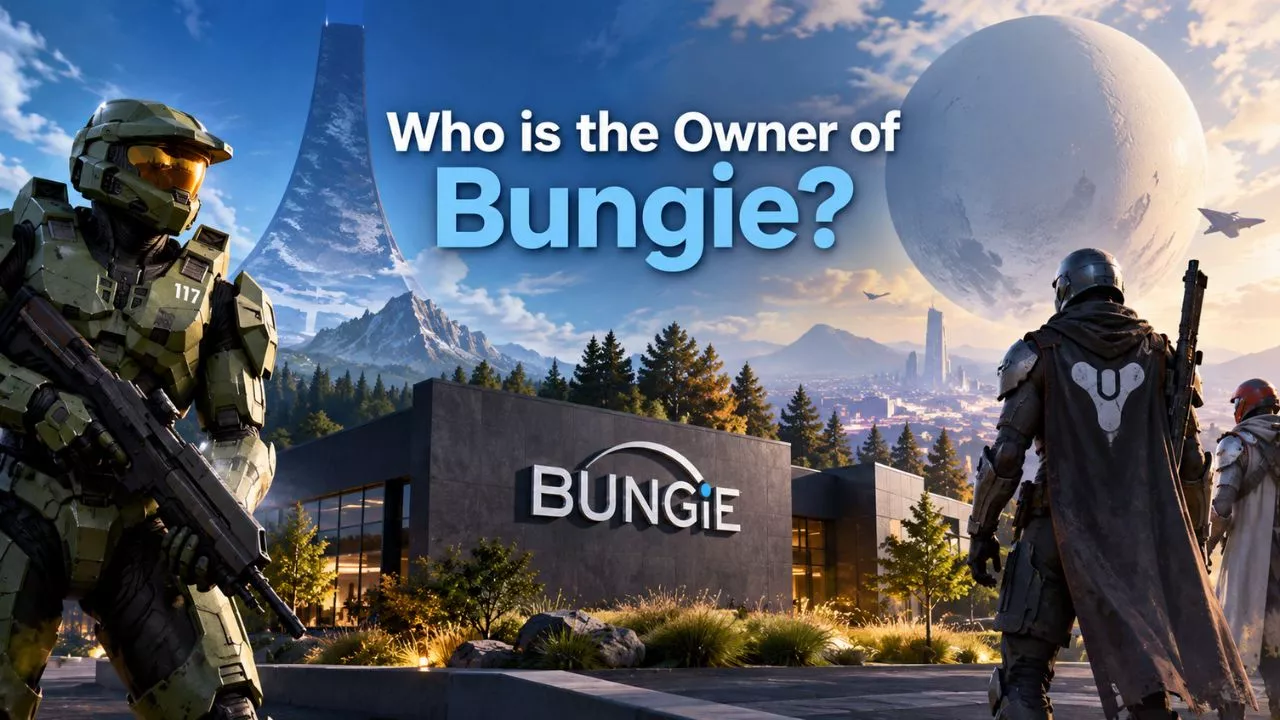
Bungie is one of the most important names in the history of video games. It created Halo — the franchise that defined the original Xbox — and then Destiny, the game that pioneered the live-service model for console shooters.
But the story of who owns Bungie in 2026 is one of the most dramatic and turbulent ownership tales in all of gaming — involving a $3.6 billion acquisition that has since been written down by $765 million, multiple rounds of devastating layoffs, and a studio that is fighting to rebuild its identity under new leadership.
Who Owns Bungie in 2026?
Bungie is currently owned by Sony Interactive Entertainment (SIE) — the gaming division of Sony Group Corporation, the Japanese multinational technology and entertainment conglomerate. Sony completed its acquisition of Bungie on July 15, 2022, in a deal valued at approximately $3.6 billion, bringing the studio under the PlayStation Studios umbrella.
Bungie operates as an independent subsidiary of Sony Interactive Entertainment. This means Sony owns it completely, but Bungie retains its own brand identity, publishes its own games, and releases them across multiple platforms — not just PlayStation. Its games are not PlayStation-exclusive, which was a deliberate and publicly stated part of the acquisition agreement from day one.
Ownership and Key Stakeholders Table
| Owner / Party | Role | Stake | Key Detail |
|---|---|---|---|
| Sony Interactive Entertainment (SIE) | Parent Company & Full Owner | 100% of Bungie | Acquisition completed July 15, 2022 for ~$3.6 billion |
| Sony Group Corporation | Ultimate Parent | Owns 100% of SIE | Japanese multinational; listed on Tokyo Stock Exchange (6758) |
| Poria Torkan | Current Studio Lead | Management role | Former VP of Operations; appointed June 2026 after Justin Truman stepped down |
| Justin Truman | Former Studio Chief | Management role (exited) | Replaced Pete Parsons in 2025; stepped down June 2026 |
| Pete Parsons | Former CEO | Exited 2025 | Co-led Bungie for over two decades; departed after revenue shortfalls |
| Microsoft | Former Owner | Fully exited 2007 | Owned Bungie 2000–2007; developed Halo under Microsoft ownership |
| Activision | Former Publisher Partner | No current stake | Publishing partner 2010–2019; Bungie split from Activision in January 2019 |
The Origin Story: Chicago, 1991
Bungie was founded in 1991 in Chicago, Illinois by Alex Seropian and Jason Jones as a game developer for Macintosh computers. The company relocated to Redmond, Washington and spent its early years building a reputation as a technically skilled developer with ambitious creative vision.
Its early hits — including the Marathon trilogy and Myth series — built a loyal fanbase. But it was the first-person shooter Halo: Combat Evolved, unveiled at the 1999 Macworld Expo by Steve Jobs himself, that changed everything.
Apple was expected to publish it, but Bungie was acquired by Microsoft in June 2000 for an estimated $30 million, and Halo became the killer app that launched the original Xbox in 2001.
Bungie spent seven years at Microsoft, releasing Halo 2, Halo 3, and Halo 3: ODST — building one of the most valuable franchise in gaming history. Then in 2007, Bungie negotiated its independence from Microsoft and became a privately held company again, leaving Halo behind and eventually partnering with Activision on a new project.
The Road to Sony: Activision, Destiny, and Independence
After splitting from Microsoft, Bungie signed a decade-long publishing deal with Activision in April 2010 and spent the next four years creating Destiny — a groundbreaking online shared-world shooter that launched in 2014. Destiny was one of the most ambitious games ever made and built a passionate global community.
The Activision relationship was often rocky, and in January 2019, Bungie announced it had parted ways with Activision and reclaimed full publishing rights to the Destiny franchise. For two years, Bungie operated as a fully independent developer and publisher — a rare position for a studio of its size.
Then came Sony’s approach. On January 31, 2022, Sony Interactive Entertainment announced it had agreed to acquire Bungie for approximately $3.6 billion. The deal was positioned as giving Sony access to world-class live-service game expertise — the kind of experience Bungie had spent a decade building with Destiny 2. The acquisition closed on July 15, 2022.
The Turbulent Post-Acquisition Years
What followed the Sony acquisition was one of the most painful stretches in Bungie’s history.
In October 2023, Bungie cut approximately 100 jobs — roughly 8% of its staff — after Destiny 2 revenue fell significantly short of internal targets. Then on July 31, 2024, Bungie announced a far larger second round of layoffs, cutting 220 employees — about 17% of its remaining workforce. A further 155 employees were transferred out of Bungie and into roles directly within Sony Interactive Entertainment.
CEO Pete Parsons announced the 2024 cuts, calling them a “necessary decision to refocus our studio.” The public reaction was brutal.
It emerged that Parsons had allegedly spent over $2.3 million on classic cars following the Sony acquisition — a revelation that triggered widespread calls for his resignation. By 2025, Parsons stepped down. Justin Truman, Destiny 2’s general manager and Bungie’s chief development officer, was named Studio Chief — with Bungie deciding it would have no CEO going forward.
The June 2026 Crisis: Mass Layoffs and a $765 Million Writedown
The most dramatic chapter in Bungie’s post-acquisition story happened just months ago — on June 25, 2026.
Sony wrote down the value of its Bungie acquisition by $765 million, acknowledging that the studio had significantly underperformed against the financial targets that justified the original $3.6 billion purchase price.
On the same day, Bungie announced its largest ever round of layoffs — approximately 400 employees, representing nearly 50% of its remaining staff of about 800 people. A Washington State WARN notice confirmed at least 292 Bellevue-based employees faced termination effective July 9, 2026.
The cuts hit virtually every part of the studio — art, gameplay design, narrative, visual effects, quality assurance, and analytics. The Destiny 2 live service, which had been running for nearly 9 years, was effectively wound down. Studio lead Justin Truman stepped down simultaneously, with former VP of Operations Poria Torkan — previously a producer at Guerrilla Games — taking over as the new studio lead.
Bungie published a statement acknowledging that Destiny 2 had “fell short of expectations” in recent years. The game’s official social media pages confirmed the end of its long-running live-service era.
What Happens Next: Marathon and Bungie’s Future Under Sony
Despite the chaos of 2026, Bungie still has a future — and it centers on Marathon, the studio’s ambitious new PvP extraction shooter set in the same sci-fi universe as its 1994 classic.
Marathon was one of the most anticipated new IP announcements in gaming when Bungie revealed it in 2023.
The game has faced multiple delays — originally targeting 2025, then pushed further — but remains in active development. With Destiny 2’s live service now winding down, Marathon carries the enormous weight of being Bungie’s primary vehicle for survival and relevance inside Sony’s ecosystem.
Sony has been clear that it intends to keep Bungie operational and that the studio retains its multi-platform publishing model. Marathon is expected to release on PlayStation, Xbox, and PC — maintaining the cross-platform philosophy that has defined Bungie since its split from Microsoft in 2007.
Frequently Asked Questions (FAQs)
Q1. Who owns Bungie in 2026?
Bungie is fully owned by Sony Interactive Entertainment (SIE), a subsidiary of Sony Group Corporation, following a $3.6 billion acquisition completed on July 15, 2022.
Q2. Did Microsoft ever own Bungie?
Yes. Microsoft acquired Bungie in June 2000 for approximately $30 million, owning it until 2007 when Bungie negotiated its independence and left Halo behind.
Q3. Who is the current leader of Bungie in 2026?
Poria Torkan, former VP of Operations and ex-Guerrilla Games producer, became Bungie’s studio lead in June 2026 after Justin Truman stepped down.
Q4. Why did Sony write down the Bungie acquisition?
Sony wrote down Bungie’s value by $765 million in 2026 because Destiny 2 repeatedly missed internal revenue targets and the studio significantly underperformed against the financial projections made at the time of the $3.6 billion acquisition.
Q5. How many employees did Bungie lay off in 2026?
In June 2026, Bungie laid off approximately 400 employees — nearly 50% of its remaining workforce of about 800 people — primarily gutting the Destiny 2 development team.
Q6. Are Bungie’s games PlayStation-exclusive under Sony ownership?
No. Bungie retained its multi-platform publishing model as part of the Sony acquisition deal. Its games — including the upcoming Marathon — will release on PlayStation, Xbox, and PC.
Q7. What happened to Bungie CEO Pete Parsons?
Pete Parsons stepped down in 2025 following years of revenue shortfalls, multiple rounds of layoffs, and public controversy over reports that he had spent over $2.3 million on classic cars following the Sony acquisition.
Q8. What is Bungie working on in 2026?
Bungie is currently developing Marathon — a PvP extraction shooter set in the same sci-fi universe as the studio’s 1994 original — which represents its primary focus following the wind-down of Destiny 2’s live-service era.
Bungie is 100% owned by Sony Interactive Entertainment, a subsidiary of Sony Group Corporation of Japan. Sony acquired Bungie on July 15, 2022 for $3.6 billion — a purchase that has since been written down by $765 million following years of Destiny 2 revenue shortfalls and multiple devastating rounds of layoffs.
The studio’s founding CEO Pete Parsons departed in 2025, his successor Justin Truman stepped down in June 2026, and Poria Torkan now leads the studio through its most challenging period in history.
Bungie retains its independent subsidiary status — publishing its own games across multiple platforms — and its future is now entirely staked on Marathon, the new extraction shooter it hopes will restore its reputation and financial position inside Sony’s gaming empire.