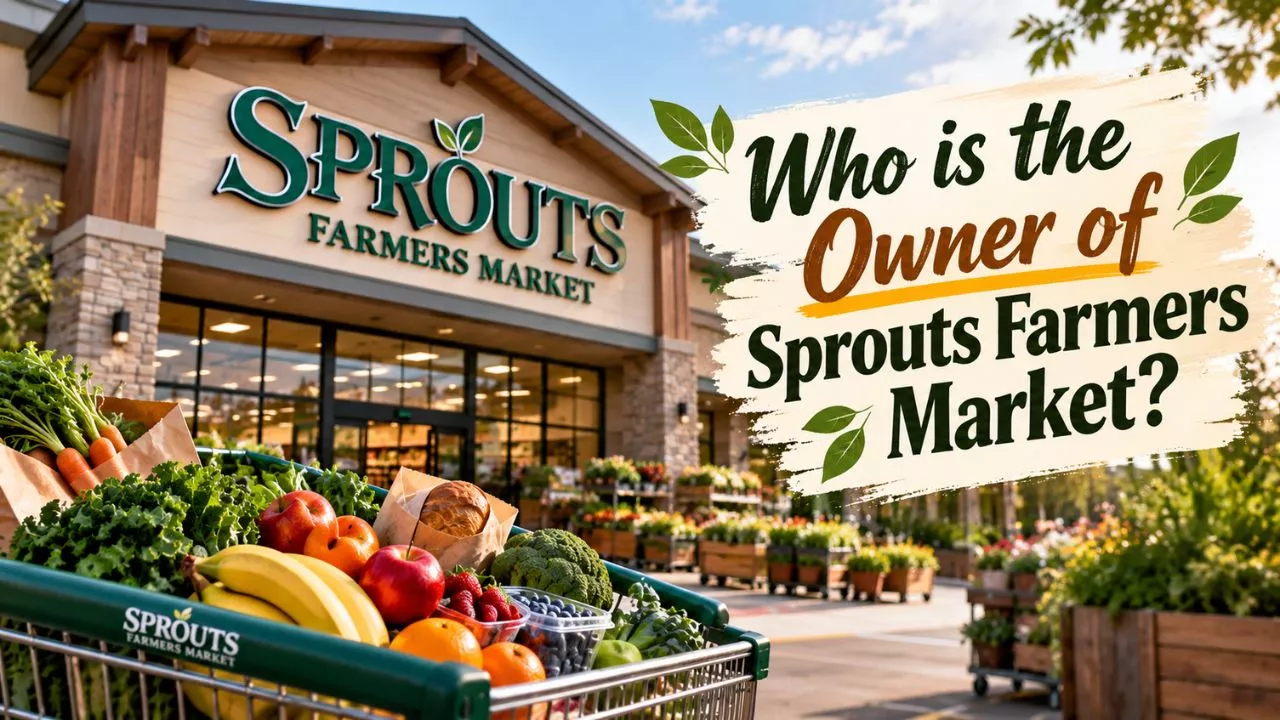
Walk into a Sprouts Farmers Market and you will notice immediately that it feels different from most grocery stores. The bulk bins, the wide organic produce section, the vitamins wall, the seed-oil-free snack labels — it is designed for a specific kind of shopper.
But behind that carefully curated health-food identity is an ownership story that is refreshingly straightforward compared to most major grocery chains. Sprouts has no corporate parent pulling strings, no private equity firm skimming off the top, and no retail giant calling the shots. It is one of the few major American grocery chains that genuinely stands alone.
Who Owns Sprouts Right Now in 2026?
Sprouts Farmers Market, Inc. is a publicly traded, independent company listed on the NASDAQ stock exchange under the ticker symbol SFM. There is no parent company, no controlling shareholder, and no single individual who owns enough to dictate the company’s direction.
Ownership is spread across thousands of institutional investors, retail shareholders, and a small number of company insiders.
This structure puts Sprouts in a very different position from its closest competitor in the organic grocery space. Unlike Whole Foods, which is a fully owned subsidiary of Amazon, Sprouts answers only to its shareholders — and no single shareholder comes close to a controlling stake.
Ownership and Key Shareholders Table
| Shareholder | Type | Stake | Key Detail |
|---|---|---|---|
| FMR LLC (Fidelity) | Largest Institutional Shareholder | ~13.29% | Largest single institutional holder as of June 2026; manages Fidelity funds |
| BlackRock, Inc. | Institutional Shareholder | ~9.0% | World’s largest asset manager; reported 8.5M shares as of June 30, 2026 |
| Vanguard Group | Institutional Shareholder | ~9.74% | Passive index fund giant; second-largest named holder |
| Nordea Investment Management | Institutional Shareholder | ~3.50% | Nordic asset management firm with consistent SFM holding |
| State Street Investment Management | Institutional Shareholder | ~3.35% | Manages SPDR ETFs; major passive holder |
| Norges Bank Investment Management | Sovereign Wealth Fund | ~3.21% | Norway’s Government Pension Fund Global |
| Jack Sinclair | CEO & Insider | ~0.29% | Current CEO; holds 269,980 shares valued at ~$18M |
| Nick Konat | President, COO & Insider | ~0.07% | Named incoming CEO effective January 4, 2027 |
| Shon A. Boney | Insider (Co-Founder family) | ~0.11% | Member of the founding Boney family; retains small insider stake |
| Apollo Global Management | Former Owner | Fully exited by 2013 IPO | Held majority stake 2011–2013; sold all shares after IPO |
The Origin Story: A Family, a Fruit Stand, and a Fresh Idea
The Sprouts story starts not with private equity or Wall Street, but with a family that had been selling fresh, affordable produce in Southern California for generations.
The Boney family had been running small-format grocery stores in California since the 1940s. By 1997, their stores were rebranded as Henry’s Farmers Market — a chain focused on fresh, affordable produce in a farmers-market-style format.
Then, on July 19, 2002, three members of the family — Stan Boney, Shon Boney, and Kevin Easler — opened the very first Sprouts Farmers Market in Chandler, Arizona.
The format was deliberately simple: a smaller footprint than a typical supermarket, produce at the center of the store, bulk bins, natural and organic products, and prices positioned well below Whole Foods.
The concept took off quickly. Sprouts expanded across Arizona and into neighboring states, building a loyal base of health-conscious shoppers who wanted organic and natural foods without paying a premium-brand premium.
How Apollo Management Came In — And Left
In February 2011, private equity giant Apollo Global Management acquired a majority stake in Sprouts Farmers Market for $214 million — approximately 58.5% of the company.
At the same time, Apollo purchased Henry’s Farmers Market from Smart & Final (another Apollo portfolio company) and merged it with Sprouts, reuniting the Boney family’s legacy brands under one roof and rebranding all locations as Sprouts.
The move accelerated expansion significantly. Under Apollo’s ownership, Sprouts grew from a regional Arizona chain into a multi-state operation with a standardized format, professional supply chain, and enough scale to justify a public listing.
On August 1, 2013, Sprouts Farmers Market went public on the NASDAQ, pricing its IPO at $18 per share.
The offering valued the company at approximately $1.5 billion. Apollo gradually sold down its position following the IPO and eventually exited completely — leaving Sprouts as a fully independent public company with no controlling shareholders from its private equity era.
Sprouts vs. Its Grocery Rivals: A Different Ownership Model
The American grocery market is largely controlled by a handful of powerful entities. Kroger is publicly traded but dominated by major institutions including Warren Buffett’s Berkshire Hathaway. Whole Foods is 100% owned by Amazon. Trader Joe’s is privately owned by the Albrecht family of Germany. Aldi is also privately owned.
Sprouts occupies a unique position: publicly traded, independent, and without any corporate parent that could shift its focus away from its health-food identity. It competes directly with Whole Foods for the organic shopper demographic — but does so from a position of genuine operational independence.
Leadership in 2026: A CEO Transition Underway
Jack Sinclair has served as CEO of Sprouts since June 2019 and has been one of the most consequential executives in the company’s history.
Under his leadership, Sprouts grew from around 310 stores to over 490 locations in 25 states, launched its first loyalty program, introduced a smaller-format store strategy, and built out a self-distribution network for fresh meat that now covers approximately 85% of all stores.
However, a leadership transition is now in motion. On August 31, 2026, Sprouts’ board announced that Nick Konat, the company’s current President and COO, will become CEO effective January 4, 2027. Sinclair will move to the role of Executive Chairman, ensuring a degree of continuity during the handover.
The timing is notable. Sprouts reported a 5% increase in net sales in its second quarter of 2026, driven primarily by new store openings, though comparable store sales dipped 1% — a trend Sinclair acknowledged was not where the company wanted to be.
The company opened 490 stores as of Q2 2026 and plans to open 42 net new stores in total during 2026 — its largest annual expansion cadence yet. The long-term ambition is even more striking: Sinclair has stated the company sees potential for up to 1,400 stores across the United States.
What Sprouts Sells — And Why It Matters to the Ownership Story
Sprouts is not trying to be everything to everyone. That focused identity is a key part of what makes the company valuable to its institutional shareholders.
The chain positions itself as a destination for shoppers who prioritize organic produce, natural packaged foods, vitamins, supplements, and bulk foods — a segment of the grocery market that has consistently grown faster than the overall food retail sector.
Organic products now account for more than 30% of total Sprouts sales, including over 50% of dairy and produce sales. The company launched approximately 1,300 new products in its second quarter of 2026 alone, with an emphasis on organic, seed-oil-free, fiber-rich, and gut-health-focused products.
Its produce section carries around 200 varieties of organic produce, and its bulk bins — once considered a quirky relic of health-food co-ops — have become one of the most traffic-driving sections in the store.
For investors, that positioning creates a moat. Sprouts is not competing on price with Walmart or Kroger — it is competing on curation, freshness, and brand identity with a customer base that is unusually loyal and unusually willing to pay for quality.
Frequently Asked Questions (FAQs)
Q1. Who owns Sprouts Farmers Market in 2026?
Sprouts is a publicly traded independent company (NASDAQ: SFM) with no parent company — the largest shareholders are Fidelity (FMR LLC) at ~13.29%, Vanguard at ~9.74%, and BlackRock at ~9.0%.
Q2. Does Amazon or Walmart own Sprouts?
No. Sprouts has no corporate parent. Unlike Whole Foods, which is owned by Amazon, Sprouts is a fully independent public company.
Q3. Who founded Sprouts and when?
Sprouts Farmers Market was founded in July 2002 in Chandler, Arizona by Stan Boney, Shon Boney, and Kevin Easler — members of the Boney family who had been in the grocery business since the 1940s.
Q4. When did Sprouts go public?
Sprouts went public on August 1, 2013, listing on the NASDAQ under the ticker symbol SFM at an IPO price of $18 per share.
Q5. Did private equity ever own Sprouts?
Yes. Apollo Global Management acquired a ~58.5% majority stake in Sprouts in February 2011 for $214 million, and fully exited after the 2013 IPO.
Q6. Who is the current CEO of Sprouts in 2026?
Jack Sinclair serves as CEO through end of 2026, with Nick Konat named as his successor effective January 4, 2027, when Sinclair becomes Executive Chairman.
Q7. How many Sprouts stores are there in 2026?
As of Q2 2026, Sprouts operates 490 stores across 25 U.S. states, with 42 net new stores planned to open throughout 2026.
Q8. Is Sprouts the same as Whole Foods?
No. They are separate, independent companies. Whole Foods is owned by Amazon; Sprouts is an independent publicly traded company with no corporate parent.
Sprouts Farmers Market is a publicly traded, independently owned company — no parent company, no controlling shareholder, no private equity firm. It trades on the NASDAQ under the ticker SFM and is owned collectively by its institutional shareholders, retail investors, and company insiders.
The three largest institutional holders as of June 2026 are FMR LLC (Fidelity) at ~13.29%, Vanguard Group at ~9.74%, and BlackRock at ~9.0%.
Founded in July 2002 by the Boney family in Chandler, Arizona, Sprouts went through a period of private equity ownership under Apollo Global Management from 2011 to 2013, before going public on the NASDAQ and never looking back.
Under outgoing CEO Jack Sinclair, the company grew to 490+ stores across 25 states and is planning 42 new openings in 2026 alone — with a long-term vision of eventually reaching 1,400 locations. Incoming CEO Nick Konat takes the reins on January 4, 2027.