
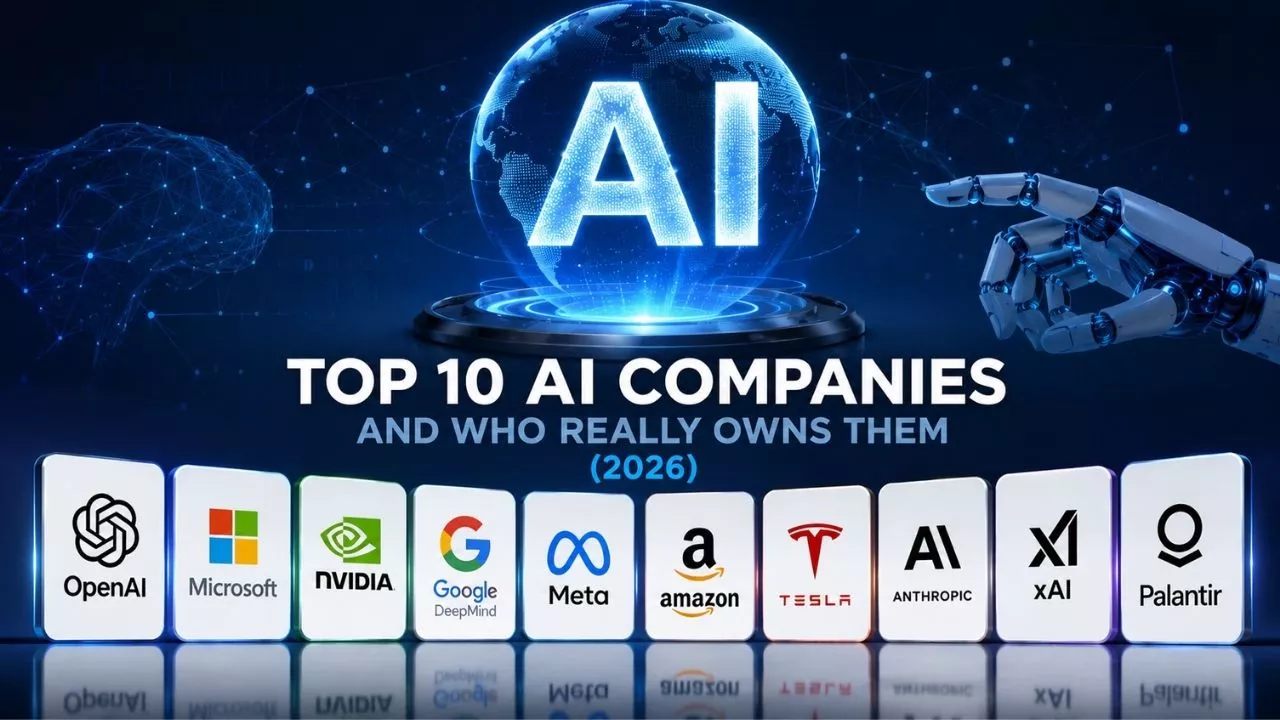
Most coverage of the AI boom focuses on the models and the founders. But if you want to understand the politics of AI in 2026 — who can deploy it, who can train on what, who gets the chips — you have to look at the ownership stacks. Almost every major AI lab in the world today is partly owned by a tech giant, a sovereign-wealth fund, or a private-equity vehicle. I’ve ranked the ten most important AI companies by the strategic weight of their backers, not by their model benchmarks.
How we built this list
Inclusion criteria: founded after 2010, primary business is general-purpose AI (foundation models, frontier research, or AI infrastructure), latest valuation over $5 billion as of May 2026. Ownership stakes come from each company’s last disclosed funding round; equity grants linked to compute or commercial partnerships are noted where publicly reported.
The Top 10
1. OpenAI — Microsoft (~49%), Khosla Ventures, Reid Hoffman, employees
OpenAI is the most-watched AI company of 2026. Microsoft holds approximately 49% of the for-profit subsidiary (OpenAI LP) via its $13+ billion cumulative investment, with a profit-sharing cap that converts to standard equity after a certain return threshold. The non-profit OpenAI Inc. parent retains governance control via the board. CEO Sam Altman has a small personal stake; Khosla Ventures was an early backer; employees hold restricted stock units.
2. Anthropic — Amazon (~$8B invested), Google (~$2B+ invested), founders, employees
Anthropic, founded by ex-OpenAI researchers Dario and Daniela Amodei, has accepted approximately $8 billion from Amazon (via AWS-specific commitments) and over $2 billion from Google. The founders and early employees retain substantial economic stakes; voting control sits with a special-purpose Long-Term Benefit Trust intended to keep mission-aligned governance even after large investments.
3. xAI — Elon Musk + private investors
Elon Musk’s xAI, launched in 2023 with the Grok chatbot, raised more than $6 billion in 2025 at a valuation north of $50 billion. Musk holds the majority economic stake; Saudi PIF, Sequoia, Andreessen Horowitz, Fidelity, and Valor Equity are reported limited partners. The X (Twitter) merger announced in 2024 brought additional Musk-controlled equity into the structure.
4. Google DeepMind (Gemini) — Alphabet (100%)
Google DeepMind is the consolidated AI research division of Alphabet — combining the original Google Brain team with DeepMind (which Google acquired in 2014 for ~£400 million). It is wholly owned by Alphabet and reports up through Sundar Pichai. As of 2026, DeepMind’s Gemini models are the primary competitor to OpenAI’s GPT family.
5. Mistral AI — General Catalyst, Microsoft (minority), founders
France-based Mistral AI raised approximately €600 million in 2024 at a €5 billion valuation. The cap table includes Microsoft as a minority investor (~$15 million strategic stake), General Catalyst, Lightspeed, Andreessen Horowitz, and the three founders. Mistral has positioned itself as the leading European AI champion.
6. Inflection AI — Microsoft (effectively absorbed via hire)
Inflection AI, co-founded by Mustafa Suleyman and Reid Hoffman, was effectively absorbed by Microsoft in March 2024 when Microsoft hired Suleyman and most of the staff. Microsoft paid Inflection’s investors a $650 million licensing fee and the original Inflection structure now exists primarily as a holding shell.
7. Cohere — Nvidia, Salesforce, Cisco, founders
Toronto-based Cohere raised approximately $500 million in 2024 at a $5.5 billion valuation. The cap table is unusually corporate-investor-heavy: Nvidia, Salesforce, Cisco, Oracle, and Index Ventures are the lead names. Founder Aidan Gomez (one of the original Transformer paper authors) retains significant equity.
8. Stability AI — Coatue, Lightspeed, Sound Ventures (Ashton Kutcher)
Stability AI, the maker of Stable Diffusion, has had a turbulent ownership history. Founder Emad Mostaque exited in early 2024; the company restructured under James Cameron’s board appointment and Coatue/Lightspeed-led recapitalization. Sean Parker’s Sound Ventures and Ashton Kutcher’s investments are also in the cap table.
9. Character.AI — Independent (Google licensing deal, no equity)
Character.AI, founded by ex-Google researchers Noam Shazeer and Daniel De Freitas, remains independently owned. In August 2024, Google paid a reported ~$2.7 billion to non-exclusively license its technology and re-hire the founders plus roughly 30 staff — but confirmed it took no equity stake. The DOJ opened an antitrust review of the deal in 2025.
10. Perplexity AI — Jeff Bezos, IVP, Nvidia, NEA, founders
Perplexity, the AI-native search competitor, raised approximately $250 million in 2025 at a $9 billion valuation. The cap table includes Jeff Bezos (one of the earliest backers), Nvidia, IVP, NEA, Founders Fund, Daniel Gross/Nat Friedman, and the four founders led by CEO Aravind Srinivas.
At-a-glance comparison
| Rank | Company | Largest Investor(s) | Approx. Valuation |
|---|---|---|---|
| 1 | OpenAI | Microsoft (~49%) | $157B |
| 2 | Anthropic | Amazon (~$8B) + Google | $60B |
| 3 | xAI | Elon Musk + Saudi PIF, Sequoia | $50B+ |
| 4 | Google DeepMind | Alphabet (100%) | n/a (subsidiary) |
| 5 | Perplexity AI | Bezos + Nvidia + IVP | $9B |
| 6 | Mistral AI | General Catalyst + Microsoft | €5B |
| 7 | Cohere | Nvidia + Salesforce | $5.5B |
| 8 | Character.AI | Google (commercial partner) | Pre-deal $5B |
| 9 | Stability AI | Coatue + Lightspeed | $1B+ |
| 10 | Inflection AI | Microsoft (absorbed 2024) | n/a (shell) |
My take
If you wanted to describe AI ownership in 2026 in one sentence, it would be: the cloud hyperscalers won the war for the model labs. Microsoft has OpenAI. Amazon and Google share Anthropic. Google has DeepMind in-house and Character.AI under commercial contract. The only frontier lab without a Big Tech anchor is xAI, which has Elon Musk as a substitute. Mistral is the European outlier and Cohere is the enterprise-focused alternative, but in terms of who controls the largest compute commitments and revenue — it’s Microsoft, Google, and Amazon. Whatever you think about AI safety regulation, the antitrust angle on this concentration is probably the bigger story.
Related Ownership Profiles
For more on the AI company that acquired this project, see who owns OpenClaw.
For another AI company’s ownership story, see who owns Perplexity AI.
Frequently Asked Questions
Who owns OpenAI?
OpenAI has a hybrid for-profit / non-profit structure. The non-profit OpenAI Inc. is the governing parent; the for-profit subsidiary OpenAI LP is approximately 49% owned by Microsoft following its cumulative $13+ billion investment. Other significant stakeholders include Khosla Ventures, Reid Hoffman, Sequoia Capital, and current and former employees holding restricted stock units.
Is Anthropic owned by Amazon?
Amazon is the single largest investor in Anthropic — it has committed approximately $8 billion in total — but it does not own Anthropic. Anthropic remains a separate company with governance held by its founders (Dario and Daniela Amodei) and a special-purpose Long-Term Benefit Trust. Google has also invested over $2 billion as a strategic partner.
Who owns xAI?
xAI is controlled by Elon Musk, who is both its founder and largest shareholder. The company raised more than $6 billion in 2025 from Saudi PIF, Sequoia, Andreessen Horowitz, Fidelity, and Valor Equity, among others. Following the 2024 merger with X (Twitter), Musk’s combined-entity stake increased further.
Did Microsoft buy Inflection AI?
Microsoft did not formally acquire Inflection AI, but it effectively absorbed the company in March 2024 by hiring co-founder Mustafa Suleyman and most of the technical staff, then paying Inflection’s investors a $650 million licensing fee. The original Inflection corporate shell continues operating with a small remaining team.
Why are tech giants investing so heavily in AI startups?
Three reasons. First, foundation-model training requires extraordinary amounts of compute — only Microsoft, Google, Amazon, and a few sovereign actors can supply it at scale. Investments are essentially compute commitments wrapped in equity. Second, the underlying technology has rapidly become strategic for cloud businesses. Third, ownership stakes provide hedging against the possibility that a competitor builds the dominant frontier model.
Who owns the biggest AI companies?
The biggest AI-focused companies are controlled by a mix of Big Tech parents and founder-led startups: OpenAI (non-profit/Microsoft-linked), Google DeepMind (Alphabet, 100%), Anthropic (founder-controlled, Amazon/Google as investors), and xAI (Elon Musk). None of the top 10 is a simple single-owner company — most involve multiple large investors.
Who owns the AI tools most people actually use?
ChatGPT is built by OpenAI (Microsoft ~49% of the for-profit arm). Gemini is built by Google DeepMind (Alphabet, 100%). Claude is built by Anthropic (Amazon and Google are its largest outside investors, but neither owns it). Character.AI remains independently owned despite its founders now working at Google.

Great work, I’m the owner, yekini nurudeen bidemi,
I’m AI generative, the policy makers