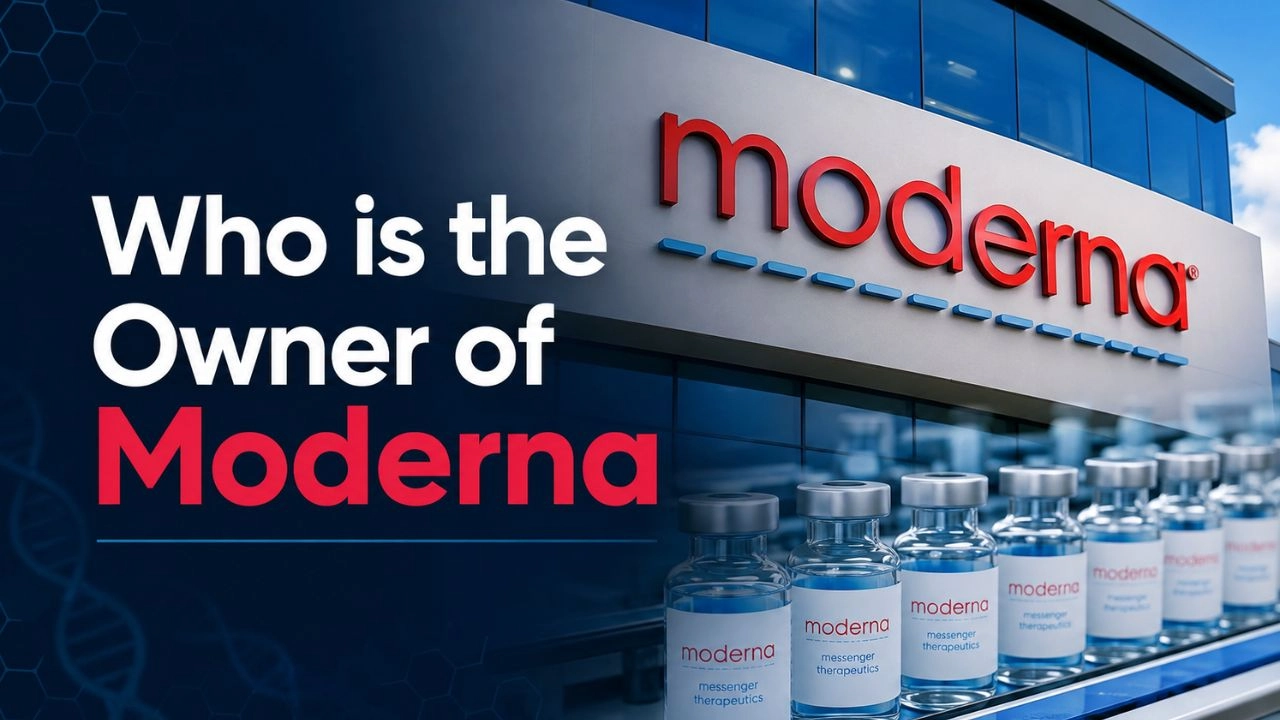
Most people first heard the name Moderna in late 2020, when the company announced that its COVID-19 vaccine was 94.5% effective — one of the most important scientific announcements in modern history. Within months, hundreds of millions of doses were being shipped around the world. But Moderna did not appear from thin air. It was built over a decade by a small group of scientists and entrepreneurs who believed that a molecule called mRNA could completely change how medicine works. Who owns that company today — and how did it get built — is one of the most fascinating stories in biotechnology.
Here is the complete, verified ownership story of Moderna, from its very first experiment in 2010 to right now in 2026.
What Is Moderna?
Moderna, Inc. is a biotechnology company specializing in messenger RNA (mRNA) medicines and is best known for developing one of the first COVID-19 vaccines authorized for emergency use. The drugmaker researches treatments for infectious diseases, cancer, and rare genetic disorders, and is exploring new uses of mRNA technology. Founded in 2010 and headquartered in Cambridge, Massachusetts, Moderna collaborates with drugmakers and government agencies worldwide to advance its research efforts. It became a publicly traded company in 2018.
The name itself is a clue to the science. The name Moderna is a portmanteau of “modified” and “RNA,” reflecting the company’s focus on developing uses for messenger ribonucleic acid (mRNA) technology.
The core idea behind mRNA medicine is revolutionary in its simplicity: instead of putting a drug or a protein directly into your body, you give your cells the instructions to make that protein themselves. Think of it like the difference between giving someone a fish and teaching them to fish — except the lesson happens inside your own cells.
Who Owns Moderna Right Now in 2026?
Moderna is publicly traded and widely held, not controlled by a family, state, or private equity sponsor. That makes who owns Moderna easier to see in filings, and it keeps control tied to the market rather than a single block holder.
Moderna trades on the NASDAQ stock exchange under the ticker symbol MRNA and is a component of the S&P 500 index.
The largest individual insider shareholders of Moderna are Stéphane Bancel (CEO) with approximately 7.3%, Noubar Afeyan (Co-founder and Chairman) with approximately 5%, Robert S. Langer (Co-founder) with approximately 4%, and Stephen Hoge (President) with approximately 1.3%.
On the institutional side, the largest institutional shareholders of Moderna include Vanguard Group Inc., BlackRock, Inc., FMR LLC (Fidelity), Baillie Gifford & Co., State Street Corp., Capital World Investors, Geode Capital Management, and Morgan Stanley.
No single person or entity controls Moderna outright. It is a widely distributed public company where the biggest voices are large index funds and asset managers — the same institutional giants that dominate most large American public companies.
Ownership and Key Stakeholders Table
| Owner / Shareholder | Type | Stake | Key Detail |
|---|---|---|---|
| Vanguard Group | Largest Institutional Shareholder | Largest institutional block | Passive index fund giant; top institutional holder of MRNA |
| BlackRock, Inc. | Institutional Investor | Significant MRNA stake | World’s largest asset manager; major index fund holder |
| FMR LLC (Fidelity) | Institutional Investor | Significant MRNA stake | One of the top 3 institutional holders of Moderna |
| Baillie Gifford & Co. | Institutional Investor | Significant MRNA stake | Scottish active fund manager; long-term biotech investor |
| State Street Corp. | Institutional Investor | Significant MRNA stake | Manages SPDR ETFs; passive institutional holder |
| Stéphane Bancel | CEO & Largest Individual Insider | ~7.3% | Joined as CEO in 2011; built Moderna from startup to S&P 500 |
| Noubar Afeyan | Co-Founder & Board Chairman | ~5% | Founder of Flagship Pioneering; conceived Moderna in 2010 |
| Robert S. Langer | Co-Founder | ~4% | MIT professor; one of the most cited scientists in history |
| Stephen Hoge | President | ~1.3% | Long-time Moderna executive; leads product development |
| Flagship Pioneering | Original Venture Backer | Reduced stake post-IPO | Incubated Moderna from its very first day; still a strategic holder |
| Public / Retail Shareholders | Retail Investors | Significant float | Traded freely on NASDAQ; anyone can buy MRNA stock |
The Origin Story: A Conversation That Changed Medicine
Moderna was founded in 2010 by Noubar Afeyan, founder and CEO of Flagship Pioneering, in collaboration with Robert Langer, a professor of chemical engineering at MIT, and Derrick Rossi, a stem cell biologist, with the aim of developing messenger RNA (mRNA) therapeutics as a novel drug modality. The company originated from exploratory work within Flagship’s VentureLabs, initially codenamed LS18, and was renamed Moderna Therapeutics to reflect its focus on modified RNA technologies.
The spark was a meeting between Noubar Afeyan and Derrick Rossi, who had been doing breakthrough research on using chemically modified mRNA to reprogram cells. Noubar Afeyan met with Bob Langer and Derrick Rossi to review recent data on the use of chemically modified mRNA to reprogram adult human fibroblast cells into induced pluripotent stem cells. Noubar envisioned a different use of engineered mRNA as a new kind of medicine and launched within Flagship’s VentureLabs group a month-long exploration which eventually led to Newco LS18, Inc. — which became Moderna.
Stéphane Bancel, who had been Chief Executive Officer of the French diagnostics company bioMérieux SA, joined Moderna’s board of directors in March 2011, and became its CEO in October 2011.
Bancel was the operational genius who took a brilliant scientific idea and turned it into a scalable company. Under his leadership, Moderna secured partnerships, built laboratories, raised hundreds of millions of dollars, and survived years of skepticism from the broader scientific and investment community — many of whom believed mRNA medicine was too speculative to ever work.
The COVID-19 Moment That Changed Everything
For its first decade, Moderna was known only within the biotechnology world. Then came 2020 — and everything changed overnight.
When SARS-CoV-2 emerged in early 2020, Moderna’s scientists began designing a vaccine within days of the viral genome being published. The mRNA platform they had spent a decade building was perfectly suited for the task — because instead of growing virus in a lab to make a traditional vaccine, Moderna just needed to encode the spike protein instructions into mRNA and inject them.
Moderna received an award from U.S. government agency BARDA for up to $483 million to accelerate development. It then announced a supply agreement with the U.S. government for an initial 100 million doses of its COVID-19 vaccine.
The result was Spikevax — one of the first two mRNA COVID-19 vaccines in history — which achieved 94.5% efficacy in clinical trials and was authorized for emergency use by the FDA in December 2020. Almost overnight, Moderna went from a well-funded biotech startup to one of the most important companies in the world.
The IPO and the Road to the S&P 500
Moderna became a public company through its 2018 IPO, which opened the cap table to public investors and shifted control from founders to shareholders. At the time of its IPO, Moderna had never had a single approved product. It went public purely on the strength of its mRNA platform and pipeline — an extraordinary level of investor conviction.
The 2018 IPO raised approximately $600 million — the largest biotech IPO in history at that time. The underwriters priced shares at $23 each. By the peak of the COVID-19 vaccine rollout in 2021, MRNA shares had hit $497 — a gain of more than 2,000% in under three years.
That surge created enormous paper wealth for the founders. Stéphane Bancel’s net worth briefly exceeded $10 billion at the peak. Noubar Afeyan and Robert Langer also saw their stakes become worth billions. The Moderna story had become one of the greatest wealth-creation events in biotechnology history.
Where Is Moderna Today in 2026?
The post-COVID world has been a harder one for Moderna. Demand for COVID-19 vaccines has normalized dramatically, and the company has posted significant losses as it works to build out its broader pipeline.
Moderna reported revenue of $1.94 billion in 2025, with a net loss of $2.8 billion and total assets of $12.3 billion. The company employs approximately 4,800 people.
But Moderna’s pipeline tells a more optimistic story. The company is advancing mRNA-based cancer vaccines — personalized treatments designed specifically for an individual patient’s tumor — and has reported promising early results in trials with Merck. CEO Stéphane Bancel stated in early 2026: “I believe 2026 will also be the year when the world sees the promise of Moderna as a leading oncology company.”
In August 2026, the FDA approved Moderna’s new mRNA-based flu vaccine — the first mRNA flu shot available to the public — marking another major milestone in the company’s mission to use mRNA to fight a wide range of diseases beyond COVID-19.
Frequently Asked Questions (FAQs)
Q1. Who owns Moderna in 2026?
Moderna (NASDAQ: MRNA) is publicly owned with no single controlling shareholder — Vanguard and BlackRock are the largest institutional holders.
Q2. Who founded Moderna?
Moderna was founded in September 2010 by Noubar Afeyan, Robert Langer, Derrick Rossi, Kenneth Chien, and Timothy Springer, backed by Flagship Pioneering.
Q3. Who is the CEO of Moderna in 2026?
Stéphane Bancel is the CEO of Moderna, a role he has held since October 2011 after being recruited by co-founder Noubar Afeyan.
Q4. What percentage of Moderna does Stéphane Bancel own?
Stéphane Bancel owns approximately 7.3% of Moderna, making him the largest individual insider shareholder.
Q5. When did Moderna go public?
Moderna held its IPO in December 2018 on NASDAQ, pricing shares at $23 — the largest biotech IPO in history at that time.
Q6. What is Moderna’s revenue in 2025?
Moderna reported $1.94 billion in revenue for 2025, with a net loss of $2.8 billion as it funds its broader pipeline beyond COVID-19 vaccines.
Q7. Does the U.S. government own part of Moderna?
No. The U.S. government funded Moderna’s COVID-19 vaccine development through BARDA grants and supply agreements but holds no equity ownership in the company.
Q8. What new products is Moderna launching in 2026?
In August 2026, the FDA approved Moderna’s first mRNA-based flu vaccine — and the company is advancing personalized mRNA cancer vaccines in partnership with Merck.
Moderna is a publicly traded company on NASDAQ (ticker: MRNA) with no single controlling owner. It was founded in September 2010 by Noubar Afeyan, Robert Langer, Derrick Rossi, Kenneth Chien, and Timothy Springer — backed from day one by Flagship Pioneering, the venture capital firm that incubated the entire concept.
The largest individual insider shareholders today are CEO Stéphane Bancel (~7.3%), Co-founder and Chairman Noubar Afeyan (~5%), and Co-founder Robert Langer (~4%). The biggest institutional holders are Vanguard, BlackRock, Fidelity, and Baillie Gifford. No single entity holds majority control — making Moderna a true public company, accountable to its broad shareholder base.
From a codenamed startup experiment in 2010 to a COVID-19 vaccine that reached hundreds of millions of people, to an mRNA flu shot approved by the FDA in 2026 — Moderna’s story is far from over.