Who Owns OpenClaw? The Full Story Behind the Fastest-Growing AI Project in History (2026)

If you have been anywhere near the tech world in early 2026, you have probably heard the name OpenClaw. It blew up almost overnight, went viral across developer communities, caught the attention of the biggest names in Silicon Valley, and ended up at the center of one of the most talked-about acquisitions of the year. But who actually owns it? The answer is a little more layered than you might expect — and it is genuinely fascinating.


What Is OpenClaw, Anyway?

OpenClaw is a free and open-source autonomous artificial intelligence agent that can execute tasks through large language models, using everyday messaging platforms as its main user interface. In simpler terms, it is software that lets an AI do real things on your behalf — like sending emails, scheduling meetings, researching leads, or posting content — all by itself, without you having to click through every step.

OpenClaw bots run locally on a user’s device and are designed to integrate with an external large language model such as Claude, DeepSeek, or one of OpenAI’s GPT models. Its functionality is accessed through a chatbot within a messaging service such as Signal, Telegram, Discord, or WhatsApp.

Think of it like having a personal assistant that lives inside your phone’s messaging app and actually gets things done — not just talks about them.


The Origin Story: A Weekend Project That Changed Everything

The project was originally published in November 2025 by Austrian software developer Peter Steinberger, under the name Clawdbot. The software was derived from Clawd, an AI-based virtual assistant he had developed, which itself was named after Anthropic’s chatbot Claude.

It was renamed Moltbot on January 27, 2026, following trademark complaints by Anthropic, and again to OpenClaw three days later after Steinberger found that the name Moltbot never quite rolled off the tongue.

So in just a few months, this thing went from a side project with a name nobody could pronounce to the most-starred open-source project on GitHub. Within weeks, OpenClaw had 196,000 stars on GitHub and 2 million people using it every week.

That kind of growth does not happen by accident. In December 2025 and especially January and early February 2026, OpenClaw saw a rapid, hockey-stick rate of adoption among AI developers impressed with its ability to complete tasks autonomously across applications and the entire PC environment.


So Who Owns OpenClaw Right Now?

Peter Steinberger, Creator and Original Author of OpenClaw

This is where things get interesting. OpenClaw does not have one single clean owner the way a traditional company product would.

The project was created by Peter Steinberger, an Austrian software developer, who is its original author. On February 15, 2026, Sam Altman announced that OpenAI had acquired OpenClaw and that Peter Steinberger was joining the company.

However, ownership of an open-source project works differently from owning a private company. Sam Altman said that the open-source tool will live in a foundation inside the company, and that OpenAI will continue to support it.

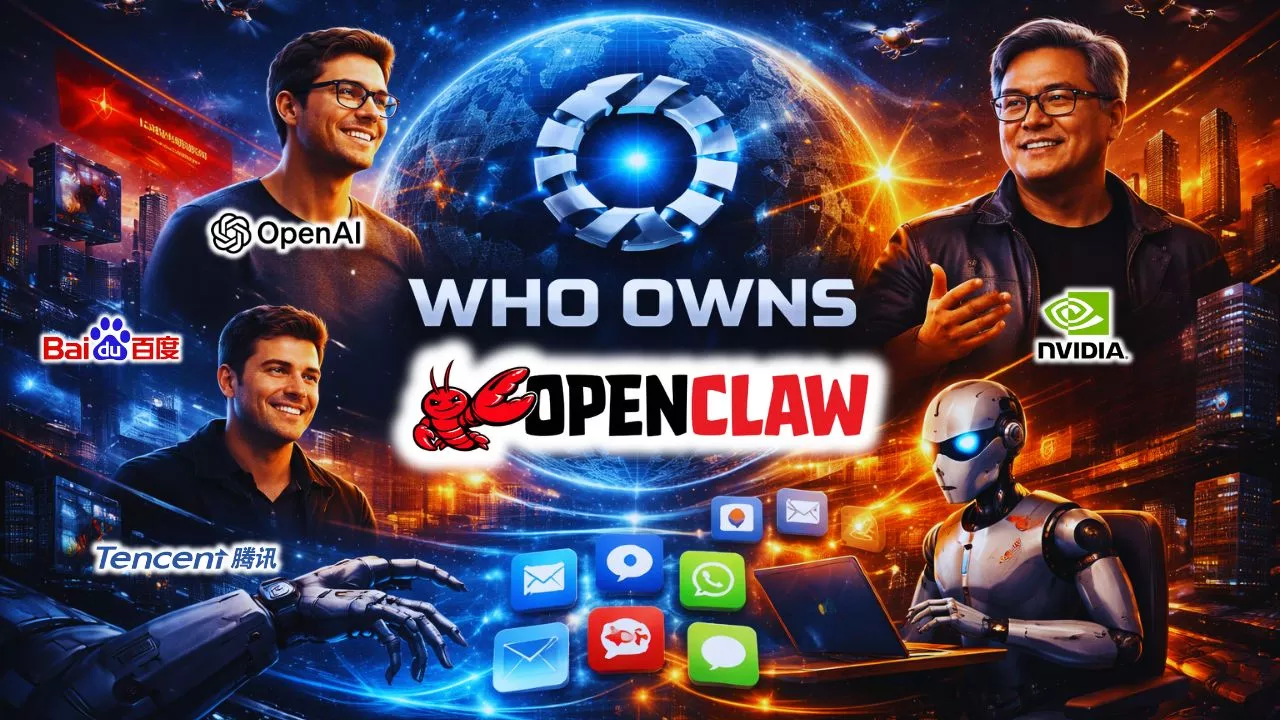
So the clearest way to put it is this: OpenAI is the primary owner and sponsor of OpenClaw as of 2026. Peter Steinberger, its creator, now works at OpenAI to continue developing it. And the project itself lives inside an independent open-source foundation that OpenAI backs and supports.


OpenClaw Ownership and Key Stakeholder Table

Other Owners and Sponsors of OpenClaw
PartyRoleStatusKey Detail
Peter SteinbergerCreator and Original AuthorJoined OpenAI in February 2026Austrian developer; built it as a side project in November 2025
OpenAIPrimary Owner and SponsorAcquired OpenClaw on February 15, 2026Sam Altman confirmed the deal; OpenClaw to become core to OpenAI products
Open-Source FoundationProject HomeIndependent but OpenAI-sponsoredOpenClaw lives here as a community-accessible open-source project
BaiduCorporate SponsorActivePlans to give users of its smartphone app direct access to OpenClaw
TencentCorporate SponsorActive since March 2026Became a sponsor after creator publicly complained about copying
NVIDIAEnterprise PartnerActiveLaunched NemoClaw, an enterprise-grade platform built on top of OpenClaw

How OpenAI Came to Own It

In his blog post announcing the move to OpenAI, Steinberger framed the decision in characteristically understated terms. He acknowledged the project could have become a huge company but said that was not what interested him. Instead, he wrote that his next mission is to build an agent that even his mum can use — a goal he believes requires access to frontier models and research that only a major lab can provide.

OpenAI did not acquire a product with paying customers. They acquired proven infrastructure with community adoption and a clear strategic thesis: the value of AI agents lies in cross-platform orchestration, not in single-application features.

OpenAI’s own previous attempts at agentic products — including its Agents API, Agents SDK, and the Atlas agentic browser — failed to gain the traction that OpenClaw achieved seemingly overnight. By bringing Steinberger and his work inside the company, OpenAI is essentially betting that the future of AI is not just about chatbots answering questions — it is about agents that actually do things.


What Makes OpenClaw Different From a Regular AI Chatbot?

Most AI tools you have used — ChatGPT, Claude, Gemini — respond to you. You ask something, they answer. OpenClaw flips that model on its head. It orchestrates workflows across disconnected platforms — reading from Google Sheets, composing emails in Gmail, posting to Slack, and scheduling calendar events in a single automated sequence.

OpenClaw has seen strong adoption among small businesses and freelancers for automating lead generation workflows, including prospect research, website auditing, and CRM integration.

It is less like a search engine and more like a junior employee who never sleeps, never forgets, and works across every app on your computer at the same time.


NVIDIA’s Big Bet on OpenClaw

Just as the OpenAI acquisition was settling in, NVIDIA came in with its own announcement. NVIDIA developed NemoClaw, an enterprise-grade AI agent platform built on top of OpenClaw, announced by CEO Jensen Huang during his GTC keynote in March 2026. The new open-source platform is essentially OpenClaw with enterprise-grade security and privacy features baked in.

Huang told the audience on stage that every company needs an OpenClaw strategy — comparing it to how every company once needed a Linux strategy and an HTTP HTML strategy when the internet was born.

That comparison to Linux is not a small thing. Linux is the open-source operating system that quietly powers the internet, most of the world’s servers, and Android phones. Jensen Huang is essentially saying he believes OpenClaw could become that kind of foundational infrastructure for the AI era.


China’s Role: Baidu, Tencent, and the Government Crackdown

OpenClaw’s story is not just an American one. In March 2026, the Chinese government moved to restrict state agencies and state-owned enterprises from using OpenClaw, citing security concerns. And yet, at the same time, major Chinese tech companies were racing to embrace it.

On March 10, 2026, Tencent said it had launched a full suite of easy-to-use AI products built on OpenClaw, which is also compatible with its superapp WeChat.

Tencent and its cloud computing unit officially became sponsors of OpenClaw in March 2026, featured on the project’s GitHub page alongside OpenAI and Baidu. This came after Steinberger publicly called out Tencent for copying skills from his project without giving back to the community financially or technically.

It is a classic open-source tension: a company benefits from a free project, the original creator pushes back, and eventually the company steps up. In this case, it worked.


The Security Question Nobody Can Ignore

With great power comes great security risk. OpenClaw’s design has drawn scrutiny from cybersecurity researchers and technology journalists due to the broad permissions it requires to function effectively. Because the software can access email accounts, calendars, messaging platforms, and other sensitive services, misconfigured or exposed instances present serious security and privacy risks.

LangChain told its own employees they could not install OpenClaw on company laptops due to the security risks involved. And that tension, ironically, is part of what made it so popular with developers who wanted to move fast and build without guardrails.

NVIDIA’s NemoClaw is a direct response to this problem — bringing the power of OpenClaw into enterprise environments with proper security controls built in from the ground up.


Final Words

OpenClaw started as a weekend project by one Austrian developer who just wanted to build something useful. In less than four months, it became the fastest-growing open-source project in history, attracted the attention of OpenAI, NVIDIA, Tencent, and Baidu, got acquired by the most valuable AI company in the world, and sparked a serious debate about the future of autonomous AI agents.

As of March 2026, OpenAI owns and sponsors OpenClaw. Peter Steinberger, the man who built it, now works at OpenAI. The project lives inside an independent open-source foundation. And the entire tech industry — from Silicon Valley boardrooms to Chinese government offices — is trying to figure out what to do with it.


Frequently Asked Questions (FAQs)

Q1. Who created OpenClaw?
OpenClaw was created by Peter Steinberger, an Austrian software developer. He first published the project in November 2025 under the name Clawdbot. After two name changes — first to Moltbot, then to OpenClaw — the project exploded in popularity in January and February 2026. Steinberger built the original version essentially as a personal side project, and it grew far beyond anything he initially planned for.

Q2. Who owns OpenClaw now in 2026?
As of February 2026, OpenAI is the primary owner and sponsor of OpenClaw. Sam Altman announced on February 15, 2026 that Peter Steinberger was joining OpenAI and that the OpenClaw project would live inside an independent open-source foundation that OpenAI actively supports. The project remains open-source, meaning anyone can still access and use the code, but OpenAI controls its strategic direction.

Q3. Did OpenAI buy OpenClaw outright?
The acquisition was not a traditional buyout with a publicly announced price tag. OpenAI brought on Peter Steinberger as an employee and took on sponsorship of the project, with OpenClaw transitioning to an open-source foundation backed by the company. Think of it less like buying a startup and more like hiring the founder and becoming the primary backer of the community project he built.

Q4. Is OpenClaw free to use?
Yes, OpenClaw is completely free and open-source. Anyone can download it, use it, and even modify it under its open-source license. The fact that it is free was one of the biggest reasons it spread so quickly, especially among individual developers, small businesses, and freelancers. NVIDIA’s NemoClaw adds security and privacy layers on top of the free OpenClaw framework for companies that need more control.

Q5. What is the difference between OpenClaw and ChatGPT?
ChatGPT is a conversational AI — you ask it a question, it gives you an answer. OpenClaw is an autonomous AI agent — it takes actions on your behalf across multiple apps and platforms without you having to manage every step. It can read your emails, update a spreadsheet, send messages, and schedule events all in one automated sequence. ChatGPT talks. OpenClaw does.

OpenClaw Official Site


Discover more from Who Is The Owner Of

Subscribe to get the latest posts sent to your email.

Leave a Comment

This site uses Akismet to reduce spam. Learn how your comment data is processed.