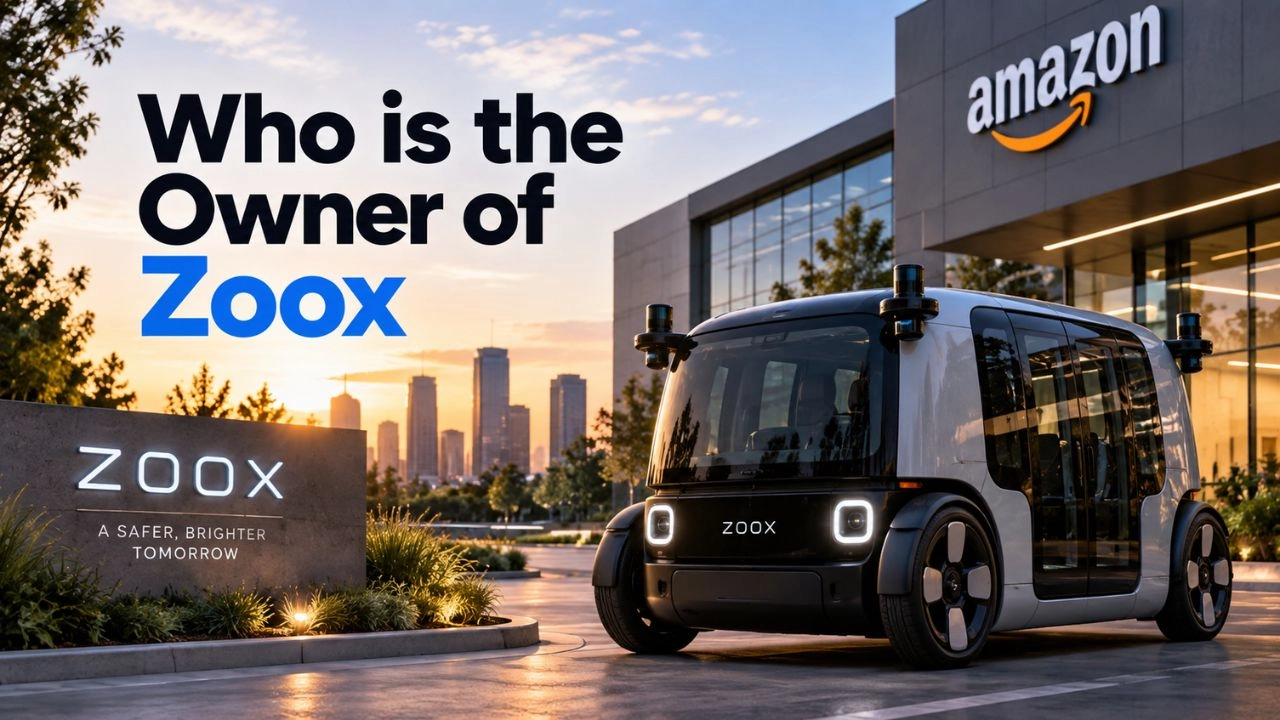
Most people have never heard of Zoox. But if you have recently seen a boxy, toaster-shaped vehicle rolling through the streets of Las Vegas or San Francisco with no steering wheel, no pedals, and no driver — you have already seen the future that Zoox is building.
This is Amazon’s bet on autonomous transportation, and in 2026 it is expanding faster than ever before. Here is everything you need to know about who owns Zoox and why it matters.
What Is Zoox?
Zoox, Inc. is an American autonomous vehicle technology company headquartered in Foster City, California. It develops fully self-driving electric vehicles designed specifically for passengers — not retrofitted from existing car platforms, but built from scratch with no steering wheel, no pedals, and seats facing each other like a living room on wheels.
Zoox describes itself as a mobility-as-a-service company — meaning it does not sell cars, it sells rides. As of late March 2026, Zoox has served over 350,000 riders across Las Vegas and San Francisco, with approximately 500,000 people on its public waitlist. The company has logged nearly 2 million autonomous miles on public roads since its founding.
Who Owns Zoox in 2026?
Zoox is a wholly owned subsidiary of Amazon.com, Inc. — the world’s largest e-commerce and cloud computing company. Amazon acquired Zoox in June 2020 for $1.2–1.3 billion, in what was one of the most significant autonomous vehicle acquisitions in tech history.
Zoox operates as part of Amazon’s Devices & Services organization, alongside units like Amazon Alexa, Amazon Lab126, and Amazon Leo.
Like other Amazon subsidiaries such as Amazon Web Services, Zoox has no independent board of directors — it reports directly into Amazon’s corporate structure. The current CEO of Zoox is Aicha Evans, who has led the company since 2019 and continued in that role after the Amazon acquisition.
Ownership and Key Stakeholders Table
| Owner / Party | Role | Stake | Key Detail |
|---|---|---|---|
| Amazon.com, Inc. | Parent Company & 100% Owner | Full ownership since June 2020 | Acquired Zoox for $1.2–1.3 billion; publicly traded on NASDAQ: AMZN |
| Aicha Evans | CEO of Zoox | Management role; no separate ownership | Has led Zoox since 2019; continues post-acquisition |
| Jesse Levinson | Co-Founder & CTO | No separate ownership post-acquisition | Son of Apple chairman Arthur D. Levinson; co-founded Zoox at Stanford |
| Tim Kentley-Klay | Original Co-Founder | Exited; no ownership post-acquisition | Australian artist-designer; departed before Amazon acquisition |
| Vanguard Group | Amazon Shareholder | ~7% of Amazon (AMZN) | Largest institutional shareholder of Amazon |
| BlackRock | Amazon Shareholder | ~5.5% of Amazon (AMZN) | Second largest institutional shareholder of Amazon |
| Jeff Bezos | Amazon Founder | ~9% of Amazon (AMZN) | Largest individual shareholder of Zoox’s parent company |
| Uber | Strategic Partner | No equity in Zoox | Signed partnership March 2026 to offer Zoox robotaxis via Uber app in Las Vegas |
The Origin Story: Stanford, a Blank Sheet, and a Big Idea
Zoox was founded on July 29, 2014 by two people with very different backgrounds — and that combination turned out to be exactly right.
Tim Kentley-Klay was an Australian artist and designer who believed that the future of transportation needed to be reimagined visually and experientially from the ground up.
Jesse Levinson was a Stanford University engineer developing cutting-edge self-driving technology, and the son of Apple Inc. chairman Arthur D. Levinson. Together, they decided to build something that no one else was attempting — a vehicle purpose-built for autonomous passengers, not a car with a driver removed from it.
Before Amazon, Zoox had raised approximately $990 million from investors including Lux Capital, DFJ Growth, and Blackbird Ventures. The company was valued at around $3.2 billion at its peak private valuation — which made Amazon’s acquisition price of $1.2–1.3 billion a significant markdown that reflected the difficulty and cost of actually delivering autonomous vehicles at scale.
How Amazon Acquired Zoox — And Why
Amazon acquired Zoox in June 2020 for $1.2–1.3 billion in one of the most closely watched autonomous vehicle deals of the decade.
The strategic logic was clear from Amazon’s perspective. At the time of the acquisition, Amazon was already spending enormous sums on last-mile delivery — the most expensive and complex part of the logistics chain.
An autonomous vehicle fleet that could deliver packages and transport passengers without drivers was the obvious long-term solution to that problem. Amazon had already invested in autonomous driving startup Aurora and was testing self-driving trucks through partnerships with Embark — but owning Zoox outright gave it a fully controlled, purpose-built autonomous vehicle platform.
Amazon announced that Zoox would continue to exist as a standalone business post-acquisition, with CEO Aicha Evans and CTO Jesse Levinson both continuing in their roles. That structure remains in place in 2026, with Zoox maintaining its own brand, headquarters, and operational identity while benefiting from Amazon’s enormous financial resources and infrastructure.
What Zoox Is Doing in 2026
Zoox is moving fast across multiple U.S. cities — and the pace of expansion in 2026 is its most aggressive yet.
The company currently offers its fully autonomous robotaxi service in Las Vegas and San Francisco, where it has served over 350,000 riders with free rides through its Explorer program.
In March 2026, Zoox announced it is expanding testing to Dallas and Phoenix, deploying retrofitted Toyota Highlander SUVs with human safety drivers to map the streets before introducing its signature bidirectional, purpose-built robotaxis.
On March 24, 2026 — just days ago — Zoox struck a landmark partnership with Uber to make its robotaxis available through the Uber ride-hailing app in Las Vegas, starting in the summer of 2026.
This is a significant commercial milestone — it means Zoox vehicles will be accessible to millions of Uber users without them needing to download a separate app. CEO Aicha Evans confirmed the Zoox app will remain the primary hailing method but acknowledged the Uber partnership as an important distribution channel for the brand.
Zoox is also expanding its manufacturing capacity, having opened a 220,000-square-foot factory in the San Francisco Bay Area that aims to produce 10,000 vehicles per year once fully operational. The company is also testing in Seattle, Austin, Miami, Los Angeles, Atlanta, and Washington, D.C.
Zoox vs. Waymo: The Autonomous Race
Zoox exists in a competitive market dominated by Alphabet-owned Waymo — widely considered the leader in commercial autonomous vehicle deployment in the U.S. But Zoox and Waymo take fundamentally different approaches.
Waymo uses modified versions of existing vehicles — such as the Jaguar I-Pace — fitted with its own self-driving technology.
Zoox built its vehicle from a completely blank sheet, resulting in the distinctive bidirectional robotaxi that has no front or back, no steering wheel, no pedals, and seats four passengers facing each other.
This radical design is both Zoox’s biggest differentiator and its biggest manufacturing challenge — producing a novel vehicle type at scale is far harder than adapting existing platforms.
Other major competitors include Tesla’s autonomous driving push, Baidu’s Apollo Go, Pony.ai, and WeRide in China. The global autonomous vehicle market is projected to reach $556 billion by 2026, and every major technology company on earth is trying to claim a piece of it.
Frequently Asked Questions (FAQs)
Q1. Who owns Zoox in 2026?
Zoox is 100% owned by Amazon.com, Inc., which acquired it in June 2020 for $1.2–1.3 billion.
Q2. When did Amazon buy Zoox?
Amazon completed its acquisition of Zoox in June 2020, making it a wholly owned subsidiary of the company.
Q3. Who founded Zoox and when?
Zoox was founded on July 29, 2014 by Tim Kentley-Klay — an Australian designer — and Jesse Levinson, a Stanford University engineer and son of Apple chairman Arthur D. Levinson.
Q4. Who is the CEO of Zoox in 2026?
Aicha Evans serves as CEO of Zoox and has led the company since 2019, continuing in her role after Amazon’s acquisition.
Q5. Where does Zoox operate its robotaxi service?
Zoox currently offers fully autonomous rides in Las Vegas and San Francisco, with testing underway in Dallas, Phoenix, Austin, Miami, Seattle, Atlanta, and Washington, D.C.
Q6. How many riders has Zoox served?
As of late March 2026, Zoox has served over 350,000 riders, with approximately 500,000 people on its public waitlist.
Q7. Did Zoox partner with Uber?
Yes. On March 24, 2026, Zoox announced a partnership with Uber to make its robotaxis available through the Uber app in Las Vegas starting in the summer of 2026.
Q8. How is Zoox different from Waymo?
Unlike Waymo, which modifies existing vehicles, Zoox built its robotaxi from scratch — a bidirectional vehicle with no steering wheel, no pedals, and four seats facing each other, designed purely around the passenger experience.
Zoox is 100% owned by Amazon.com, Inc., which acquired it in June 2020 for $1.2–1.3 billion. It operates as a wholly owned subsidiary within Amazon’s Devices & Services organization, with no independent board and no outside shareholders.
Zoox was founded in 2014 by Tim Kentley-Klay and Jesse Levinson in Foster City, California, with a vision to build autonomous vehicles from scratch — not retrofit existing ones.
Under CEO Aicha Evans, Zoox has logged nearly 2 million autonomous miles, served over 350,000 riders, expanded to 10 U.S. cities, opened a 220,000-square-foot manufacturing facility, and just signed a landmark Uber partnership in March 2026.
It is Amazon’s most ambitious bet in transportation — and the race to compete with Waymo is only heating up.