Walk into almost any gas station or convenience store in America today and you will find a small display of little round cans near the register. The most prominent brand on that display — the one that is almost always sold out in the most popular flavors — is ZYN. It is a nicotine pouch, it contains no tobacco, and it has become one of the fastest-growing consumer products in the entire country. Politicians talk about it. Podcasters use it on air. Athletes keep it tucked under their lip during games. And now the FDA has officially recognized it as less harmful than cigarettes.
But who actually owns ZYN? The answer travels from a Swedish laboratory in the early 2010s all the way to a $16 billion acquisition by one of the world’s biggest tobacco giants — and it ends with a company that is quietly betting its entire future on tiny pouches of nicotine.
More Fast-Growing Restaurant Chains
For another fast-growing chain story, read about who owns Jersey Mike’s.
What Is ZYN?
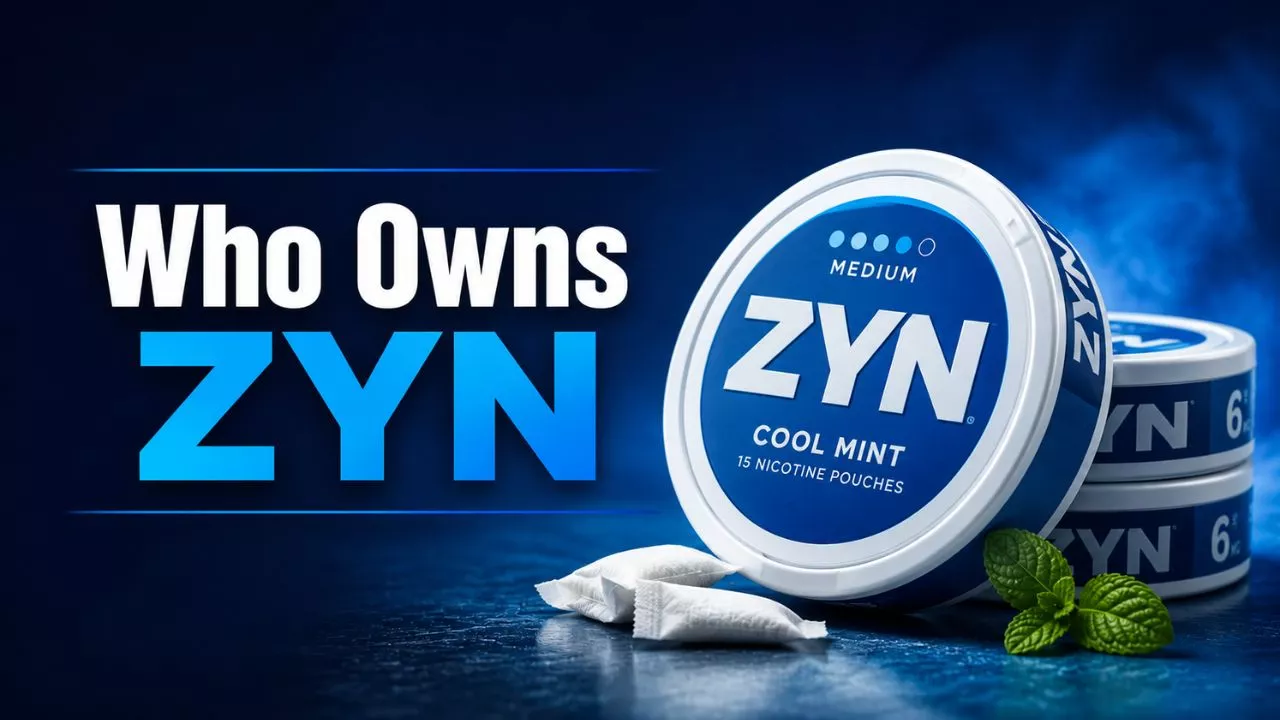
ZYN is a tobacco-free nicotine pouch — a small, white, pre-portioned pouch that users place between their lip and gum to absorb nicotine without smoking, vaping, or chewing tobacco. Each pouch contains nicotine, plant-based fibers, flavorings, and sweeteners — but zero tobacco leaf.
ZYN was launched in the United States in 2016 by Swedish Match North America LLC. However, the development of ZYN began in the early 2010s as part of the company’s strategy to create tobacco-free nicotine products. It progressively gained popularity as a discreet and smokeless nicotine alternative, especially in markets where there is increasingly stronger demand for non-tobacco nicotine options.
ZYN is now the clear market leader in its category. ZYN remains the market leader with more than $2.4 billion in annual sales, controlling approximately 70% of the U.S. nicotine pouch market.
Who Owns ZYN Right Now in 2026?
The direct answer is straightforward: ZYN is owned by Philip Morris International (PMI) — one of the largest tobacco companies in the world — through its wholly owned subsidiary Swedish Match.
Swedish Match, together with all its subsidiaries around the world, was officially acquired by Philip Morris International (PMI) in November 2022. PMI completed the acquisition after a prolonged bidding process, which valued Swedish Match at approximately US$16 billion. As a result of the Swedish Match acquisition, Philip Morris International owns ZYN as part of its smoke-free portfolio.
The ownership structure is clean and simple:
Philip Morris International (NYSE: PM) → Swedish Match AB (wholly owned subsidiary) → ZYN Brand
Jacek Olczak serves as CEO of Philip Morris International, which means he has ultimate oversight of ZYN along with everything else in PMI’s massive portfolio. He is steering the entire smoke-free strategy, and ZYN is currently the brand doing the most heavy lifting in the U.S. market.
ZYN and PMI Ownership — Key Stakeholders Table
| Owner / Shareholder | Type | Stake | Key Detail |
|---|---|---|---|
| Philip Morris International (NYSE: PM) | Direct Parent Company | 100% of Swedish Match & ZYN | Acquired Swedish Match for ~$16 billion in November 2022 |
| Swedish Match AB | Wholly Owned Subsidiary | 100% of ZYN brand | Original creator and manufacturer of ZYN; founded in Sweden |
| The Vanguard Group | Largest Institutional Shareholder of PMI | ~9–10% of PM shares | Passive index fund giant; top institutional PMI holder |
| BlackRock, Inc. | Second Largest Institutional Shareholder | ~7–8% of PM shares | World’s largest asset manager; major PM holder |
| Altria Group | No ownership in PMI | 0% | Common misconception — Altria and PMI are separate companies |
| Jacek Olczak | CEO of Philip Morris International | Minimal executive stake | Group CEO since 2021; architect of ZYN global expansion |
| Public Shareholders (NYSE: PM) | Retail & Institutional Investors | Remaining PMI shares | PMI is publicly traded; anyone can buy PM stock |
The Origin Story: How ZYN Was Born in Sweden
ZYN did not come from an American startup or a Silicon Valley lab. It was born in Sweden — a country with a long tradition of oral tobacco products called snus — as part of a deliberate strategy to create a cleaner, tobacco-free nicotine alternative.
Swedish Match was the company that first developed and launched ZYN. It is a Swedish company that makes smokeless tobacco and nicotine products all over the world. The development of ZYN began in the early 2010s as the company’s response to growing demand for smoke-free, tobacco-free nicotine options.
Swedish Match launched ZYN in the United States in 2016 with a simple thesis: millions of American adults who used nicotine wanted options beyond cigarettes, cigars, and chewing tobacco. A small, white, odorless pouch that could be used anywhere — at a desk, in a meeting, on a plane, at the gym — was exactly what they were looking for.
The product grew slowly at first, then exploded. By the early 2020s, ZYN had become a cultural phenomenon — particularly popular with young male professionals, athletes, and increasingly, political figures. Former Fox News host Tucker Carlson helped popularize the brand on the right before later souring on ZYN and launching his own nicotine pouch brand. Health and Human Services Secretary Robert F. Kennedy Jr. uses nicotine pouches, and President Trump recently asked Kennedy which pouches he used after a lunch with tobacco executives.
The $16 Billion Deal: How PMI Came to Own ZYN
By 2022, ZYN had become so valuable — and nicotine pouches as a category were growing so fast — that Philip Morris International decided it had to own the market leader outright.
PMI completed the acquisition of Swedish Match in November 2022 after a prolonged bidding process that valued the company at approximately US$16 billion. The deal was one of the largest acquisitions in the history of the global tobacco industry.
For PMI, the logic was clear. The company had spent years publicly committing to a “smoke-free future” — a strategy of replacing traditional cigarettes with reduced-risk products like IQOS (heated tobacco), VEEV (vaping), and now ZYN (nicotine pouches). Swedish Match was not just an acquisition — it was the company buying its way into the fastest-growing segment of the nicotine market in one decisive move.
An important distinction worth knowing: PMI, the Marlboro owner in international markets, is not owned by Altria, the parent company of Marlboro in the United States. PMI and Altria are completely separate, independent, publicly traded companies that split from each other in 2008. So ZYN belongs to PMI — not Altria, not Marlboro’s parent.
The FDA Decision: A Historic Win for ZYN
The most significant regulatory moment in ZYN’s history happened in 2025 and 2026 — and it changed everything about how the product can be marketed.
On January 16, 2025, the U.S. Food and Drug Administration (FDA) authorized ZYN nicotine pouches — making ZYN the first and only authorized nicotine pouch in the United States. The FDA’s authorization of all ZYN nicotine pouches currently marketed by Swedish Match in the U.S. is an important step to protect the public health by providing better alternatives to cigarettes.
Then came an even bigger win. In June 2026, the FDA allowed 20 Philip Morris-owned ZYN nicotine pouch products to carry a modified-risk claim — saying that switching from cigarettes to ZYN lowers the risk of several smoking-related diseases. The decision gives Philip Morris a major marketing win for one of the fastest-growing nicotine products as cigarette sales decline in the U.S.
This is a massive commercial advantage. No competitor can currently make the same claim on their packaging.
ZYN’s Investment in American Manufacturing
PMI is not just owning ZYN — it is pouring extraordinary amounts of money into building out the capacity to meet demand.
Philip Morris International invested $232 million into a ZYN production facility in Owensboro, Kentucky, resulting in about 450 jobs. The changes at the Owensboro facility are expected to boost ZYN production by about 900 million cans in 2025.
PMI also earmarked $600 million over two years to boost ZYN production at the company’s Aurora, Colorado facility. In total, PMI has committed over $800 million to new ZYN factories in the U.S. to meet growing demand.
These investments reflect a company that is completely committed to ZYN as the centerpiece of its American strategy for the next decade.
ZYN’s Performance in 2026
ZYN is now available in 60 markets worldwide, with strong volume growth in the UK, Poland, Greece, Pakistan, and the Philippines. IQOS and ZYN are leading growth and expansion into 109 markets globally.
PMI reported its strongest quarterly revenue ever at $11 billion in the second quarter of 2026, with smoke-free products like IQOS and ZYN powering organic sales growth. PMI’s full-year 2026 guidance projects organic net revenue growth of 5–7% and adjusted diluted EPS of $8.26–$8.41.
ZYN’s growth in international markets is accelerating, though the U.S. market saw some slowdown in early 2026 due to inventory movements and higher manufacturing costs. The company is responding by launching new products including ZYN Ultra and additional dry variants to keep the American market growing.
Is ZYN the Same as Altria or Marlboro?
This is one of the most common questions people ask — and the answer is a firm no.
Philip Morris International and Altria Group were once the same company — Philip Morris Companies Inc. — but they split into two entirely separate, publicly traded corporations in 2008. Altria kept the U.S. rights to the Marlboro brand and operates in America. PMI took the international rights to Marlboro and operates outside the U.S.
ZYN belongs to PMI — the international company. Altria has no ownership stake in ZYN or in PMI whatsoever.
Frequently Asked Questions (FAQs)
Q1. Who owns ZYN nicotine pouches in 2026?
ZYN is owned by Philip Morris International (NYSE: PM) through its wholly owned subsidiary Swedish Match AB, acquired for ~$16 billion in November 2022.
Q2. Did Swedish Match create ZYN?
Yes. Swedish Match, a Swedish smokeless tobacco and nicotine company, developed ZYN in the early 2010s and launched it in the U.S. in 2016.
Q3. Is ZYN owned by Altria or Marlboro?
No. ZYN belongs to Philip Morris International (PMI), which split from Altria in 2008. Altria has zero ownership in ZYN or PMI.
Q4. How much did PMI pay for Swedish Match and ZYN?
Philip Morris International completed the acquisition of Swedish Match in November 2022 for approximately US$16 billion after a prolonged bidding process.
Q5. Is ZYN FDA approved? Yes. In January 2025, the FDA authorized ZYN as the first and only authorized nicotine pouch in the U.S., and in June 2026 granted it a modified-risk marketing claim.
Q6. How much does ZYN sell annually?
ZYN generates more than $2.4 billion in annual sales and controls approximately 70% of the U.S. nicotine pouch market as of 2026.
Q7. Is ZYN available outside the United States?
Yes. ZYN is now available in 60 markets worldwide, with growing volumes in the UK, Poland, Greece, Pakistan, and the Philippines.
Q8. How much is PMI investing in ZYN production in the U.S.?
Philip Morris International has committed over $800 million to new ZYN manufacturing facilities in Owensboro, Kentucky and Aurora, Colorado.
ZYN is owned by Philip Morris International (NYSE: PM) through its wholly owned subsidiary Swedish Match AB. PMI acquired Swedish Match in November 2022 for approximately $16 billion — making it one of the largest deals in tobacco industry history. ZYN was originally developed by Swedish Match in Sweden in the early 2010s and launched in the U.S. in 2016. Today it controls approximately 70% of the U.S. nicotine pouch market, is available in 60 countries, and earned $2.4 billion in annual sales.
The biggest institutional shareholders of PMI — and therefore indirect owners of ZYN — are Vanguard Group and BlackRock. PMI CEO Jacek Olczak leads the company’s global smoke-free transformation, with ZYN and IQOS as the two crown jewels of that strategy. In June 2026, the FDA granted ZYN the right to market itself as less harmful than cigarettes — a first for any nicotine pouch product in history.