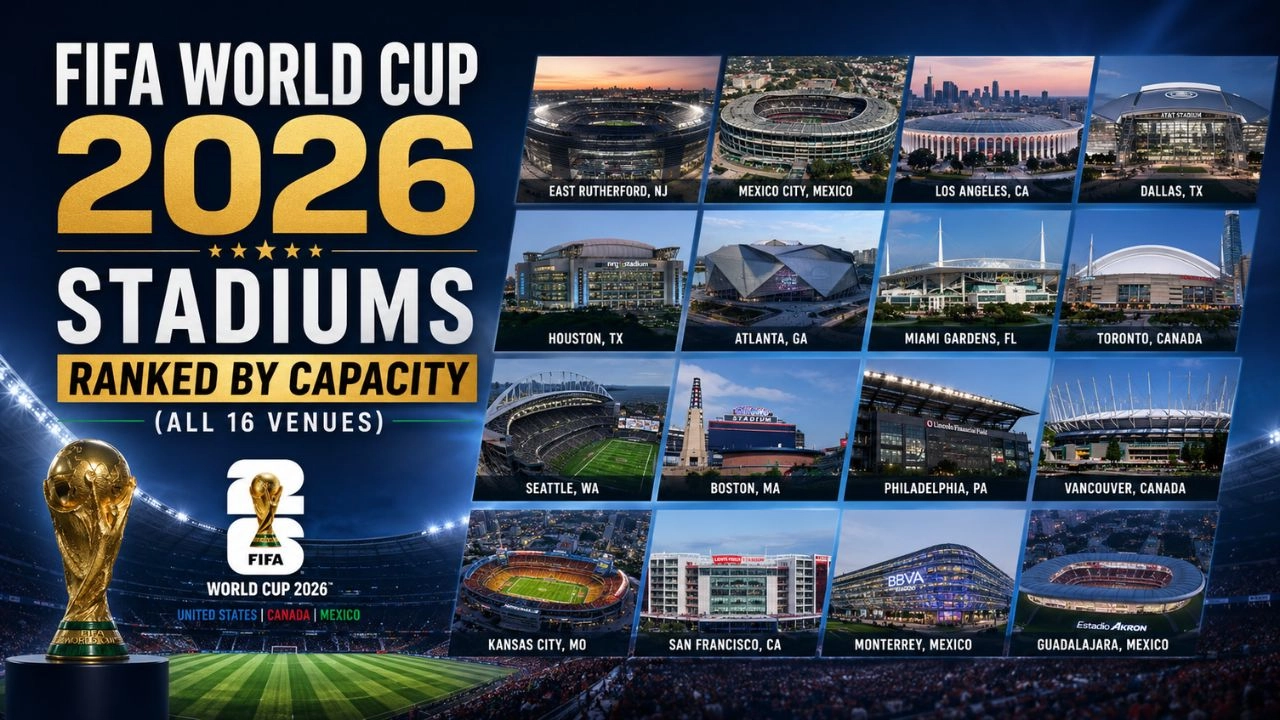
One of the first questions I get every World Cup is simple: which stadium is the biggest? For 2026, the answer is a familiar one — AT&T Stadium in Dallas, which can pack in about 94,000 fans. At the other end sits Toronto’s BMO Field at roughly 45,000.
After seven years tracking these venues, I’ve put together a clear, ranked breakdown of all 16 FIFA World Cup 2026 stadiums by capacity — plus who owns the biggest ones.
FIFA World Cup 2026 Stadiums Ranked by Capacity
Here are all 16 venues ranked from largest to smallest, using their tournament (net seating) capacities. These figures are set by FIFA for the event and can differ slightly from the stadiums’ regular NFL or soccer configurations, because pitches are widened and some seating is given over to broadcast and hospitality.
| Rank | Stadium | World Cup Name | City | Capacity |
|---|---|---|---|---|
| 1 | AT&T Stadium | Dallas Stadium | Arlington, TX | ~94,000 |
| 2 | Estadio Azteca | Estadio Ciudad de México | Mexico City | ~83,000 |
| 3 | MetLife Stadium | New York New Jersey Stadium | East Rutherford, NJ | ~82,500 |
| 4 | Mercedes-Benz Stadium | Atlanta Stadium | Atlanta, GA | ~75,000 |
| 5 | Arrowhead Stadium | Kansas City Stadium | Kansas City, MO | ~73,000 |
| 6 | NRG Stadium | Houston Stadium | Houston, TX | ~72,000 |
| 7 | Levi’s Stadium | San Francisco Bay Area Stadium | Santa Clara, CA | ~71,000 |
| 8 | SoFi Stadium | Los Angeles Stadium | Inglewood, CA | ~70,000 |
| 9 | Lincoln Financial Field | Philadelphia Stadium | Philadelphia, PA | ~69,000 |
| 10 | Lumen Field | Seattle Stadium | Seattle, WA | ~66,000 |
| 11 | Hard Rock Stadium | Miami Stadium | Miami Gardens, FL | ~65,000 |
| 12 | Gillette Stadium | Boston Stadium | Foxborough, MA | ~63,800 |
| 13 | BC Place | BC Place Vancouver | Vancouver, BC | ~54,000 |
| 14 | Estadio BBVA | Estadio Monterrey | Monterrey, MX | ~53,500 |
| 15 | Estadio Akron | Estadio Guadalajara | Guadalajara, MX | ~48,000 |
| 16 | BMO Field | Toronto Stadium | Toronto, ON | ~45,000 |
The Biggest Stadium: AT&T Stadium (~94,000)
No surprise here. AT&T Stadium in Arlington — “Dallas Stadium” for the tournament — is the largest venue at the 2026 World Cup, with a tournament capacity around 94,000. It’s fitting that the biggest stadium also drew the biggest schedule: nine matches, including a semifinal. Here’s the twist most people miss: the building is publicly owned by the City of Arlington, even though everyone calls it “Jerry’s World.” I cover that in my guide to who owns AT&T Stadium.
The Smallest Stadium: BMO Field (~45,000)
At the other end is Toronto’s BMO Field — “Toronto Stadium” — which had to add roughly 17,000 temporary seats just to reach about 45,000 for the World Cup. It’s owned by the City of Toronto and run by MLSE; read more in my breakdown of who owns BMO Field. The three smallest venues are all comparatively intimate: BMO Field, Estadio Akron in Guadalajara, and Estadio BBVA in Monterrey.
Why World Cup Capacities Differ From the NFL Season
If these numbers look a little different from the capacities you see on a normal NFL Sunday, there’s a reason. To meet FIFA standards, stadiums have to widen the playing surface to full soccer dimensions, which often removes the lower-bowl seats closest to the field. Broadcast platforms, camera positions, and expanded hospitality areas also take up space. The result is a “net seating” figure that’s set specifically for the tournament.
Who Owns the Biggest Venues?
This is where it gets interesting for my corner of the internet. The top of the capacity table is a mix of public and private ownership: AT&T Stadium (City of Arlington), Estadio Azteca (Grupo Televisa), MetLife Stadium (the Giants and Jets), and Mercedes-Benz Stadium (Arthur Blank). For the full ownership picture across all 16, see my FIFA World Cup 2026 host stadium ownership guide, and you can cross-check the official figures at FIFA.com.
The Bottom Line
For 2026, capacity tells a story of scale: American NFL stadiums dominate the top of the list, led by AT&T Stadium at ~94,000, Mexico’s historic Azteca is the largest non-US venue, and the Canadian and Mexican grounds round out the smaller end. With these net-seating figures, the tournament is on track to be the biggest-attended World Cup in history.
Frequently Asked Questions (FAQs)
Q1. What is the biggest stadium at the 2026 World Cup?
AT&T Stadium in Arlington, Texas, with a tournament capacity of about 94,000.
Q2. What is the smallest 2026 World Cup stadium?
BMO Field in Toronto, at roughly 45,000 after a temporary seating expansion.
Q3. What is the biggest stadium outside the United States?
Estadio Azteca in Mexico City, at around 83,000.
Q4. Why are the capacities lower than NFL games?
Stadiums widen the pitch to FIFA dimensions and give up seats to broadcast and hospitality, producing a tournament-specific “net seating” capacity.
Q5. Where is the World Cup 2026 final, and how big is it?
The final is at MetLife Stadium (~82,500), the third-largest venue in the tournament.