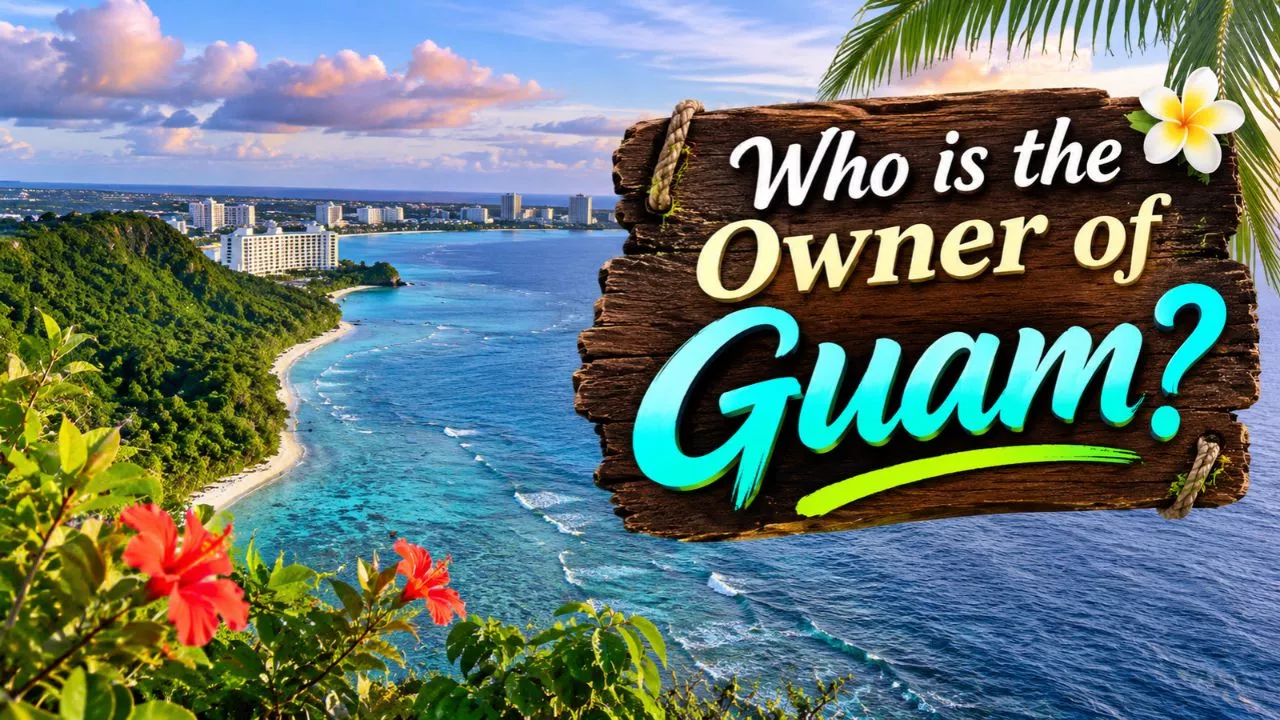
Guam is an island of about 212 square miles in the western Pacific. It is home to more than 150,000 people, a busy tourism industry, and some of the most important U.S. military bases in Asia. The short answer to who owns it is the United States. The full answer is layered, because sovereignty, land, and local government sit in different hands.
Who Owns Guam in 2026?
Guam is an organized, unincorporated territory of the United States. That means the U.S. holds sovereignty over the island, but Guam is not one of the 50 states. Congress has the final say, and the Interior Department’s Office of Insular Affairs handles relations with Washington, as this overview of Guam’s politics explains.
People born on Guam are U.S. citizens. They elect their own governor and a 15-member legislature, and they send a nonvoting delegate to the U.S. House. They cannot vote for president.
Ownership and Key Stakeholders Table
| Party | Role | What They Hold | Key Detail |
|---|---|---|---|
| United States (Congress and the President) | Sovereign power | Sovereignty over Guam | Acquired from Spain under the 1898 Treaty of Paris |
| Office of Insular Affairs | Federal liaison | Manages federal-territory relations | Part of the Department of the Interior |
| Government of Guam | Local government | Governs under the 1950 Organic Act; manages public land | Governor Lou Leon Guerrero (term-limited) |
| U.S. Department of Defense | Largest federal landholder | Roughly 25–29% of the island’s land | Andersen Air Force Base, Naval Base Guam, Camp Blaz |
| Chamorro Land Trust Commission | Territorial land program | Leases government land to qualified Chamorros | Lease rate of $1 per year |
| Private owners | Families and businesses | The remaining land | Includes ancestral family land |
| People of Guam | U.S. citizens | Citizenship since 1950 | Roughly 39% are CHamoru, the island’s indigenous people |
How the United States Came to Own Guam
Ferdinand Magellan reached the island on March 6, 1521. Spain began formal colonization in 1668, when Jesuit missionaries arrived, according to Joint Region Marianas. Spain held Guam for more than two centuries.
The U.S. captured the island on June 21, 1898, during the Spanish–American War. Spain ceded it under the Treaty of Paris, signed December 10, 1898, and the Navy then ran Guam as a naval government, as the Naval Government of Guam page describes. Residents were not granted U.S. citizenship during those decades.
Japan invaded on December 8, 1941, hours after Pearl Harbor. It occupied the island for about 31 months, until American forces retook it on July 21, 1944, now marked as Liberation Day. In 1950, the Guam Organic Act gave residents citizenship and created a civilian government, moving Guam from the Navy to the Interior Department, as Guampedia notes.
What “Unincorporated Territory” Really Means
Unincorporated means not every part of the U.S. Constitution applies automatically, and Guam has no voting seat in Congress. The United Nations also lists Guam among 17 non-self-governing territories, according to Wikipedia’s Guam entry. Island leaders have debated statehood, free association, independence, or keeping the current status for decades.
Strategic places often work this way. As with the Panama Canal, the party that legally owns a place and the party that uses it can be two different things.
Who Owns the Land on Guam?
Sovereignty is one thing, and land title is another. The Department of Defense holds roughly a quarter of the island, about 36,000 acres, according to Guampedia’s land update. Other estimates run closer to 29%.
Right after World War II the figure was far higher. Guampedia says the military controlled more than 85,000 acres, about 63% of the island. The Chamorro Land Trust lets qualified applicants lease government land for $1 a year, and the Guam Ancestral Lands Commission works to return excess federal land to its original owners.
The Military Footprint in 2026
Guam hosts Andersen Air Force Base, Naval Base Guam, and Marine Corps Base Camp Blaz. Camp Blaz was activated on October 1, 2020, and it was the first new Marine base since 1952, according to the Congressional Research Service.
Roughly two-thirds of an $8.9 billion relocation budget has been spent. About 150 Marines were assigned as of January 2026, with about 4,000 more expected from Okinawa, Stars and Stripes reported. The island is also getting a layered missile defense that reportedly includes THAAD, a system built by Lockheed Martin.
The Council on Foreign Relations says Defense Department spending on Guam was about $2.5 billion in fiscal 2022. That was roughly 41% of the island’s GDP.
Who Runs Guam Today, and What Changed in November 2026
Lou Leon Guerrero, a Democrat, is the current governor and is term-limited. In the November 3, 2026 election, Republican Vicente “Tony” Ada and running mate E.J. Calvo led Democrats Therese Terlaje and Sabina Perez by 15,945 votes to 14,925, according to The Guam Daily Post. Terlaje conceded.
In the delegate race, Democrat Alicia Limtiaco led incumbent Republican James Moylan 15,645 to 14,983, Newsweek reported. All results stay unofficial until the Guam Election Commission certifies them.
Guam’s Economy: Tourism and the Military
Guam’s economy rests on two pillars, tourism and military spending. The island drew about 688,000 visitors in fiscal 2026, down 5.6%, while Japanese arrivals rose 3.1% to 246,438, according to eTurboNews. Japan alone supplies roughly 36% of visitors.
Frequently Asked Questions (FAQs)
Q1. Who owns Guam?
The United States holds sovereignty over Guam, which is an organized, unincorporated territory.
Q2. Is Guam a U.S. state?
No, Guam is a territory and has no voting seat in Congress.
Q3. When did the U.S. take Guam?
The U.S. captured it on June 21, 1898, and Spain ceded it under the Treaty of Paris.
Q4. Are people from Guam U.S. citizens?
Yes, the 1950 Organic Act granted them citizenship.
Q5. Can Guam residents vote for president?
No, they elect a nonvoting delegate to the U.S. House instead.
Q6. How much of Guam does the military own?
The Department of Defense holds roughly a quarter of the land, and some estimates say about 29%.
Q7. Who is the governor of Guam?
Lou Leon Guerrero is governor now, and Tony Ada led the unofficial 2026 results to succeed her.
Q8. Who ruled Guam before the United States?
Spain ruled it from 1668 to 1898, and Japan occupied it from 1941 to 1944.
Official website: guam.gov
Guam belongs to the United States as an organized, unincorporated territory, held since the 1898 Treaty of Paris. Its people are U.S. citizens with a local government and a nonvoting delegate, but no vote for president. The island’s land is split among the Department of Defense (roughly a quarter or more), the Government of Guam, and private owners.
In November 2026, Guam appeared to elect a new Republican governor and a Democratic delegate, pending certification. The question of Guam’s long-term political status remains open.