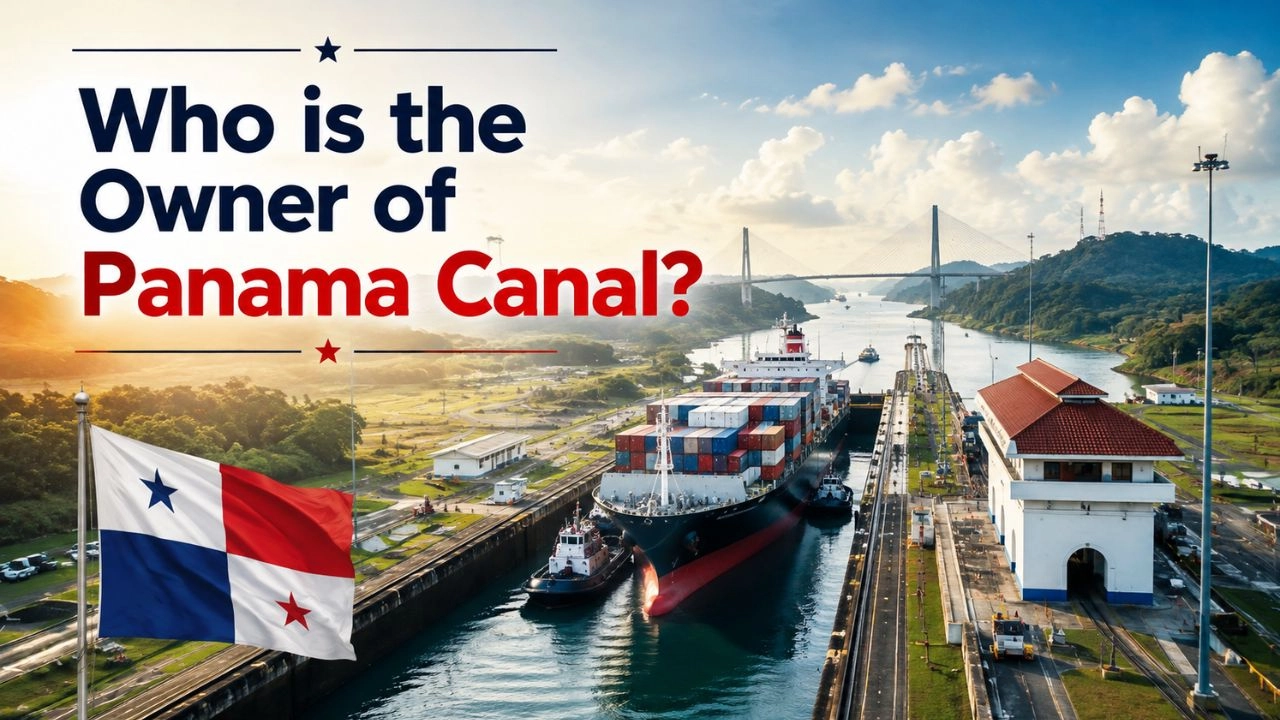
Every single day, dozens of massive cargo ships, oil tankers, and cruise liners squeeze through a narrow stretch of water in Central America that is only 40 miles long. In doing so, they move approximately 5% of all global trade.
That strip of water is the Panama Canal — and it sits at the center of one of the most politically charged ownership stories on the planet right now.
The legal answer is clean and simple: Panama owns the canal. The Republic of Panama has held 100% constitutional ownership of the waterway since December 31, 1999, and no foreign government has any ownership stake in the canal itself.
But the real story of who controls what around the Panama Canal in 2026 is anything but simple. It involves President Trump’s threats to “take back” the canal, a $23 billion port deal that China tried to block, and a Panama Supreme Court ruling that threw out a Hong Kong company’s port concession overnight.
More Sports Franchise Ownership Stories
Interested in more women’s sports franchise ownership stories? Read about who owns the Dallas Wings.
What Is the Panama Canal?
The Panama Canal is a constructed waterway that connects the Atlantic and Pacific Oceans across the Isthmus of Panama. It is owned and administered by Panama, and it is 40 miles long from shoreline to shoreline.
Ships can cross in either direction, and it takes about 10 hours to travel from one side to the other. Ships from any country are treated equally with respect to conditions of passage and tolls.
Panama Canal FY2025 revenue reached $5.71 billion, marking a 14.4% increase from FY2024. Total vessel transits recorded 13,404 ships — a 19.3% year-over-year increase.
The canal contributed $2.965 billion directly to Panama’s national treasury in FY2025 — approximately 4% of Panama’s entire GDP.
Who Owns the Panama Canal Right Now in 2026?
The Republic of Panama holds 100% ownership through constitutional mandate. The Panamanian people are the ultimate stakeholders. No government administration can sell or transfer control, regardless of political pressure.
The canal is managed day-to-day by the Panama Canal Authority (ACP) — an autonomous government agency of Panama.
The ACP board has 11 directors who set operational policies and guide long-term strategy. Each director serves a staggered nine-year term, designed to maintain continuity across different presidential administrations. Dr. Ricaurte Vásquez Morales has served as Administrator since September 2019.
It is critical to understand what Panama owns and what it does not. Panama owns and operates the canal itself — the locks, the water, the tolls, the management.
The ports on either side of the canal — Balboa and Cristóbal — are separate infrastructure historically managed by private operators under government concessions. That distinction is at the heart of every political battle happening around the canal right now.
Panama Canal Ownership and Key Stakeholders Table
| Party | Role | Status | Key Detail |
|---|---|---|---|
| Republic of Panama | 100% Owner of the Canal | Permanent constitutional ownership | Cannot be sold or transferred under Panamanian law |
| Panama Canal Authority (ACP) | Operator and Manager | Active autonomous government agency | 11-member board; Administrator Dr. Ricaurte Vásquez Morales |
| APM Terminals (Maersk subsidiary) | Interim Port Operator — Balboa Port | Temporary arrangement since Feb 24, 2026 | Stepped in after CK Hutchison concession ruled unconstitutional |
| MSC Terminal Investment Ltd (TIL) | Interim Port Operator — Cristóbal Port | Temporary arrangement since Feb 24, 2026 | Part of the original BlackRock consortium |
| BlackRock / Global Infrastructure Partners | Proposed Port Buyer | Deal stalled in 2026 | $23B deal announced March 2025; blocked by China |
| CK Hutchison Holdings | Former Port Concession Holder | Concession ruled unconstitutional Jan 30, 2026 | Hong Kong-based; operated Balboa and Cristóbal ports since 1997 |
| United States | Largest Canal User | No ownership since Dec 31, 1999 | ~40–70% of canal shipping traffic originates or ends in the U.S. |
| China / Cosco Shipping | Sought port stake | Not approved | Beijing pushed to include Cosco in BlackRock deal; deal stalled |
The History: How Panama Got Its Canal Back
The Panama Canal’s ownership history is one of the most dramatic stories in 20th century geopolitics.
The canal was first conceived as a French project in the 1880s, when engineer Ferdinand de Lesseps attempted to cut a sea-level canal through Panama. The project collapsed after engineering failures and devastating disease killed tens of thousands of workers.
The United States picked up where France left off. Theodore Roosevelt negotiated the Hay-Bunau-Varilla Treaty, giving the U.S. control of the Canal Zone. Work under U.S. supervision began in 1904, and the Panama Canal was completed in 1914.
The U.S. operated the canal for 85 years — but Panamanian resentment over American control of their land grew steadily.
The United States owned and operated the canal until 1977, when President Carter negotiated the canal treaties amid Panama City’s growing demands for sovereignty. The Torrijos-Carter Treaties established joint U.S.-Panamanian authority until 1999, at which point the United States relinquished full control to the Panama Canal Authority.
On December 31, 1999, the last American soldier left the Canal Zone. Panama took full sovereign control of its most important national asset — and that transfer has never been reversed.
Trump’s Push to “Take Back” the Canal
No story about the Panama Canal in 2026 is complete without addressing President Trump’s repeated statements about “reclaiming” the canal for the United States.
President Trump told Congress: “My administration will be reclaiming the Panama Canal, and we’ve already started doing it.”
The Panamanian government pushed back immediately. Panamanian President Jose Raul Mulino said that Trump was lying when he claimed his administration was “reclaiming” the Panama Canal.
Trump’s real focus was not the canal itself — which is constitutionally owned by Panama — but the ports on either side, which had been operated by CK Hutchison, a Hong Kong-based company with ties to China.
Hutchison Ports had recently been awarded a 25-year no-bid extension to run the ports, but an audit looking at that extension was already underway, widely seen as a step toward eventually rebidding the contract.
The $23 Billion BlackRock Deal — And China’s Attempt to Block It
The most dramatic business story surrounding the canal broke on March 5, 2025.
CK Hutchison Holding agreed to sell all shares in its port subsidiaries to a consortium in a deal valued at $22.8 billion. The deal would give BlackRock, Global Infrastructure Partners, and Terminal Investment Limited control over 43 ports in 23 countries — including Balboa and Cristóbal at either end of the Panama Canal.
Trump celebrated the deal as a foreign policy win. But Beijing had other ideas.
China’s market regulator launched a review of the deal. Beijing pushed for state-owned shipping giant Cosco to be included in the transaction. Amid mounting pressure, CK Hutchison announced that the exclusive negotiation window with BlackRock had expired.
As of 2026, the BlackRock deal remains unresolved — stalled between Washington’s desire for American control and Beijing’s determination to block any outcome that excludes Chinese interests.
The Panama Supreme Court Ruling: CK Hutchison Is Out
While the geopolitical tug-of-war played out, Panama’s own legal system delivered a landmark ruling.
On January 30, 2026, the Supreme Court of Panama ruled that CK Hutchison’s concession renewal to run the two ports was unconstitutional. The company’s ties to Beijing had become a major sticking point for the U.S., making the ruling a win for President Trump.
The Panamanian government formally took over the two ports on February 24, 2026. APM Terminals (a Maersk subsidiary) would temporarily operate Balboa, while MSC’s Terminal Investment Limited would temporarily operate Cristóbal.
CK Hutchison — the company at the center of the entire political storm — is now completely out. The ports it operated for nearly 30 years are under Panamanian government control.
Does China Own or Control the Panama Canal?
This is the single most common misconception about the canal — and the answer is an emphatic no.
China does not own or run any part of the Panama Canal. It is managed and run by the ACP, an authority appointed by the President and approved by the Assembly. All of the board members are Panamanian.
What China had was an indirect relationship through CK Hutchison — a private Hong Kong-based company that operated two of the four major ports adjacent to the canal.
Its Hong Kong roots and Chinese regulatory exposure gave Beijing leverage over its business decisions — which is precisely what concerned Washington. With the Panama Supreme Court ruling of January 30, 2026, even that indirect connection is now gone.
The Canal’s $8.5 Billion Future
Despite all the political noise, the Panama Canal Authority is getting on with one of the most ambitious infrastructure programs in its history.
The ACP announced an $8.5 billion modernization plan running through 2035. The initiative includes new container terminals at Corozal and Telfers Island that will add 5.5 million TEUs of capacity.
A $1.6 billion Rio Indio reservoir project is also planned, targeting completion by 2031 to address water supply challenges — a critical issue after 2023’s historic drought forced the canal to limit ship crossings and raise tolls dramatically.
Frequently Asked Questions (FAQs)
Q1. Who owns the Panama Canal in 2026?
The Republic of Panama owns 100% of the Panama Canal through a permanent constitutional mandate that cannot be overridden by any foreign government.
Q2. Does the United States own the Panama Canal?
No. The U.S. transferred full ownership to Panama on December 31, 1999, under the Torrijos-Carter Treaties signed in 1977.
Q3. Does China own or control the Panama Canal?
No. The canal is run entirely by the Panama Canal Authority, staffed by Panamanians. China has no ownership stake in the canal itself.
Q4. Who managed the Panama Canal ports before 2026?
CK Hutchison, a Hong Kong-based company, operated Balboa and Cristóbal ports since 1997 — until Panama’s Supreme Court ruled its concession unconstitutional on January 30, 2026.
Q5. What is the BlackRock Panama Canal deal?
In March 2025, BlackRock struck a $22.8 billion deal to buy CK Hutchison’s global ports including the two Panama ports — but China’s regulatory resistance has stalled the deal as of 2026.
Q6. How much revenue does the Panama Canal generate?
The canal generated $5.71 billion in revenue in FY2025, contributing $2.965 billion directly to Panama’s national treasury.
Q7. Who currently operates the Panama Canal ports in 2026?
Since February 24, 2026, APM Terminals (a Maersk subsidiary) operates Balboa and MSC’s Terminal Investment Limited operates Cristóbal on a temporary basis.
Q8. Can the U.S. take back the Panama Canal?
No. Under Panamanian constitutional law, the canal is inalienable national patrimony and cannot legally be sold or transferred to any foreign entity — including the United States.
The Panama Canal is owned by the Republic of Panama — fully, constitutionally, and permanently. It has been Panama’s since December 31, 1999, when the Torrijos-Carter Treaties completed the handover from the United States.
The canal is operated by the Panama Canal Authority and generated $5.71 billion in revenue in FY2025.
The ports on either side — Balboa and Cristóbal — are a separate matter. CK Hutchison’s concession was ruled unconstitutional on January 30, 2026. The Panamanian government took control on February 24, 2026. A $23 billion BlackRock deal to transfer those ports to American control remains stalled due to Chinese resistance.
Trump can threaten to “reclaim” the canal all he wants. Panama’s constitution says otherwise — and so does international law.