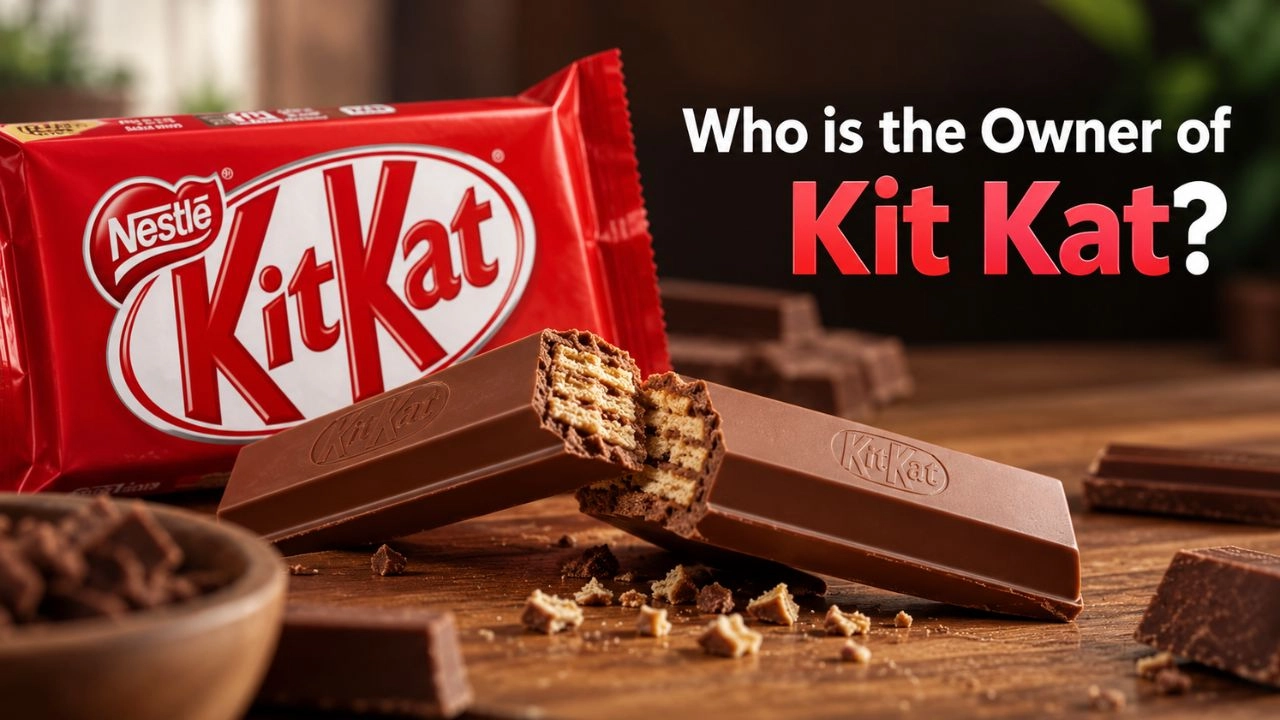
There is a very good chance you have snapped open a Kit Kat at some point today — or at least thought about it. With more than 5 billion bars sold every year across 85+ countries, Kit Kat is one of the most consumed chocolate products on the planet.
But here is the twist: the answer to “who owns Kit Kat?” is actually two different answers depending entirely on which country you are standing in. And the reason why is one of the most fascinating accidental business arrangements in the history of food.
Who Owns Kit Kat Right Now in 2026?
Kit Kat is owned globally by Nestlé S.A. — the Swiss multinational food and beverage corporation headquartered in Vevey, Switzerland. Nestlé acquired Kit Kat in June 1988 when it purchased Rowntree’s of York, England for $4.6 billion — gaining worldwide rights to produce and sell Kit Kat in every country on Earth.
There is one enormous exception: the United States. In the US, Kit Kat is made and sold exclusively by The Hershey Company — one of the biggest chocolate manufacturers in America — under a perpetual licensing agreement that dates back to 1970. When Nestlé bought Rowntree’s in 1988, it had no choice but to honor the existing Hershey agreement. That means two completely separate companies own and produce the same Kit Kat bar, depending on which side of the Atlantic you are on.
Ownership and Key Stakeholders Table
| Owner / Party | Role | Territory | Key Detail |
|---|---|---|---|
| Nestlé S.A. | Global Brand Owner | Worldwide except USA | Acquired Kit Kat via Rowntree’s purchase in June 1988 for $4.6 billion |
| Rowntree’s of York | Original Creator | UK (1935–1988) | Created Kit Kat in 1935; sold to Nestlé in 1988 |
| The Hershey Company | US Licensee | United States only | Holds a perpetual license since 1970; Kit Kat is one of Hershey’s top 5 brands |
| H.B. Reese Candy Company | Hershey’s manufacturing arm | United States | Division of Hershey that physically produces US Kit Kats |
| Nestlé Confectionery Japan | Regional Partner | Japan | Produces 350+ unique Japan-exclusive Kit Kat flavors |
| Vanguard Group | Largest Nestlé Shareholder | Institutional | Major institutional investor in Nestlé (NESN on SIX Swiss Exchange) |
| BlackRock | Major Nestlé Shareholder | Institutional | Significant institutional holder of Nestlé shares |
| Public Shareholders | Retail Investors | Global | Nestlé is publicly traded on the SIX Swiss Exchange under NESN |
The Origin Story: A York Factory Worker’s Lunch Box Idea
Kit Kat was not invented by a scientist or a marketing executive. According to Nestlé’s own official records, the idea came from an ordinary factory worker.
Rowntree’s, a confectionery company based in York, England, had been trading since 1862 and trademarked the names “Kit Cat” and “Kit Kat” in 1911 — names originally associated with a political club called the Kit-Cat Club, whose members ate mutton pies made by a pastry chef named Christopher Cat in 18th-century London. The company used those names for a box of chocolate crisps in the 1920s, but the product did not take off.
The breakthrough came from a suggestion box. Thanks to an employee suggesting an idea for a chocolate bar that could easily fit in a lunch box, the bars that you know and love today made their first appearance on 29 August 1935. That first Kit Kat was a four-finger, chocolate-covered wafer bar — identical in concept to what 5 billion people enjoy today.
The bar was an immediate hit in London and across Southern England. By the 1940s, Kit Kat had been exported to Canada, South Africa, Ireland, Australia, and New Zealand. In 1957, advertising executive Donald Gilles created the iconic slogan “Have a Break, Have a Kit Kat” — one of the most recognized advertising lines in history, still used globally today.
How Nestlé Took Control: The $4.6 Billion Rowntree’s Deal
The single most important event in Kit Kat’s ownership history happened in June 1988 — and it was one of the biggest food industry acquisitions of the entire decade.
Swiss company Nestlé purchased Rowntree’s of York for $4.6 billion, giving Nestlé global rights to Kit Kat and all other Rowntree’s brands including Rolo, Polo, and After Eight. It was a landmark deal that transformed Nestlé into the world’s most powerful confectionery company overnight. Nestlé moved quickly to build production capacity, establishing new Kit Kat manufacturing facilities in Malaysia, India, China, and Japan to meet global demand.
The only problem was the United States — where an existing licensing agreement with The Hershey Company, signed back in 1970 by Rowntree’s, meant Nestlé could not sell its own Kit Kat in the world’s largest consumer market. Nestlé was legally obligated to honor the deal. It tried on multiple occasions to buy its way out of the agreement, but Hershey refused every approach — and has continued to do so ever since.
The Hershey Deal: Why America Gets a Different Kit Kat
The US Kit Kat story is genuinely unique in the history of branded consumer goods — and it all comes down to a 1970 handshake between Rowntree’s and Hershey.
Rowntree’s wanted distribution muscle in the American market in the 1970s, and Hershey was the obvious partner. The two companies signed a perpetual licensing agreement in 1970, giving Hershey the exclusive right to manufacture and sell Kit Kat in the United States. The agreement included a critical clause: Hershey could keep the Kit Kat license permanently — unless Hershey itself was sold to another company.
When Nestlé bought Rowntree’s in 1988, it inherited this agreement and had no legal way to terminate it. Nestlé tried to acquire Hershey in 2002 specifically to reclaim the Kit Kat rights, but Hershey rejected the offer. The license remains in place today and is described by Hershey as one of its five most important brands in the American market.
The result is that American Kit Kats and Nestlé Kit Kats are actually slightly different products. They use different chocolate recipes, different manufacturing processes, and different flavor profiles. Many chocolate enthusiasts insist the Nestlé version has a creamier, smoother taste — though Hershey fans will strongly disagree.
Kit Kat Turns 90: A Brand Worth €8 Billion
2025 marked a historic milestone — Kit Kat’s 90th birthday. And the numbers behind the celebration are extraordinary.
Kit Kat is available in over 85 countries with more than 5 billion bars sold annually, making it Nestlé’s leading confectionery brand in terms of both revenue and brand value. Most recently, Nestlé launched the Kit Kat bar aggressively across Europe, where sales grew by over 1.4 billion Swiss francs (approximately €1.49 billion) in just two years, bringing the total Kit Kat brand value to 7.5 billion Swiss francs — approximately €8 billion — in 2025.
The home of Kit Kat — York, England — still produces the bar today, in the same city where it was invented in 1935. York’s R&D and manufacturing headquarters for Kit Kat remain the brand’s creative and technical heartbeat, even as production spans the globe.
Japan’s Kit Kat Obsession: 350+ Flavors and Counting
No article about Kit Kat ownership is complete without acknowledging the extraordinary phenomenon that has unfolded in Japan under Nestlé’s ownership.
Nestlé Japan has turned Kit Kat into something far beyond a chocolate bar — it is a cultural institution. Japan produces over 350 unique Kit Kat flavors, including matcha, sake, wasabi, soy sauce, strawberry cheesecake, roasted tea, and seasonal limited editions. Development of a new flavor in Japan can take less than a week. Kit Kat is also a popular gift in Japan because its name sounds similar to the Japanese phrase “Kitto Katsu” — meaning “You will surely win” — making it a beloved good-luck gift for students before exams.
Nestlé has fully leaned into this cultural connection, opening dedicated Kit Kat boutique shops across Japan and partnering with local chefs and artisans to create premium flavor experiences that bear almost no resemblance to the simple wafer bar sold in a York corner shop in 1935.
Formula 1 Partnership: Kit Kat’s Biggest New Deal in 2025
In 2025, Nestlé announced a landmark multi-year partnership making Kit Kat the official break of Formula 1 — one of the biggest sports sponsorship deals in the brand’s 90-year history. The partnership spans F1 races globally and includes branding at circuits, on broadcasts, and across digital channels — perfectly aligning the “Have a Break” messaging with the high-intensity, fast-paced world of motorsport.
The F1 deal signals exactly how Nestlé is thinking about Kit Kat in 2026 — not just as a chocolate bar, but as a global lifestyle brand with the marketing power and financial muscle to compete for the world’s biggest sponsorship properties.
Frequently Asked Questions (FAQs)
Q1. Who owns Kit Kat in 2026?
Kit Kat is owned globally by Nestlé S.A., except in the United States, where it is produced under a perpetual license by The Hershey Company.
Q2. When did Nestlé buy Kit Kat?
Nestlé acquired Kit Kat in June 1988 when it purchased the original creator Rowntree’s of York, England for $4.6 billion.
Q3. Who created Kit Kat originally?
Kit Kat was created by Rowntree’s — a confectionery company based in York, England — and launched on 29 August 1935, inspired by a factory worker’s suggestion for a chocolate bar that fits in a lunch box.
Q4. Why does Hershey make Kit Kat in the USA?
Hershey signed a perpetual licensing agreement with Rowntree’s in 1970, giving it exclusive rights to produce Kit Kat in the US. When Nestlé bought Rowntree’s in 1988, it was legally required to honor that deal.
Q5. Is the US Kit Kat different from Nestlé’s Kit Kat?
Yes. Hershey uses its own chocolate recipe for US Kit Kats, while Nestlé uses a different formulation globally — resulting in slightly different taste profiles between the two versions.
Q6. How much is the Kit Kat brand worth in 2026?
Kit Kat is valued at approximately 7.5 billion Swiss francs (around €8 billion) in 2025, making it Nestlé’s most valuable confectionery brand by revenue and brand value.
Q7. How many Kit Kat flavors exist in Japan?
Nestlé Japan produces over 350 unique Kit Kat flavors, including matcha, sake, wasabi, and hundreds of seasonal limited editions, making Japan the global capital of Kit Kat innovation.
Q8. Is Nestlé publicly traded?
Yes. Nestlé S.A. is publicly traded on the SIX Swiss Exchange under the ticker symbol NESN, with major institutional shareholders including Vanguard Group and BlackRock.
Kit Kat is owned globally by Nestlé S.A., the Swiss food giant that acquired the brand through its $4.6 billion purchase of Rowntree’s in June 1988. In the United States, Kit Kat is produced and sold exclusively by The Hershey Company under a perpetual license dating to 1970 — an arrangement Nestlé inherited and has never been able to change.
Nestlé is publicly traded on the SIX Swiss Exchange under NESN, with major institutional shareholders including Vanguard and BlackRock.
Kit Kat turned 90 years old in 2025, is now worth €8 billion as a brand, sells over 5 billion bars annually in 85+ countries, has 350+ flavors in Japan, and just signed a landmark deal as the official break of Formula 1. From a York factory worker’s lunch box idea to one of the most valuable chocolate brands in the world — the story of Kit Kat is as satisfying as the bar itself.