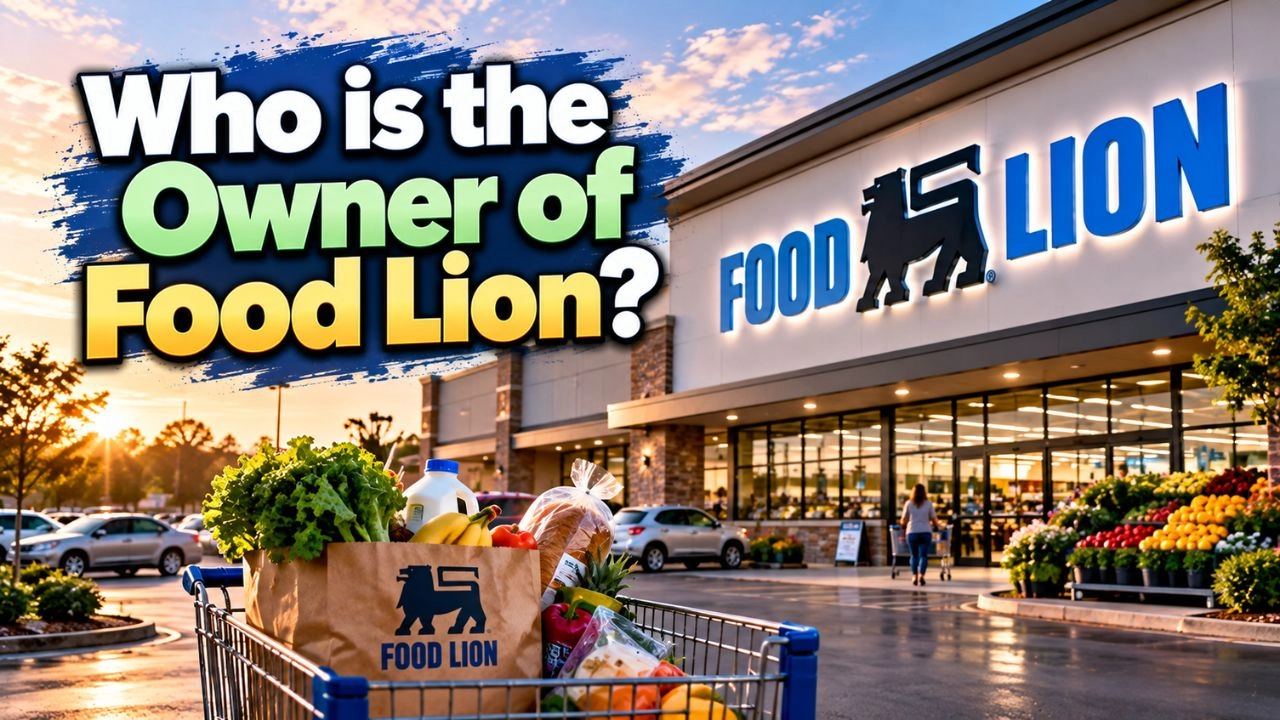
Walk into any Food Lion store across the American Southeast or Mid-Atlantic, and you will find wide aisles, affordable prices, and a familiar green-and-white logo featuring a roaring lion. What most shoppers do not know is that this deeply American grocery chain is actually owned by a company headquartered in the Netherlands — one of the largest retail food groups on the entire planet. Here is the full, verified story of who owns Food Lion and how it got there.
What Is Food Lion?
Food Lion is an American regional supermarket chain founded in 1957 and headquartered in Salisbury, North Carolina. As of 2026, it operates over 1,100 stores across 10 states — primarily in the Southeast and Mid-Atlantic regions — and employs more than 82,000 associates serving nearly 10 million customers every week.
The chain originally opened under the name Food Town before rebranding to Food Lion in 1983. The lion in the name came directly from its parent company’s logo — Delhaize, the Belgian grocery giant that had acquired the chain nearly a decade earlier and whose brand featured a lion prominently in its identity.
Who Owns Food Lion in 2026?
Food Lion is owned by Ahold Delhaize — a Dutch-Belgian multinational grocery and retail company officially named Koninklijke Ahold Delhaize N.V., headquartered in Zaandam, Netherlands. It is publicly traded on Euronext Amsterdam under the ticker symbol AD.
More specifically, Food Lion is directly owned and operated by Ahold Delhaize USA — the American division of Ahold Delhaize that manages all of the group’s grocery brands in the United States. In June 2026, Claire Peters was appointed as the new CEO of Ahold Delhaize USA, replacing Jerry W. Fleeman. The overall President and CEO of the parent company Ahold Delhaize is Frans Muller.
Ownership and Key Stakeholders Table
| Owner / Shareholder | Type | Stake | Key Detail |
|---|---|---|---|
| Ahold Delhaize N.V. (Euronext: AD) | Direct Parent Company | 100% of Food Lion LLC | Dutch-Belgian multinational; headquartered in Zaandam, Netherlands |
| Ahold Delhaize USA | Operational Parent | Manages all U.S. Food Lion stores | U.S. division overseeing Food Lion, Stop & Shop, Giant, Hannaford |
| BlackRock, Inc. | Largest Institutional Shareholder | ~5.19% of Ahold Delhaize | World’s largest asset manager; top named shareholder of AD |
| The Vanguard Group | Second Largest Institutional Shareholder | ~4.11–4.66% of Ahold Delhaize | Passive index giant; consistent major holder of AD shares |
| JPMorgan Chase & Co. | Institutional Investor | ~3.23% of Ahold Delhaize | Major Wall Street institutional holder of AD |
| State Street Global Advisors | Institutional Investor | ~3.03% of Ahold Delhaize | Major index fund manager; consistent AD shareholder |
| Amundi Asset Management | Institutional Investor | ~3.08% of Ahold Delhaize | Europe’s largest asset manager |
| General Public / Retail Investors | Public Shareholders | ~49–51% of Ahold Delhaize | Broadly held; no single controlling private shareholder |
| Frans Muller | President & CEO of Ahold Delhaize | Less than 1% insider stake | Leads the entire Ahold Delhaize group globally |
| Claire Peters | CEO of Ahold Delhaize USA | Management role | Appointed June 2026; directly oversees Food Lion operations |
The Origin Story: Three Founders, One Small Town, One Big Dream
The story of Food Lion begins not with a multinational corporation but with three ordinary grocery men in a small North Carolina city.
Wilson Smith, Ralph Ketner, and Brown Ketner opened the first Food Town store in Salisbury, North Carolina on March 5, 1957. Their vision was simple — offer groceries at consistently low prices in a clean, efficient store.
Ralph Ketner in particular championed a bold LFPINC philosophy — “Lowest Food Prices in North Carolina” — which drove aggressive pricing that built fierce customer loyalty across the region. Throughout the 1960s and early 1970s, the founders steadily expanded their small chain, opening new locations across the Carolinas.
That regional success attracted exactly the kind of attention the founders might have expected — from buyers. In 1974, the Belgian grocery company Delhaize Group purchased the Food Town chain, marking the moment when this small-town North Carolina grocery store became part of a global enterprise.
The Name Change: Why Food Town Became Food Lion
One of the most charming details in Food Lion’s history is how it got its distinctive name — and it had more to do with saving money than brand strategy.
The chain operated as Food Town until 1983, when it needed to expand into regions where other unrelated stores were already using the Food Town name. The owners needed a new name that worked nationally.
Two factors drove the final choice of Food Lion: first, parent company Delhaize already had a lion in its logo and used it on many store-brand products; second — and perhaps more importantly — changing the word “Town” to “Lion” meant switching out only two letters, saving enormously on rebranding costs like signage, uniforms, and packaging.
On December 12, 1982, the name change was announced, and by the end of March 1983, every store had been rebranded to Food Lion.
The chain’s beloved mascot Leo the Food Lion has been part of the brand since January 17, 1997, adding a friendly face to the familiar lion logo.
How Ahold Delhaize Was Created: The 2016 Mega-Merger
For most of its corporate life, Food Lion was owned by the Delhaize Group alone — the Belgian grocery company that had purchased it in 1974. That changed permanently in 2016.
On July 25, 2016, Delhaize Group completed a landmark merger with Koninklijke Ahold N.V. — the Dutch retail giant — to form Ahold Delhaize.
The merger combined two of Europe’s most respected grocery companies into a single organization that immediately became one of the largest food retail groups in the world. The deal was structured so that Ahold shareholders received 61% of the new combined entity, while Delhaize shareholders received the remaining 39%. The new company began trading on Euronext Amsterdam on the same day under the ticker AD.
For Food Lion, the practical impact was clear: it went from being a brand under a purely Belgian parent company to being one brand in a massive Dutch-Belgian multinational portfolio that also includes Stop & Shop, Giant, Hannaford, FreshDirect, and Peapod Digital Labs in the United States alone.
How Big Is Ahold Delhaize — And What Else Does It Own?
Ahold Delhaize is one of the largest grocery retailers in the world, and Food Lion is just one piece of a very large operation.
Ahold Delhaize generated revenue of €89.4 billion in 2024, making it one of the top 20 largest retail companies globally by revenue. In the U.S. alone, Ahold Delhaize operates over 2,000 stores across 23 states through its various regional brands.
Beyond Food Lion, its U.S. portfolio includes Stop & Shop (Northeast), The GIANT Company (mid-Atlantic), Giant Food (mid-Atlantic), and Hannaford (New England and upstate New York).
Ahold Delhaize is rated Investment Grade BBB+ (Long-Term) by S&P — a strong credit rating that reflects the financial stability and scale of the company that ultimately stands behind every Food Lion store.
Who Are the Biggest Shareholders of Ahold Delhaize in 2026?
Because Ahold Delhaize is publicly traded, ownership of Food Lion flows through whoever holds AD shares. The ownership is widely distributed, with no single private family or investor holding a dominant controlling position.
BlackRock, Inc. is the largest institutional shareholder of Ahold Delhaize, holding approximately 5.19% of shares as of August 2026. The Vanguard Group is the second largest at approximately 4.11–4.66%, followed by JPMorgan Chase (~3.23%), State Street Global Advisors (~3.03%), and Amundi Asset Management (~3.08%).
The Norwegian Government Pension Fund Global (Norges Bank) holds approximately 2.9%. General public and retail investors collectively own roughly 49–51% of the company — making them the single largest ownership group in aggregate.
Frequently Asked Questions (FAQs)
Q1. Who owns Food Lion in 2026?
Food Lion is owned by Ahold Delhaize N.V., a publicly traded Dutch-Belgian multinational grocery company headquartered in Zaandam, Netherlands.
Q2. Is Food Lion an American company?
Food Lion was founded in America in 1957, but its parent company Ahold Delhaize is a Netherlands-based multinational — so it is American-operated but foreign-owned.
Q3. When did Delhaize buy Food Lion?
The Belgian grocery company Delhaize Group purchased the Food Town chain — now Food Lion — in 1974, marking the start of its foreign ownership.
Q4. What is the parent company of Food Lion?
The parent company is Ahold Delhaize N.V. (Euronext: AD), formed through the 2016 merger of Ahold and Delhaize Group, with Food Lion managed under its Ahold Delhaize USA division.
Q5. Who is the CEO of Food Lion’s parent company in 2026?
Frans Muller is the President and CEO of Ahold Delhaize, while Claire Peters was appointed CEO of Ahold Delhaize USA in June 2026, directly overseeing Food Lion.
Q6. How many Food Lion stores are there in 2026?
Food Lion operates over 1,100 stores across 10 U.S. states, primarily in the Southeast and Mid-Atlantic regions, with more than 82,000 employees.
Q7. Who are the biggest shareholders of Ahold Delhaize in 2026?
The largest shareholders are BlackRock (~5.19%), Vanguard (~4.66%), JPMorgan Chase (~3.23%), and State Street Global Advisors (~3.03%), as of August 2026.
Q8. Why did Food Town change its name to Food Lion?
In 1983, the chain rebranded to Food Lion to expand nationally — combining parent Delhaize’s lion logo with a name change of only two letters from “Town” to “Lion,” saving significantly on rebranding costs.
Food Lion is owned by Ahold Delhaize N.V. — a publicly traded Dutch-Belgian multinational grocery company headquartered in Zaandam, Netherlands, trading on Euronext Amsterdam under the ticker AD.
Food Lion operates as a subsidiary of Ahold Delhaize USA, the company’s American division, now led by Claire Peters, who was appointed CEO in June 2026.
The chain was founded in 1957 as Food Town in Salisbury, North Carolina, acquired by Belgian grocer Delhaize Group in 1974, rebranded to Food Lion in 1983, and became part of the global Ahold Delhaize group following the 2016 merger.
Today, with over 1,100 stores, 82,000 employees, and nearly 10 million weekly customers, Food Lion remains one of the most important grocery chains in the American South — quietly backed by one of the most powerful retail companies on earth.