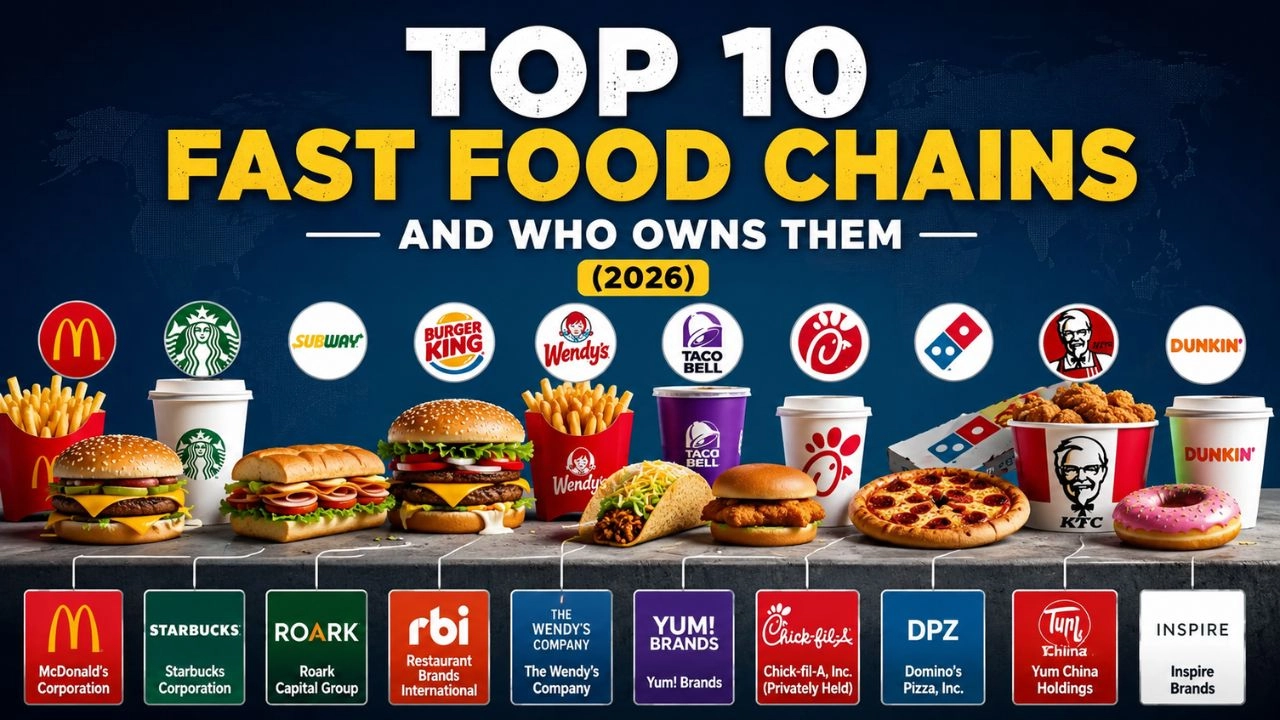
Drive past any American suburb and you’ll see the logos: golden arches, white-and-red, blue-and-yellow. What’s invisible from the parking lot is that more than half of the country’s biggest quick-service chains are actually owned by just three corporate parents — Yum! Brands, Restaurant Brands International, and Inspire Brands. The other half is either independently public, family-owned, or held by private equity. Here’s a map of the ten biggest fast-food chains in America and exactly who collects the franchise fees.
How we built this list
Ranking is by US system-wide sales (most recent full-year reported figures, mid-2025). I’ve focused on traditional fast food, not fast-casual or sit-down chains. Franchise structures are included — most of these brands are run through a parent company that owns the brand and licenses it to thousands of franchisees who actually operate the restaurants.
The Top 10
1. McDonald’s — McDonald’s Corporation (independent, public)
McDonald’s Corporation is publicly traded on the NYSE (ticker: MCD) and operates more than 41,000 locations globally. The largest shareholders are passive institutional investors: Vanguard (~9%), BlackRock (~7%), and State Street. The company is the world’s largest restaurant by revenue and brand value. Approximately 95% of locations are operated by franchisees who pay royalties to corporate.
2. Starbucks — Starbucks Corporation (independent, public)
Although often described as fast-casual rather than fast-food, Starbucks’ scale and operating model fit this list. The company is public (NASDAQ: SBUX). Largest shareholders are Vanguard, BlackRock, and State Street. Founder Howard Schultz retained an emeritus role until 2023 and currently holds approximately 1.5% of shares.
3. Subway — Roark Capital
Subway, the world’s largest sandwich chain by location count, was sold by the founding DeLuca and Buck families to Roark Capital for ~$9.6 billion in 2024. Roark also owns Arby’s, Inspire Brands (Buffalo Wild Wings, Sonic, Jimmy John’s, Dunkin’), and several other restaurant brands — making it the largest US restaurant private-equity holder.
4. Yum! Brands — KFC, Pizza Hut, Taco Bell, Habit Burger
Yum! Brands (NYSE: YUM) owns four of the largest US chains. The company was spun off from PepsiCo in 1997 and has been independent since. Major shareholders are passive institutionals; activist investor Keith Meister of Corvex Management has periodically held meaningful positions. Yum China was further spun off in 2016 and is now separately listed.
5. Restaurant Brands International — Burger King, Tim Hortons, Popeyes, Firehouse Subs
RBI (NYSE: QSR) is the parent of four major chains following the 2014 merger of Burger King and Tim Hortons, plus the 2017 Popeyes acquisition and 2021 Firehouse Subs purchase. 3G Capital, the Brazilian-American PE firm behind the original Burger King deal, holds the largest single ownership stake at approximately 28%.
6. Inspire Brands — Arby’s, Buffalo Wild Wings, Sonic, Jimmy John’s, Dunkin‘, Baskin-Robbins
Inspire Brands is the operating company behind several major chains, all consolidated under Roark Capital ownership. The portfolio came together through a series of acquisitions: Arby’s (Roark, 2011), Buffalo Wild Wings (2018), Sonic (2018), Jimmy John’s (2019), and Dunkin’ Brands (2020, for $11.3B). Paul Brown is CEO.
7. Chick-fil-A — Cathy family (private)
Chick-fil-A remains tightly owned by the Cathy family, descendants of founder S. Truett Cathy. The company is private and not for sale; the family has been outspoken about keeping it that way. Dan Cathy serves as chairman; Andrew T. Cathy as CEO. The chain has the highest average per-unit revenue of any US fast-food brand.
8. Chipotle — Public (NYSE: CMG)
Chipotle is an independent public company. The largest shareholders are passive institutional investors (Vanguard, BlackRock, State Street) and activist investor Bill Ackman (Pershing Square), who built a stake in 2016 that influenced the choice of CEO Brian Niccol — who himself was poached by Starbucks in 2024.
9. Domino’s Pizza — Public, broad institutional ownership
Domino’s Pizza (NYSE: DPZ) is publicly traded with no controlling shareholder. The Domino’s franchise model is one of the most studied in the industry — corporate owns roughly 5% of stores, franchisees operate the rest. Bain Capital was a long-term private-equity owner pre-IPO (1998–2010) but has since fully exited.
10. In-N-Out Burger — Snyder family (private)
In-N-Out remains family-owned by Lynsi Snyder, granddaughter of founder Harry Snyder. The chain is famously slow-growing and refuses to franchise. Lynsi Snyder is the sole owner and has stated publicly that she will not sell or take the company public during her lifetime.
At-a-glance comparison
| Rank | Chain | Parent / Owner | Type |
|---|---|---|---|
| 1 | McDonald’s | McDonald’s Corp. (public) | Public |
| 2 | Starbucks | Starbucks Corp. (public) | Public |
| 3 | Chick-fil-A | Cathy family | Private/family |
| 4 | Subway | Roark Capital (2024) | Private equity |
| 5 | KFC / Pizza Hut / Taco Bell | Yum! Brands (public) | Public |
| 6 | Burger King / Tim Hortons / Popeyes | RBI (3G Capital ~28%) | Public |
| 7 | Dunkin’ / Arby’s / Sonic / BWW / Jimmy John’s | Inspire Brands (Roark) | Private equity |
| 8 | Chipotle | Public | Public |
| 9 | Domino’s | Public | Public |
| 10 | In-N-Out | Snyder family | Private/family |
My take
Two stories stand out from this list. First: how much of the American fast-food industry is now in private-equity hands. Roark Capital alone now controls Subway, Arby’s, BWW, Sonic, Jimmy John’s, and Dunkin’ — that’s six iconic brands under one PE firm. Second: the holdouts are equally interesting. Chick-fil-A and In-N-Out have both stayed family-owned despite generations of buyout offers, and both consistently outperform their publicly-traded peers in per-store revenue. There’s a lesson in there about long-term ownership models that the PE-rollup approach tends to forget.
Related Ownership Profiles
For a look at a completely different industry, see our list of Top 10 American Car Brands and Their Parent Companies.
Frequently Asked Questions
Who owns McDonald’s?
McDonald’s Corporation is publicly traded on the NYSE (ticker MCD) and has no controlling shareholder. The largest holders are passive institutional investors: Vanguard with about 9%, BlackRock with around 7%, and State Street with approximately 5%. Approximately 95% of McDonald’s restaurants are franchisee-operated.
Who owns Subway?
Subway was acquired by private-equity firm Roark Capital in 2024 for approximately $9.6 billion. The DeLuca and Buck families, who had owned the company since founder Fred DeLuca opened the first sandwich shop in 1965, fully exited as part of the sale. Roark Capital also owns Inspire Brands.
Who owns Burger King?
Burger King is owned by Restaurant Brands International (NYSE: QSR), which was formed in 2014 when Brazilian private-equity firm 3G Capital orchestrated the merger of Burger King with Canadian coffee chain Tim Hortons. 3G Capital remains the largest single shareholder of RBI at approximately 28%.
Is Chick-fil-A publicly traded?
No. Chick-fil-A is privately owned by the Cathy family, descendants of founder S. Truett Cathy. The family has stated publicly that they will not take the company public or sell to a private-equity buyer. Dan Cathy serves as chairman and Andrew T. Cathy as CEO.
Who owns Dunkin’ Donuts?
Dunkin’ (the company dropped ‘Donuts’ from its name in 2018) is owned by Inspire Brands, the restaurant holding company controlled by Roark Capital. Inspire acquired Dunkin’ Brands in 2020 for $11.3 billion, taking the chain private after over a decade as a publicly-traded company.