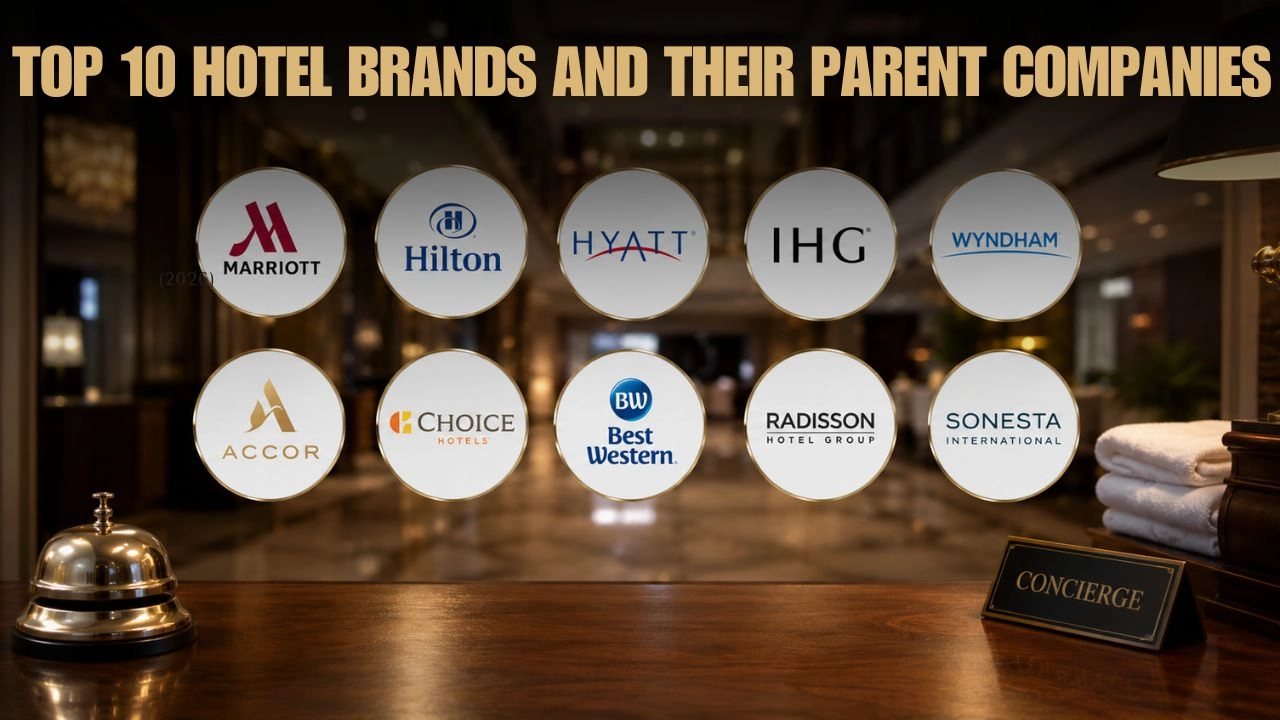
When you book a Marriott, you’re usually not actually staying at a Marriott property — you’re staying at a franchise that licenses the brand. The hotel business runs almost entirely on this asset-light model: the parent owns the name, the booking system, and the loyalty program; investors and franchisees own the actual buildings. There are about a dozen brand families that control nearly every major hotel chain you’ve heard of. Here’s how that map looks in 2026.
How we built this list
Ranking is by total rooms in the global system (per each parent’s most recent annual report). The ‘parent’ column is the publicly-traded or privately-owned brand company; the actual hotel buildings are usually owned by separate REITs, sovereign funds, or franchisees.
The Top 10
1. Marriott International — Public, Marriott family ~7%, Vanguard ~9%
Marriott (NASDAQ: MAR) is the largest hotel company in the world by total rooms (~1.7M across 31 brands). The Marriott family (J. Willard Marriott’s descendants) retains approximately 7% of shares; Bill Marriott served as executive chairman until 2024. Anthony Capuano is CEO. Brand families under Marriott include Ritz-Carlton, JW Marriott, W Hotels, Westin, Sheraton, Le Méridien, Courtyard, Fairfield, and Moxy.
2. Hilton Worldwide — Public (Blackstone exited 2018)
Hilton Worldwide (NYSE: HLT) is the second-largest hotel chain by room count (~1.2M). Blackstone took Hilton private in 2007 for $26 billion, then re-IPO’d it in 2013 and fully exited by 2018 — one of the largest PE returns in history. CEO Chris Nassetta has led the company since 2007. Brands include Waldorf Astoria, Conrad, Hilton, DoubleTree, Hampton Inn, and Tru.
3. IHG Hotels & Resorts — Public (UK-listed)
InterContinental Hotels Group (LSE: IHG) is the British-listed parent of InterContinental, Holiday Inn, Crowne Plaza, Kimpton, Six Senses, Regent, and a dozen other brands. CEO Elie Maalouf took over in 2023. The company is fully publicly-held with no single dominant shareholder; passive institutional investors dominate.
4. Hyatt Hotels Corporation — Pritzker family ~58% voting
Hyatt (NYSE: H) is unique among major hotel parents in that the founding Pritzker family retains majority voting control through Class B shares. The Pritzker family — descendants of Jay Pritzker and his brother Donald — controls approximately 58% of voting power despite a much smaller economic stake. Mark Hoplamazian is CEO.
5. Wyndham Hotels & Resorts — Public, broad institutional
Wyndham (NYSE: WH) was spun off from Wyndham Worldwide in 2018 (the other spin-off was Travel + Leisure Co., for the timeshare business). Wyndham operates Days Inn, Super 8, Ramada, Howard Johnson, La Quinta, Wyndham, and others — a portfolio focused on the economy and mid-scale segments. CEO Geoff Ballotti has led the company since spin-off.
6. Choice Hotels International — Public, Bainum family ~40%
Choice Hotels (NYSE: CHH) is dominated by the Bainum family — descendants of Stewart Bainum Sr., who built the company starting in the 1960s. The family retains approximately 40% of common stock through various family trusts. Patrick Pacious is CEO. Brands include Comfort Inn, Sleep Inn, Cambria, Ascend, Rodeway, and Quality.
7. Accor — Public (Paris-listed)
Accor SA (Euronext: AC) is the largest hotel parent in Europe. CEO Sébastien Bazin has led the company since 2013. Brands include Sofitel, Pullman, MGallery, Novotel, ibis, and the luxury brand Raffles. Major shareholders include Jin Jiang International (Chinese, ~13%), QIA (Qatar Investment Authority, ~6%), and Kingdom Holding (Saudi Arabia).
8. Hostmark Hospitality Group — Privately held
Hostmark and its affiliated brand family are privately held. Founded in 1965 and based in Chicago, Hostmark operates and develops both branded (under Hilton, Marriott, IHG flags) and independent hotels. The company is held within a closely-private group of family-office investors and management ownership.
9. Las Vegas Sands — Adelson family majority
Sands (NYSE: LVS) is technically more of a casino operator than a pure hotel company, but operates major hotel properties (The Venetian/The Palazzo formerly, Marina Bay Sands in Singapore). The Adelson family — Miriam Adelson and her children, following Sheldon Adelson’s death in 2021 — retains majority voting control. Miriam Adelson is one of the wealthiest American widows.
10. Airbnb — Public, founder-controlled
Airbnb (NASDAQ: ABNB) isn’t a hotel chain in the traditional sense — it’s a peer-to-peer short-term-rental platform — but it competes directly with the major hotel chains and is one of the largest accommodations marketplaces by listing count. Co-founders Brian Chesky (CEO), Joe Gebbia, and Nathan Blecharczyk retain super-voting Class B shares with majority control.
At-a-glance comparison
| Rank | Parent Company | Family/Control | Brands |
|---|---|---|---|
| 1 | Marriott International | Marriott family ~7% | 31 brands |
| 2 | Hilton Worldwide | Public (no family control) | 20+ brands |
| 3 | IHG | Public (UK) | InterContinental, Holiday Inn |
| 4 | Hyatt | Pritzker family ~58% voting | Hyatt, Andaz, Park Hyatt |
| 5 | Wyndham | Public | Days Inn, Super 8 |
| 6 | Choice Hotels | Bainum family ~40% | Comfort Inn, Quality |
| 7 | Accor | Public (Jin Jiang ~13%) | Sofitel, Novotel, ibis |
| 8 | Las Vegas Sands | Adelson family majority | Marina Bay Sands |
| 9 | Airbnb | Founders supermajority voting | Platform model |
| 10 | Hostmark Hospitality | Private | Operator |
My take
The hotel industry is one of the cleanest examples of a sector that looks consolidated from the consumer side but is actually deeply family-controlled at the parent level. Marriott, Hyatt, Choice, Sands, and Airbnb all have founding families or founders that retain real governance influence. Hilton is the outlier — the only major US hotel parent without a founder or family in control, and even then Hilton’s modern history was shaped decisively by Blackstone’s eleven-year private-equity ownership cycle. If you want to understand why hotel brands behave the way they do (loyalty programs that almost never devalue dramatically, franchisee relationships that last decades), look at the multi-generational ownership structures behind them.
Embassy Suites Ownership
Embassy Suites is one of the brands covered in this pillar. Read the dedicated Embassy Suites ownership story for the full details.
Frequently Asked Questions
Who owns Marriott Hotels?
Marriott International (NASDAQ: MAR) is publicly traded but the Marriott family (descendants of founder J. Willard Marriott) retains approximately 7% of common stock. Bill Marriott served as executive chairman until 2024. Anthony Capuano is the current CEO. The family is no longer a controlling shareholder but remains influential.
Who owns Hilton Hotels?
Hilton Worldwide (NYSE: HLT) is fully publicly traded. Blackstone took the company private in 2007 for $26 billion, then re-listed it in 2013 and exited fully by 2018. Today there is no dominant shareholder; passive institutional investors (Vanguard, BlackRock, State Street) lead the cap table.
Is Hyatt family-owned?
Hyatt Hotels Corporation (NYSE: H) is publicly traded but the Pritzker family retains majority voting control through Class B super-voting shares. The Pritzkers control approximately 58% of voting power despite holding a smaller economic stake. Mark Hoplamazian is CEO.
Who owns IHG (Holiday Inn / InterContinental)?
InterContinental Hotels Group (LSE: IHG) is a UK-listed publicly traded company with no single dominant shareholder. The cap table is dominated by passive institutional investors. CEO Elie Maalouf has led the company since 2023.
Is Airbnb a hotel company?
Airbnb isn’t a traditional hotel chain — it’s a peer-to-peer marketplace where individual hosts list properties. But Airbnb directly competes with major hotel chains for accommodation bookings and is one of the largest lodging marketplaces by listing count. Co-founders Brian Chesky, Joe Gebbia, and Nathan Blecharczyk retain super-voting Class B shares.
Related Reading
See also our profile of fellow hospitality brand Sandals Resorts.
See also our profile of independently-owned property Hampton Inn Lakeville.
See also our profile of fellow hospitality brand Crowne Plaza.