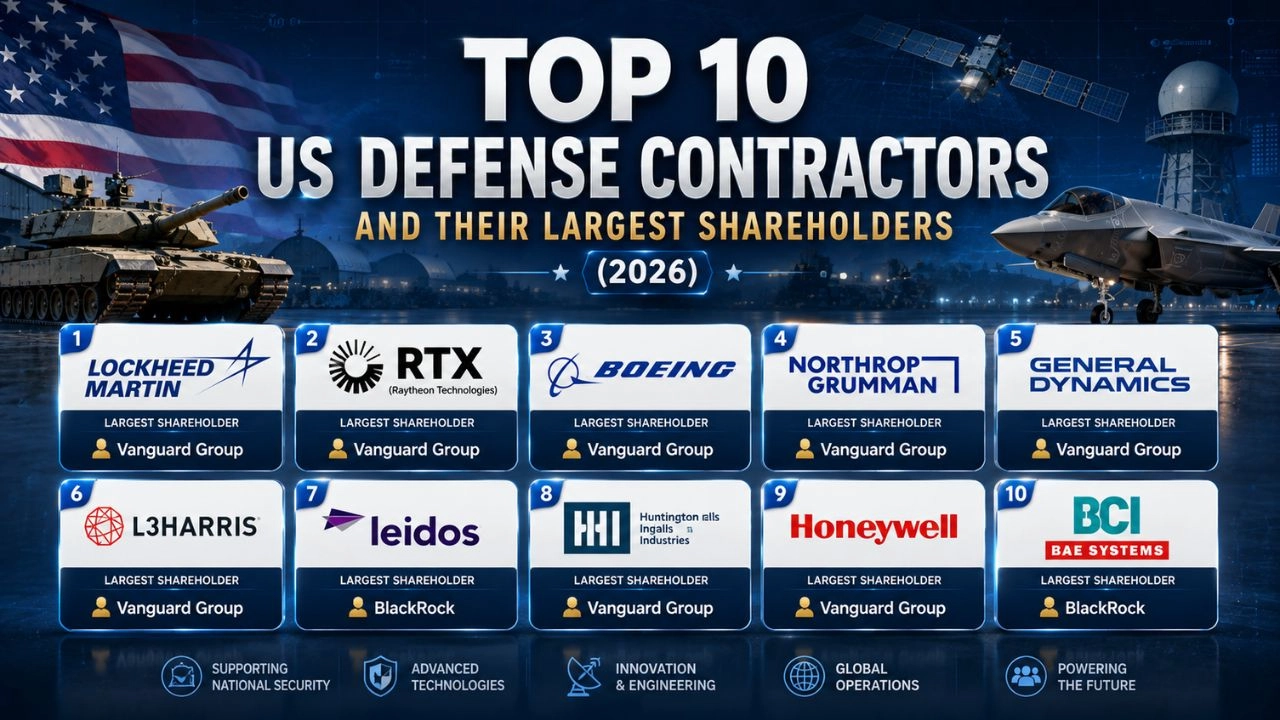
The American defense industry is a strange creature: the customer is the US government (and allied governments), the contracts are largely public, but the companies themselves are mostly held by the same passive index investors that own everything else. There are a few activist or strategic exceptions — Berkshire’s stake in Boeing supplier RTX comes and goes; sovereign wealth has nibbled at the edges; the Pentagon’s own restrictions limit foreign ownership. Here’s the full top 10 by Pentagon contract awards, with who actually holds the cap table.
How we built this list
Ranking is by total US Department of Defense prime-contract awards for fiscal year 2025 (per USAspending.gov). Shareholders come from the most recent DEF 14A proxy filings. CFIUS limits foreign ownership of US defense contractors; where strategic foreign minority stakes exist (Saab, BAE, Airbus), I note them.
The Top 10 US Defense Contractors and Their Largest Shareholders
1. Lockheed Martin — Vanguard ~9%, BlackRock ~7.8%, State Street ~4.9%
Lockheed Martin (NYSE: LMT) is the largest defense contractor in the world by Pentagon contract value, with FY2025 awards exceeding $50 billion. CEO Jim Taiclet has led the company since 2020. Major shareholders are passive institutionals. Lockheed makes the F-35 fighter jet, Aegis missile defense systems, and a significant share of US satellite and space technology.
2. RTX Corporation (Raytheon Technologies) — Vanguard ~9%, BlackRock ~7.5%
RTX (NYSE: RTX) was formed by the 2020 merger of Raytheon Company and United Technologies. Christopher Calio became CEO in 2024. The company makes Patriot and Stinger missile systems, Pratt & Whitney jet engines, and Collins Aerospace components. Major shareholders are passive institutional investors.
3. Boeing (Defense, Space & Security) — Vanguard ~6.4%, BlackRock ~5%, Newport Trust ~7%
Boeing’s defense division is the second-largest contributor to its revenue (commercial-aircraft division is larger by revenue). Boeing as a whole has faced unprecedented operational challenges since 2024 (737 MAX issues, Starliner delays, leadership changes). CEO Kelly Ortberg took over in mid-2024. The largest single voting shareholder is Newport Trust at ~7%.
4. Northrop Grumman — Vanguard ~9%, BlackRock ~7.5%, State Street ~4.5%
Northrop Grumman (NYSE: NOC) builds the B-21 Raider stealth bomber, the Sentinel ICBM program, and is the prime contractor for major NASA programs including the James Webb Space Telescope’s successor. CEO Kathy Warden has led the company since 2019. Standard passive-institutional shareholder base.
5. General Dynamics — Crown family ~10%, Vanguard ~8.5%
General Dynamics (NYSE: GD) is one of the few major defense contractors with a significant family-held stake. The Crown family of Chicago, descendants of Henry Crown (early GD investor), still holds approximately 10% of common stock. Phebe Novakovic has been CEO since 2013. The company owns Gulfstream Aerospace and a large naval-shipbuilding business.
6. L3Harris Technologies — Vanguard ~8.5%, BlackRock ~7.5%
L3Harris was formed by the 2019 merger of L3 Technologies and Harris Corporation. CEO Christopher Kubasik has led the combined entity since the merger. L3Harris acquired Aerojet Rocketdyne in 2023 for $4.7 billion, adding solid-rocket-motor production capacity. Standard passive-institutional ownership.
7. Huntington Ingalls Industries — Vanguard ~10%, BlackRock ~8.5%
Huntington Ingalls (NYSE: HII) is the largest US shipbuilder. The company was spun off from Northrop Grumman in 2011 and remains independent. Huntington Ingalls builds Virginia-class submarines (with General Dynamics), Ford-class aircraft carriers, and amphibious assault ships. CEO Chris Kastner took over in 2022.
8. Booz Allen Hamilton — Vanguard ~9%, BlackRock ~7%
Booz Allen (NYSE: BAH) is a technology and management consulting firm that derives most of its revenue from the US government, including significant classified work. Carlyle Group was a major shareholder for years following the 2008 take-private and subsequent 2010 IPO; Carlyle exited fully by 2019. Horacio Rozanski is CEO.
9. Leidos — Vanguard ~10%, BlackRock ~8%, State Street ~4.5%
Leidos (NYSE: LDOS) was formed by SAIC’s split in 2013 and merged with Lockheed Martin’s IT services business in 2016. The company is one of the largest IT-services contractors to the US government. CEO Tom Bell took over in 2023. Standard passive-institutional shareholder base.
10. Anduril Industries — Founders Fund, General Catalyst, Andreessen Horowitz, Palmer Luckey
Anduril is the newest entrant on this list — founded in 2017 by Palmer Luckey (former founder of Oculus VR) and a team of Silicon Valley engineers. The company is privately held; major investors include Founders Fund (Peter Thiel), Andreessen Horowitz, General Catalyst, and 8VC. As of 2025 Anduril had raised over $3 billion at a $14 billion valuation. The company makes autonomous systems and is rapidly winning major Pentagon contracts.
At-a-glance comparison
| Rank | Contractor | Largest Holder | Notes |
|---|---|---|---|
| 1 | Lockheed Martin | Vanguard ~9% | F-35 prime |
| 2 | RTX | Vanguard ~9% | Patriot, P&W engines |
| 3 | Boeing (Defense) | Newport Trust ~7% | Operational challenges |
| 4 | Northrop Grumman | Vanguard ~9% | B-21, Sentinel ICBM |
| 5 | General Dynamics | Crown family ~10% | Family stake |
| 6 | L3Harris | Vanguard ~8.5% | Acquired Aerojet 2023 |
| 7 | Huntington Ingalls | Vanguard ~10% | Subs + carriers |
| 8 | Leidos | Vanguard ~10% | IT services |
| 9 | Booz Allen Hamilton | Vanguard ~9% | Consulting |
| 10 | Anduril Industries | Founders Fund / Luckey | Private, $14B val |
Related Ownership Profiles
One of the largest names on that list has its own full ownership story — see who owns Lockheed Martin.
Frequently Asked Questions
Who is the largest US defense contractor?
Lockheed Martin (NYSE: LMT) is the largest US defense contractor by Department of Defense contract awards. In fiscal year 2025, Lockheed received more than $50 billion in prime contracts, more than any other firm. The company makes the F-35 fighter jet, Aegis missile defense, and a significant share of US space and satellite technology.
Is Boeing owned by the US government?
No. Boeing is publicly traded on the NYSE (ticker BA) and is not owned by the US government. The largest single voting shareholder is Newport Trust at approximately 7%. The company has accepted certain forms of government support during recent operational difficulties but remains private-sector controlled.
Who owns Anduril Industries?
Anduril is privately held. The company was founded in 2017 by Palmer Luckey (former founder of Oculus VR) and a team of Silicon Valley engineers. Major investors include Founders Fund (Peter Thiel), Andreessen Horowitz, General Catalyst, and 8VC. Anduril has raised more than $3 billion and is valued at approximately $14 billion.
Are foreign investors allowed to own US defense contractors?
Foreign ownership of major US defense contractors is restricted by the Committee on Foreign Investment in the United States (CFIUS). Strategic foreign companies (like BAE Systems and Airbus) operate US subsidiaries under special governance arrangements; foreign sovereign-wealth funds are generally limited to passive minority stakes in publicly-listed defense companies.
Why do Vanguard and BlackRock show up so often?
Vanguard and BlackRock are the world’s two largest passive index-fund managers. They own substantial percentages of nearly every publicly-traded US company — including all major US defense contractors. This is a structural feature of the index-fund era, not a strategic position in the defense industry specifically.
What’s worth watching in defense ownership is Anduril. It’s the first Silicon Valley-style defense company to genuinely compete with the legacy primes (Lockheed, RTX, Boeing) for major Pentagon programs since SpaceX broke open launch. The Anduril cap table is a different species from the rest of the list — venture capital instead of index funds, founder-controlled instead of CEO-managed. If Anduril and a handful of similar new-entrant defense startups (Shield AI, Saronic, Hadrian) successfully convert their early Pentagon work into long-cycle programs over the next decade, the entire defense-contractor cap-table picture changes meaningfully. Until then, it’s index funds and one family.