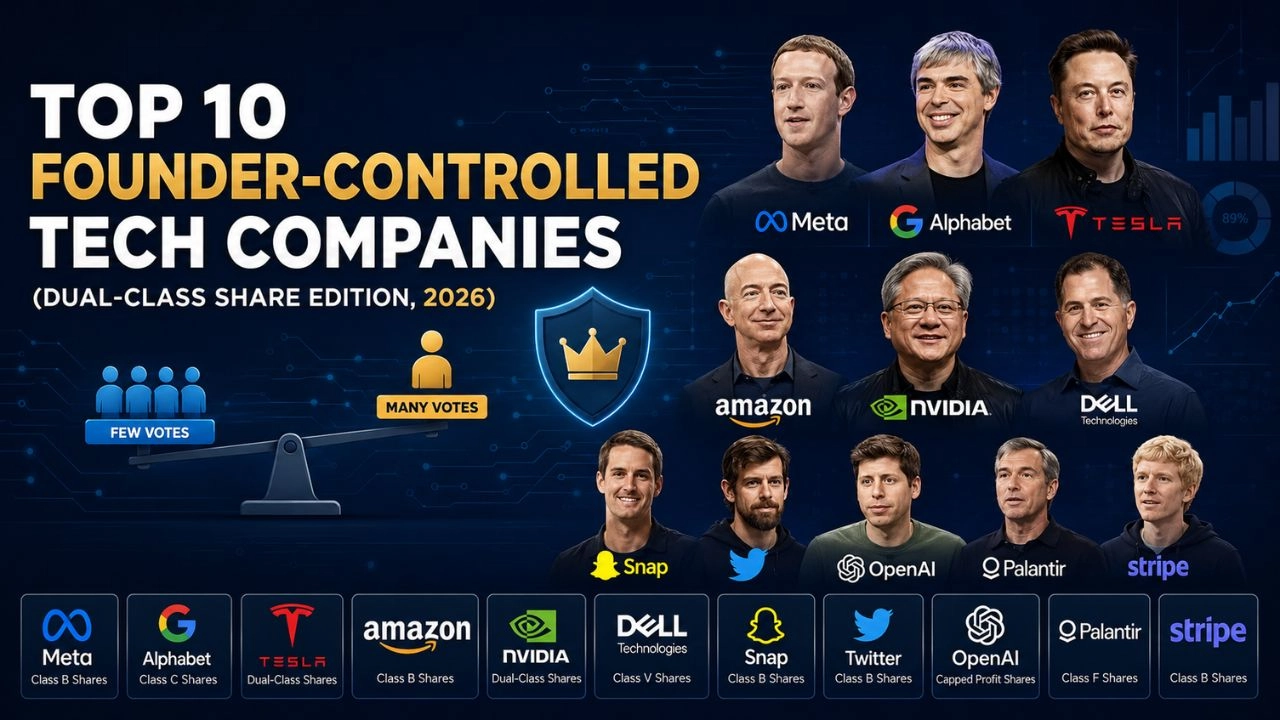
There is a quiet truth about Silicon Valley that doesn’t show up in news headlines: many of the biggest tech companies in the world are not actually controlled by their public shareholders. Through dual-class or multi-class share structures, founders retain voting control even after IPOs, sometimes for decades. I went through every US-listed tech company with a market cap over $50 billion and identified the ones where founders still hold the keys — ranked by how absolute that control is.
How we built this list
Voting-power figures come from each company’s most recent DEF 14A proxy statement filed with the SEC. I’m including only companies where the founder (or founding family) controls more than 50% of votes via super-voting shares, regardless of how many economic shares they hold. Dual-class structures with sunset provisions that have not yet triggered are included; those that have already converted to a single-class structure are not.
The Top 10
1. Meta Platforms — Mark Zuckerberg, ~57–61% voting power
Mark Zuckerberg owns about 13% of Meta’s economic shares but commands roughly 57–61% of voting power thanks to his Class B super-voting shares (10 votes each vs. 1 vote per Class A). His effective veto over any board, strategic, or M&A decision is the textbook example of dual-class control.
2. Alphabet (Google) — Sergey Brin & Larry Page, ~51% voting power combined
Brin and Page each hold Class B shares with 10 votes apiece, plus Class C non-voting public shares. Together they control roughly 51% of votes despite stepping back from operational roles. Sundar Pichai runs the company day-to-day, but no major strategic decision moves without the founders’ nod.
3. Snap Inc. — Evan Spiegel & Bobby Murphy, ~99% voting power combined
Snap may be the most extreme example in modern markets: founders Spiegel and Murphy control nearly all voting power. When Snap went public in 2017, it sold non-voting (Class A) shares to the public — meaning IPO investors literally had zero votes. This was unprecedented and triggered an industry debate about shareholder rights.
4. Palantir Technologies — Alex Karp, Peter Thiel & Stephen Cohen, ~49–50% combined voting power
Palantir uses a unique multi-class structure including Class F shares — sometimes called ‘founder shares’ — that grant the three founders a variable supermajority calibrated to keep them at roughly 49–50% of votes regardless of economic dilution. As of 2026, that floor still holds.
5. Spotify — Daniel Ek & Martin Lorentzon, ~75% voting power combined
Spotify went public through a direct listing in 2018. The two founders hold beneficiary certificates that grant them disproportionate voting rights. Together, Ek and Lorentzon control roughly 75% of votes — meaning no shareholder activism can meaningfully challenge their direction.
6. Roblox — David Baszucki, ~70% voting power
CEO and co-founder David Baszucki holds Class B super-voting shares that give him approximately 70% of voting control. Although Roblox went public in 2021 via direct listing, the dual-class structure ensures Baszucki retains full strategic command of the platform.
7. Coinbase — Brian Armstrong, ~37–45% voting power
Brian Armstrong’s stake fluctuates with share repurchases and grants, but typically sits in the 37–45% voting-control range thanks to his Class B shares. Combined with co-founder Fred Ehrsam’s stake and other insider holdings, the founders effectively control Coinbase even when Brian’s stake dips below 50%.
8. Pinterest — Ben Silbermann & Evan Sharp, ~40% combined voting power
Pinterest’s founders hold Class B shares with 20 votes per share (yes, twenty — one of the highest ratios in tech). Combined they control roughly 40% of votes despite owning a much smaller share of economic value. The structure was specifically designed to survive multiple rounds of dilution.
9. DoorDash — Tony Xu, ~40% voting power
DoorDash’s CEO and co-founder Tony Xu holds Class B shares with 20 votes per share. Despite owning a relatively modest economic stake, his voting power has remained near 40% since the 2020 IPO, allowing him to direct strategic decisions like the Wolt acquisition and recent expansion into grocery delivery.
10. Rivian Automotive — RJ Scaringe, lower than 50% but dominant via board structure
Rivian’s founder RJ Scaringe holds a smaller direct stake than most names on this list, but the company’s bylaws and his lead-investor relationship with Amazon and Ford have given him outsized day-to-day control. Notable as a founder-controlled IPO without classical dual-class shares — closer to the Tesla model.
At-a-glance comparison
| Rank | Company | Founder(s) | Approx. Voting Power |
|---|---|---|---|
| 1 | Snap | Spiegel + Murphy | ~99% |
| 2 | Spotify | Ek + Lorentzon | ~75% |
| 3 | Roblox | Baszucki | ~70% |
| 4 | Meta | Zuckerberg | ~57–61% |
| 5 | Alphabet | Brin + Page | ~51% |
| 6 | Palantir | Karp + Thiel + Cohen | ~49–50% |
| 7 | Coinbase | Armstrong + Ehrsam | ~37–45% |
| 8 | Silbermann + Sharp | ~40% | |
| 9 | DoorDash | Xu | ~40% |
| 10 | Rivian | Scaringe | Effective via board |
My take
Dual-class share structures used to be a Wall-Street curiosity — a couple of media families like the Sulzbergers at the New York Times and a handful of others kept them through the twentieth century. Then Google’s IPO in 2004 normalized the format, Facebook’s 2012 IPO doubled down on it, and Snap’s 2017 IPO took it to its logical extreme. As of 2026, dual-class control is essentially the default for any founder-led tech IPO. Whether that’s good for public shareholders is a real debate; what’s not debatable is that it’s the structural reason so many tech CEOs can make decisions a regular corporate board could never get away with.
Related Ownership Profiles
For another industry ownership roundup, see our list of Top 10 Pharma Companies and Their Top Shareholders.
Frequently Asked Questions
What is a dual-class share structure?
A dual-class share structure is when a company issues two or more share classes with different voting rights. Typically, Class A shares carry one vote each and are sold to public investors, while Class B (or higher-class) shares are held by founders and insiders with multiple votes per share — often 10 or 20. This allows founders to retain voting control even after selling a majority of their economic stake.
Which company has the most extreme founder control?
Snap Inc. has the most extreme founder-control structure of any major US-listed company. When Snap went public in 2017, it sold only non-voting Class A shares to public investors — meaning IPO buyers got zero votes. Founders Evan Spiegel and Bobby Murphy together control approximately 99% of voting power, even though they hold a far smaller economic stake.
Are dual-class shares legal?
Yes, dual-class shares are fully legal under US securities law and accepted by all major US stock exchanges. Some institutional investors and proxy-advisory firms (like ISS and Glass Lewis) recommend against companies that use them, and a few stock indexes (notably the S&P 500 historically) have rules about including or excluding dual-class issuers.
Do dual-class structures last forever?
Most do not. Many recent dual-class IPOs include ‘sunset provisions’ that automatically convert super-voting shares into single-vote shares after a fixed period (commonly 7–15 years) or upon the founder’s death or departure. Alphabet, for example, does not have a sunset clause; Snap’s structure is similarly perpetual; most newer 2023–2025 IPOs include 10-year sunsets.
Why do public investors buy these companies if they have no real voting power?
Most public investors buy these stocks for the economic upside, not governance rights. The argument from companies like Meta and Alphabet is that founder control allows them to make long-term, sometimes-controversial decisions (massive R&D bets, capital allocation, M&A) without short-term shareholder pressure. Critics counter that it removes a key accountability mechanism. Empirically, the highest-performing dual-class companies have rewarded shareholders handsomely — but the structure also masks weaker performers from corrective pressure.