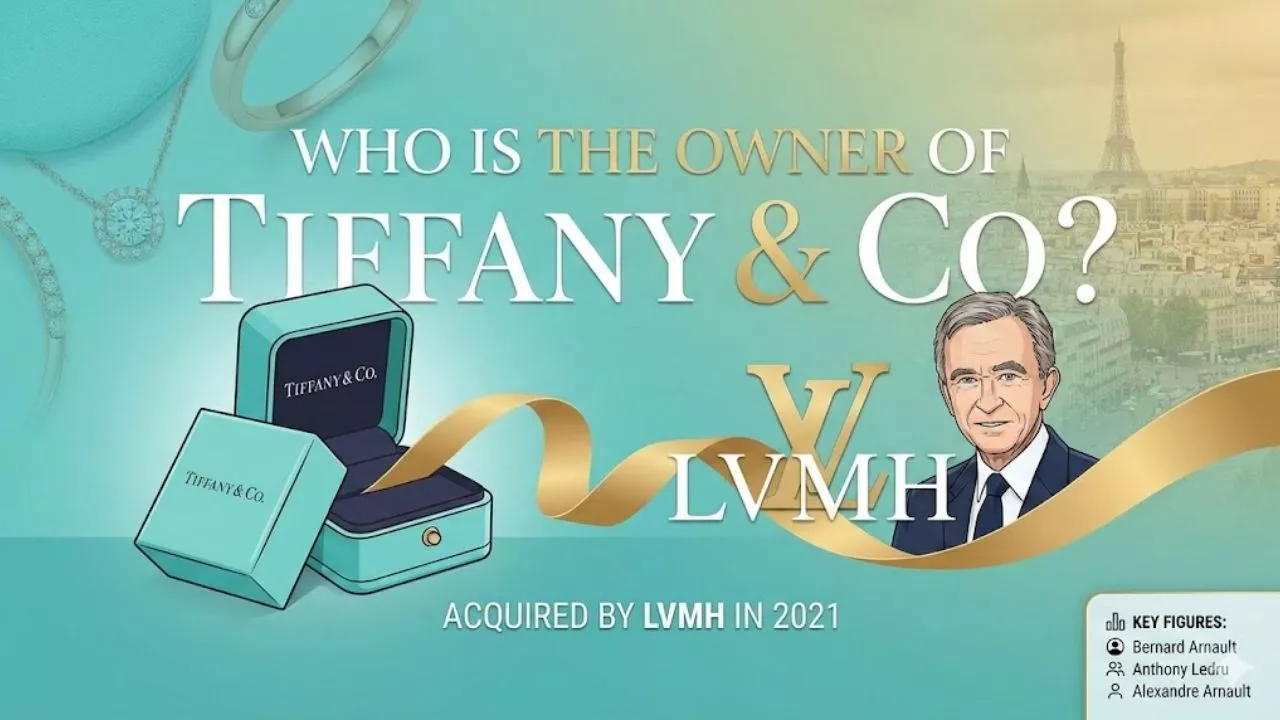
💎 Tiffany & Co — Key Facts
| Current Owner | LVMH Moët Hennessy Louis Vuitton (EPA: MC) |
| Acquisition Price | $15.8 billion (January 2021 — largest luxury deal ever) |
| LVMH Controller | Bernard Arnault family (~47.5% via Christian Dior SE) |
| Founded | 1837, New York City (by Charles Lewis Tiffany) |
| Trademark Color | “Tiffany Blue” (Pantone 1837) — legally protected trademark |
| CEO (post-acquisition) | Anthony Ledoux (since 2023) |
Tiffany & Co. is owned by LVMH Moët Hennessy Louis Vuitton (EPA: MC), the French luxury conglomerate controlled by Bernard Arnault and his family. LVMH completed the acquisition of Tiffany in January 2021 for $15.8 billion — the largest luxury goods acquisition in history. The famous jewelry brand, founded in 1837 in New York City and known worldwide for its iconic robin’s-egg blue color, is now LVMH’s jewel in the crown of American luxury brands.
Who Is the Owner of Tiffany & Co?
Tiffany & Co. is owned by LVMH, the world’s largest luxury goods conglomerate, which controls brands including Louis Vuitton, Christian Dior, Bulgari, TAG Heuer, Fendi, Givenchy, Moët & Chandon, Dom Pérignon, Hennessy, Sephora, and dozens more. LVMH is listed on the Paris Bourse (EPA: MC) and is controlled by Bernard Arnault (currently the world’s richest or second-richest person, with net worth fluctuating between $150–200 billion), who controls approximately 47.5% of LVMH through a family holding company structure via Christian Dior SE. Alexandre Arnault, Bernard’s son, serves as EVP of Product and Communications at Tiffany, extending the family’s direct involvement in the brand’s creative direction.
The Acquisition Drama: Almost Didn’t Happen
The Tiffany acquisition began with LVMH’s initial offer of $16.2 billion in November 2019 — at the time, Tiffany’s board had to be convinced the price was fair. Both parties agreed to a deal. Then came COVID-19 and the March 2020 market crash. In September 2020, LVMH stunned Wall Street by announcing it was backing out of the deal, citing Tiffany’s financial performance during the pandemic and a dispute involving a French government request (which many observers viewed as manufactured). Tiffany sued LVMH; LVMH countersued. The parties ultimately renegotiated at a lower price of $15.8 billion (a reduction of $400M) and closed in January 2021. Despite the drama, the deal has since proved extremely valuable for LVMH, as Tiffany’s revenues and profitability have grown substantially under LVMH ownership.
Tiffany’s History and the Blue Box
Tiffany & Co. was founded by Charles Lewis Tiffany in September 1837 in New York City as a “stationery and fancy goods emporium.” Tiffany quickly pivoted toward jewelry and silver, becoming famous for fine diamonds and establishing the Tiffany Diamond Cut (later adopted as the global standard). The iconic Tiffany Blue (Pantone 1837) has been the brand’s signature color since the 1800s, predating the concept of brand color identity by decades. The color is a legally protected Tiffany trademark — competitors cannot reproduce the exact shade for jewelry packaging. The little blue box has become one of the most powerful brand signals in luxury retail.
Related Reading
For more on the supply side of the diamond industry, see our look at the global diamond market and De Beers.
See also our profile of fellow LVMH-owned retailer Sephora.
Tiffany & Co. is one of several LVMH-owned luxury houses covered here, alongside Dior.