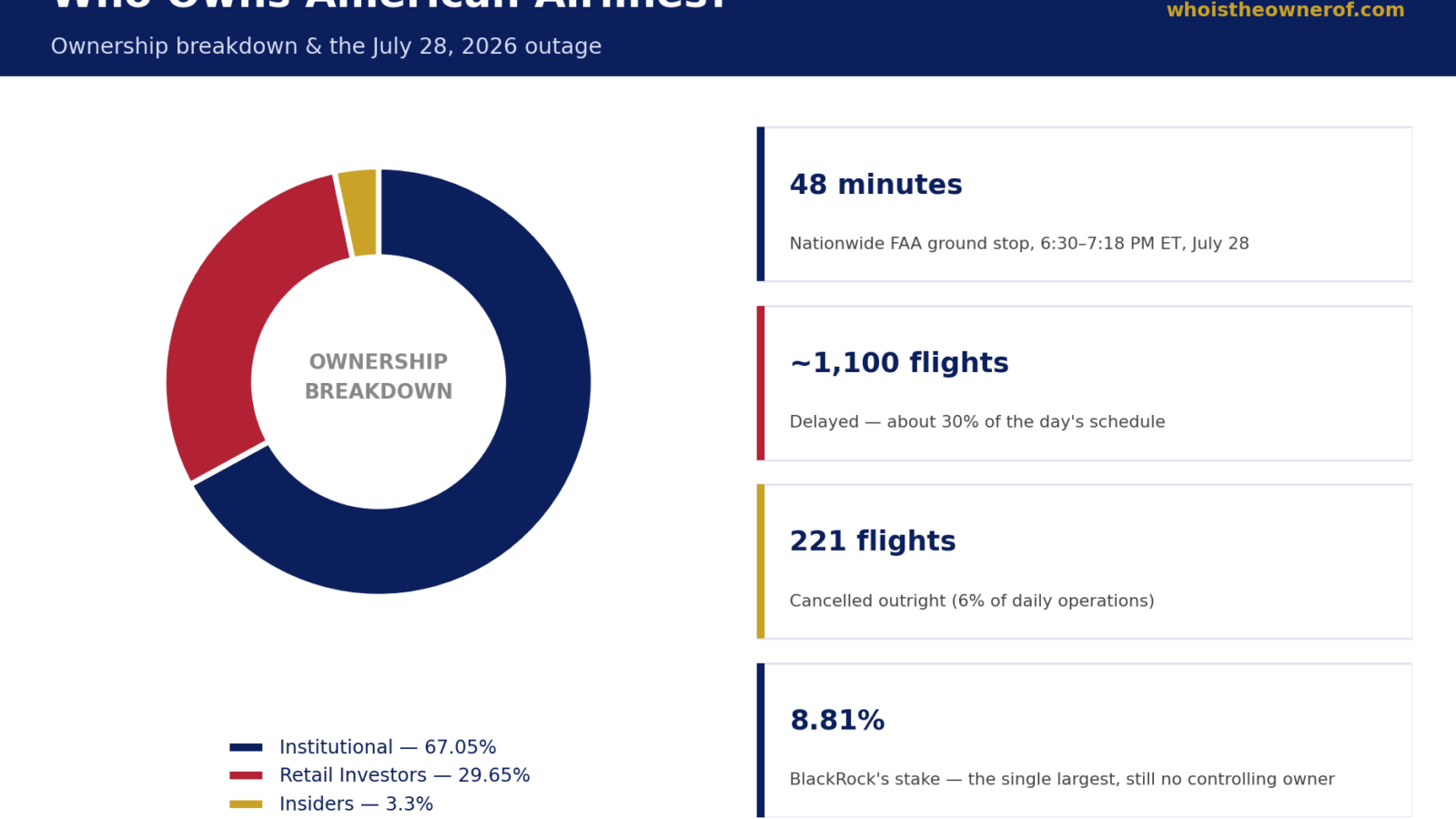
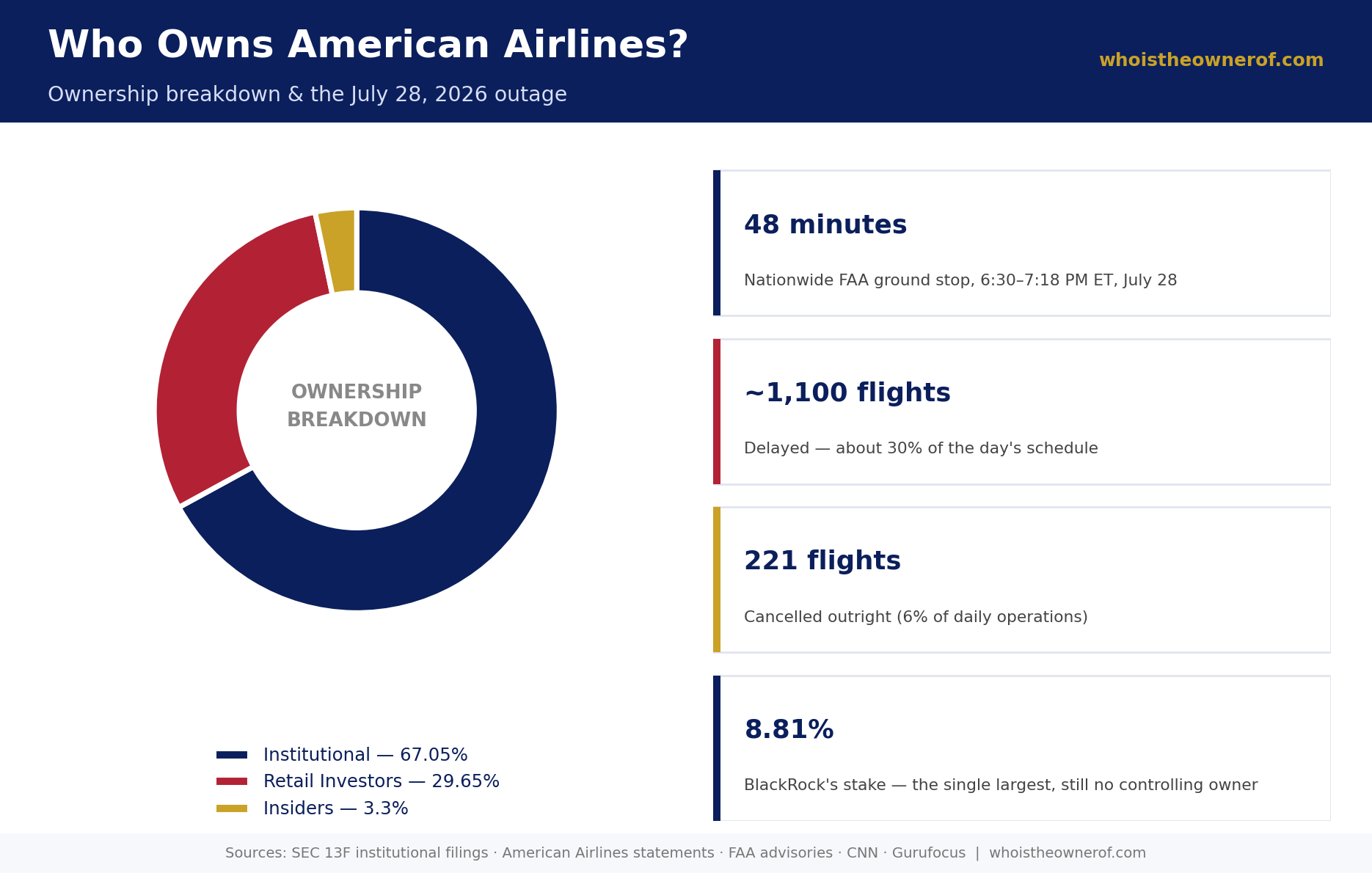
At 6:30 PM Eastern on July 28, the FAA issued a nationwide ground stop for American Airlines. Every American flight in the country sat on the tarmac while the airline worked through a technology failure. It lasted 48 minutes. By the time it lifted, about 1,100 flights were delayed and 221 were cancelled outright.
My first reaction was the same as everyone else’s: who’s responsible for that? So I pulled American’s ownership filings to find out — and the honest answer is that there’s no one to point to.
What Happened on July 28
American hit a technology failure that knocked out connectivity for systems the airline needs to safely dispatch flights. Rather than send aircraft out without those systems working, American and the FAA put a temporary nationwide ground stop in place around 6:30 PM ET.
Systems came back online and the ground stop lifted at roughly 7:18 PM ET — under an hour, start to finish. The ripple effect ran longer: roughly 30% of the day’s schedule, about 1,100 flights, ended up delayed, and 221 were cancelled. The disruption also landed on a day of severe weather across the East Coast, which almost certainly slowed the recovery even after the technical issue itself was fixed.
American’s public statement was short: “We apologize to our customers for the inconvenience.” Neither the airline nor the FAA has released a detailed account of what actually failed, as of this writing.
So Who’s Actually on the Hook?
When a company this size grounds every flight in the country, even for less than an hour, the instinct is to ask who owns it. I checked, because that’s the job. American Airlines Group trades on the Nasdaq under AAL, and roughly 67% of it is held by institutions, another 30% by retail investors, and just over 3% by the executives and directors who actually run the place.
BlackRock is the single largest shareholder at 8.81%, trailed by PRIMECAP Management at 7.41% and Vanguard’s various funds at a combined 4.29%. None of that is unusual for a major US airline — it’s the same passive, index-fund-heavy ownership pattern you’ll find across the sector, which I mapped out in a separate rundown of the ten largest US carriers and their shareholders. What it means here is simple: there’s no majority holder, and no single name that shows up demanding answers on behalf of a controlling stake.
The people actually accountable for an incident like this are CEO Robert Isom, who’s run American since 2022 after taking over from Doug Parker, and the board he answers to. Isom faces that fragmented shareholder base once a year at the annual meeting, and the FAA on safety and operations year-round — but there’s no owner in the traditional sense absorbing the reputational hit from a bad Tuesday evening.
A Deliberately Different Structure Than SK Hynix
I wrote about the opposite setup this same week at SK hynix, where a single 20.5% stake means one family’s fortune rises and falls with the company’s stock. American went the other direction on purpose, and it dates back further than this week.
American emerged from AMR Corporation’s 2011 bankruptcy and merged with US Airways in 2013 to form what was then the world’s largest airline — a deal that spread ownership across a huge, mostly passive investor base rather than concentrating it in any founder or family, the way I’ve covered at American’s full ownership profile. It’s the same shape you’ll find at Delta and United, both of which went through their own consolidation waves in the same era.
There’s a real tradeoff in that structure. Dispersed ownership means no single shareholder can be blamed when something breaks. It also means no single shareholder has the concentrated financial incentive to force operational changes afterward. Accountability runs through management and regulators rather than an owner’s phone call to the CEO.
FAQ
Who owns American Airlines?
No single person or entity. American Airlines Group is publicly traded (NASDAQ: AAL), with institutional investors holding roughly 67% collectively — led by BlackRock at 8.81% — retail investors around 30%, and company insiders just over 3%.
What caused the American Airlines outage on July 28, 2026?
American and the FAA attributed it to a technology issue affecting systems the airline needs for flight dispatch. Neither has released a detailed technical explanation publicly. The FAA-issued ground stop ran about 48 minutes, from roughly 6:30 to 7:18 PM ET.
Is CEO Robert Isom also American’s owner?
No. Isom holds a comparatively small equity stake as part of the 3.3% total held by all insiders combined. He answers to the board and to shareholders broadly, not to a personal controlling owner the way a founder-run company would work.
Sources: SEC 13F institutional ownership filings, American Airlines public statements, FAA advisories, CNN, KVIA, Gurufocus.