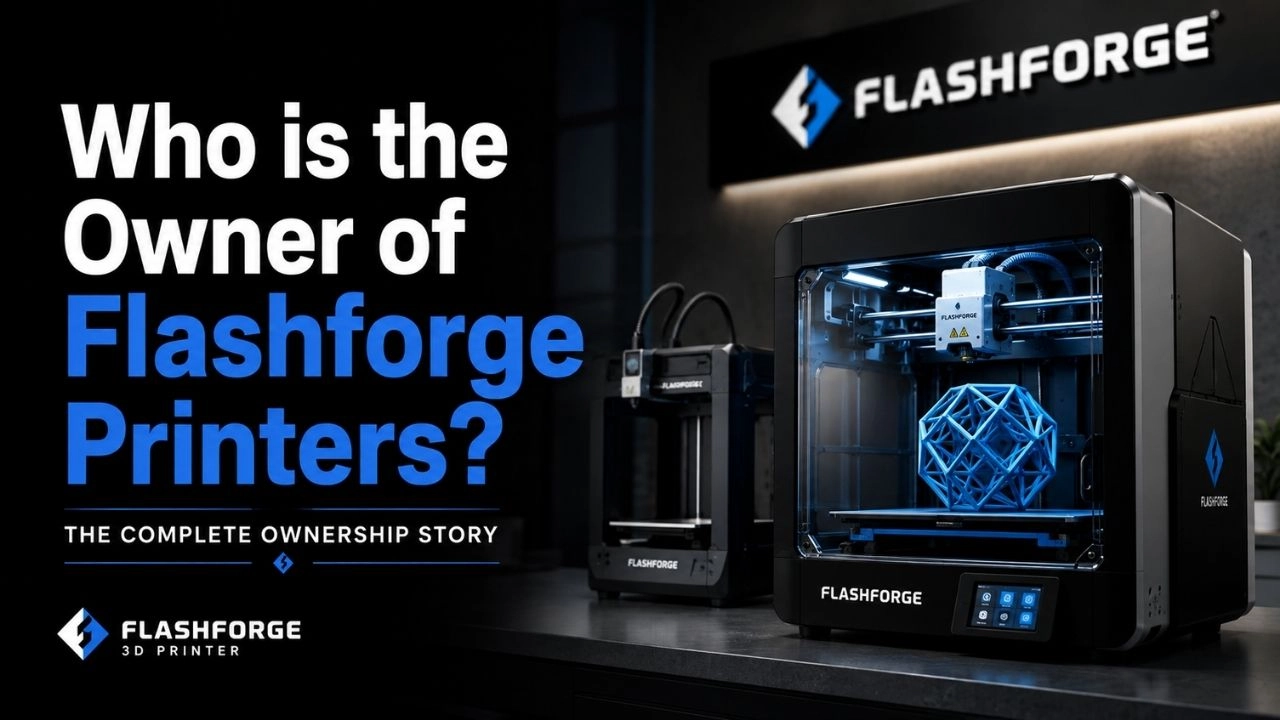
If you have ever looked into buying a 3D printer, chances are Flashforge came up early in your research. It is one of the most recognized names in the global 3D printing industry — trusted by hobbyists, educators, engineers, and jewelers across more than 130 countries. But who actually owns Flashforge? Unlike many tech companies controlled by corporate giants, the answer here is refreshingly simple — and it starts with one founder in China who built something genuinely world-class from the ground up.
What Is Flashforge?
Flashforge is a Chinese 3D printer manufacturer whose full legal name is Zhejiang Flashforge 3D Technology Co., Ltd. The company develops, manufactures, and sells 3D printers, filaments, 3D scanners, and 3D design software for consumer, commercial, and industrial customers worldwide.
Flashforge is one of China’s first professional enterprises engaged in the research, development, and production of 3D printing equipment and consumables. The company has a registered capital of 41.919 million yuan, employs over 500 staff, and operates production and office facilities covering an area of 26,000 square meters in Jinhua City, Zhejiang Province, China.
Its products are exported to over 130 countries and have won multiple international awards including the prestigious iF Design Award and the Canton Fair CF Award.
Who Owns Flashforge in 2026?
Flashforge is a privately owned company. It is not publicly traded on any stock exchange and has no external corporate parent. The company is wholly owned and controlled by its founder and chairman, Pei Wen Jian — the man who built it from scratch.
Pei Wen Jian is the Founder and Chairman of Flashforge. He founded the company in 2012 in Jinhua, Zhejiang Province, China, and has led it ever since as a private enterprise with no outside investors or institutional shareholders. This is a key part of what makes Flashforge unusual in the global 3D printing space — while competitors like Stratasys trade on NASDAQ and others like Bambu Lab have taken venture capital funding, Flashforge has remained fully private and founder-controlled throughout its entire history.
Ownership and Key Details Table
| Party | Role | Ownership | Key Detail |
|---|---|---|---|
| Pei Wen Jian | Founder & Chairman | 100% private ownership | Founded Flashforge in 2012 in Jinhua, Zhejiang, China |
| Zhejiang Flashforge 3D Technology Co., Ltd. | Operating Entity | Parent of all Flashforge brands | Full legal name; registered capital 41.919 million yuan |
| Voxelab | Sub-brand | Fully owned by Flashforge | Budget-friendly consumer 3D printer brand under the same parent |
| No external investors | N/A | No outside funding raised | Bootstrapped; no VC, PE, or public shareholders |
| No parent company | N/A | Independent private company | Not owned by any conglomerate or holding group |
The Origin Story: China’s 3D Printing Pioneer
Flashforge was established in June 2012 — making it one of the very first professional 3D printer manufacturers in China. At the time, 3D printing was still widely seen as a technology reserved for large industrial companies with massive budgets. The idea that a consumer could buy an affordable, reliable 3D printer for home or classroom use was still just a dream.
Pei Wen Jian and his founding team saw that opportunity early. They focused from day one on making 3D printing accessible — delivering reliable machines at price points that ordinary consumers, schools, and small businesses could actually afford. That philosophy drove the company’s early products and continues to define its market position today.
The company quickly established itself as a full-service provider, covering the entire 3D printing value chain — from the printers themselves to the filaments that feed them, the software that drives them, and the services that support customers after purchase. In 2017, Flashforge’s products were recognized as Zhejiang Famous Brand products — the first 3D printing company in the province to earn that designation. In 2018, it was rated a “Hidden Champion” enterprise in Zhejiang Province, a prestigious recognition given to world-class niche market leaders that operate largely below the public radar.
What Products Does Flashforge Make?
Flashforge covers three major additive manufacturing technology types: FDM (Fused Deposition Modeling), DLP (Digital Light Processing), and MJP (Multi-Jet Printing). Its product lines span consumer, commercial, and industrial segments.
On the consumer side, popular models include the Adventurer series, the Finder series, and the Creator series. The Adventurer 5X is priced at approximately $349, making it one of the most accessible enclosed 3D printers on the market. The Creator 5 — a multi-color printer with four independent print heads and an interchangeable nozzle system — retails at around $699 and targets more advanced users.
In May 2026, Flashforge launched the C5 Series 4-nozzle Multi-Color 3D Printer, with global pre-orders exceeding 15,000 units. The company also unveiled the WJ51C — described as the world’s first desktop wax 3D printer for jewelry applications — at a trade show in May 2026. That product alone signals how far Flashforge has moved beyond simple hobbyist printers into specialized professional markets.
For industrial customers, Flashforge offers the WaxJet series for jewelry manufacturing, advanced resin printers, and large-format systems used in medicine, engineering, and prototyping.
Who Is Voxelab — And How Does It Connect to Flashforge?
One thing that surprises many people is that Flashforge also owns a second 3D printer brand called Voxelab.
Flashforge owns the 3D printer brand Voxelab. Like Flashforge, Voxelab offers affordable 3D printers in the consumer sector. Voxelab operates as a separate-facing brand targeting entry-level buyers who want the lowest possible price point — while Flashforge targets the mid-range and above. Both brands are manufactured under the same roof, under the same ownership of Pei Wen Jian, and benefit from the same engineering and supply chain expertise.
Think of it like a car company that owns both a budget and a premium brand — the same parent, different audiences, different price positioning.
Flashforge in 2026: AI Integration and Global Expansion
Flashforge is not standing still in 2026. The company has been pushing aggressively into new technology and new markets.
In May 2026, Flashforge integrated Meshy AI into its Flash Studio software — enabling users to go from an AI-generated 3D model directly to a multi-color print with a single click. That kind of AI-to-print workflow is a significant step forward for consumer 3D printing, dramatically lowering the barrier for people who do not know how to design their own models.
The company also expanded its U.S. retail presence, with its AD5X Multi-Color FDM 3D Printer arriving at Micro Center stores across the country in September 2025 — marking a meaningful push into American brick-and-mortar retail. In 2026, Flashforge participated as an exhibitor at TCT Asia in Shanghai, one of the world’s most important 3D printing trade shows, cementing its position as a global industry leader.
The Controversy: Ghost Guns and the Manhattan DA’s Letter
No article about Flashforge in 2026 would be complete without acknowledging a serious controversy that drew international attention in October 2025.
Manhattan District Attorney Alvin L. Bragg Jr. wrote a formal letter to Flashforge Founder and Chairman Pei Wen Jian on October 15, 2025, raising concerns about Flashforge printers being used to manufacture “ghost guns” — privately made, untraceable firearms — in New York City. The DA’s office noted that a Flashforge printer had been used in the production of gun parts seized by the NYPD, and called on the company to take stronger action to prevent its products from being used to make illegal firearms.
Flashforge’s own terms of use explicitly prohibit using its products to create firearms or firearm components. The company has been working on software-level restrictions to address the issue. The controversy highlights a broader challenge facing the entire 3D printing industry — the same technology that creates dental models, custom jewelry, and educational tools can also be misused, and manufacturers are under growing pressure to find technical and policy solutions.
Frequently Asked Questions (FAQs)
Q1. Who owns Flashforge 3D printers in 2026?
Flashforge is 100% privately owned by its Founder and Chairman Pei Wen Jian — with no outside investors, parent company, or public shareholders.
Q2. Where is Flashforge headquartered?
Flashforge is headquartered in Jinhua City, Zhejiang Province, China, with its full legal name being Zhejiang Flashforge 3D Technology Co., Ltd.
Q3. When was Flashforge founded?
Flashforge was founded in June 2012 by Pei Wen Jian, making it one of China’s first professional 3D printer manufacturers.
Q4. Is Flashforge publicly traded?
No. Flashforge is a fully private company and is not listed on any stock exchange — it has not raised any external funding rounds.
Q5. Does Flashforge own any other brands?
Yes. Flashforge owns Voxelab, a budget-focused 3D printer brand that targets entry-level consumers under the same parent company.
Q6. What technologies do Flashforge printers use?
Flashforge printers use three major technologies — FDM (Fused Deposition Modeling), DLP (Digital Light Processing), and MJP (Multi-Jet Printing) — across consumer, commercial, and industrial product lines.
Q7. How many countries does Flashforge sell in?
Flashforge products are exported to over 130 countries and territories worldwide, with a growing retail presence in the United States, including Micro Center stores.
Q8. What is the latest Flashforge product in 2026?
In May 2026, Flashforge launched the C5 Series 4-nozzle Multi-Color 3D Printer with global pre-orders exceeding 15,000 units, and the WJ51C — the world’s first desktop wax 3D printer for jewelry manufacturing.
Flashforge is a 100% privately owned company, controlled entirely by its Founder and Chairman Pei Wen Jian. Its full legal name is Zhejiang Flashforge 3D Technology Co., Ltd., headquartered in Jinhua, Zhejiang Province, China. Founded in 2012, it is one of China’s first professional 3D printer manufacturers and has grown into a global brand with products in over 130 countries, more than 500 employees, and an expanding portfolio that includes the budget Voxelab brand.
No conglomerates. No venture capital. No stock market listing. Just one founder, one company, and a 14-year track record of making 3D printing accessible to the world — with cutting-edge AI integration, a world-first desktop wax printer for jewelry, and a growing presence in the U.S. retail market in 2026.