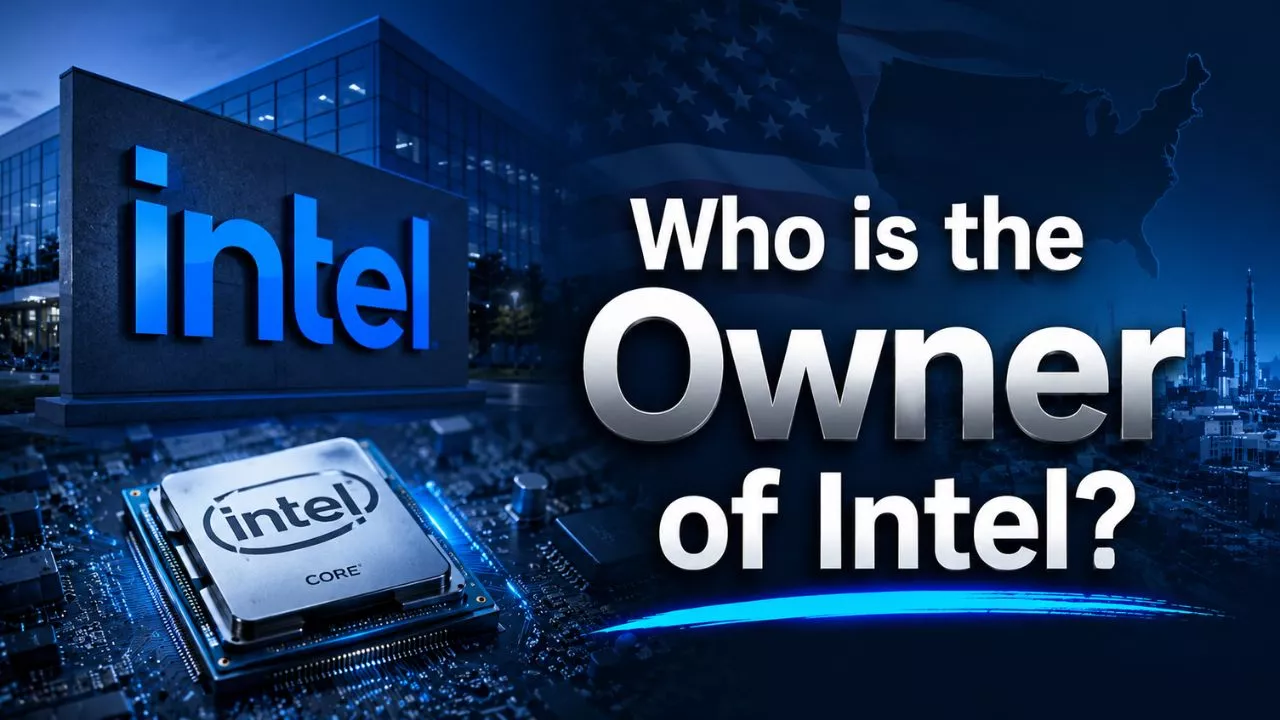
Intel is one of the founding companies of Silicon Valley — literally. Gordon Moore and Robert Noyce co-founded it in 1968, and for decades it was the undisputed king of semiconductor manufacturing. The “Intel Inside” sticker was ubiquitous on every PC. But when I look at Intel today, I see a company in genuine crisis — not terminal crisis, but a profound strategic inflection point. It missed the smartphone chip wave, it fell behind TSMC in manufacturing, it fumbled its early AI chip positioning. Now under new leadership, Intel is attempting one of the most ambitious industrial turnarounds in modern American corporate history: rebuilding US semiconductor manufacturing capacity while competing against companies that are years ahead of it on process technology.
🔵 Intel — Company Highlights
| Full Name | Intel Corporation |
| Ticker | NASDAQ: INTC |
| Founded | 1968 |
| Headquarters | Santa Clara, California, USA |
| CEO | Lip-Bu Tan (since March 2025) |
| Revenue (2024) | ~$53 billion |
| Employees | ~108,000 (post-2024 restructuring) |
| CHIPS Act Funding | ~$8.5 billion in US government grants |
Who Owns Intel?
Intel is a widely held public company with no controlling shareholder. Vanguard Group (~9%) and BlackRock (~6%) are consistently the largest institutional holders, followed by State Street and other major index fund managers. No founder family retains a controlling stake. The company’s strategic direction is determined by its board and CEO — and as of early 2024, that means Lip-Bu Tan, who replaced Pat Gelsinger after Gelsinger’s ambitious turnaround plan ran into severe headwinds. For context on the broader semiconductor competitive landscape, see our posts on who owns AMD and who owns ARM Holdings.
| Shareholder | Type | Approx. Stake | Notes |
|---|---|---|---|
| Vanguard Group | Institutional | ~9% | Largest single institutional holder |
| BlackRock | Institutional | ~6% | Major passive holder |
| State Street | Institutional | ~4% | Significant institutional position |
| Public / retail shareholders | Public | Remaining % | Widely distributed; no controlling individual |
Intel — Key Milestones
| Year | Milestone |
|---|---|
| 1968 | Gordon Moore and Robert Noyce found Intel in Mountain View, California |
| 1971 | Releases the 4004 — the world’s first commercially available microprocessor |
| 1981 | IBM chooses Intel 8088 for the original IBM PC; “Intel Inside” era begins |
| 2006 | Apple switches Mac computers from PowerPC to Intel processors |
| 2021 | Pat Gelsinger becomes CEO; announces Intel Foundry Services (IFS) strategy |
| 2023 | Launches Intel 4 process node; receives $8.5B in US CHIPS Act grants |
| 2024 (Feb) | Pat Gelsinger ousted; Lip-Bu Tan named new CEO in March 2024 |
| 2024 | Intel announces plans to spin out foundry business; major restructuring continues |
Leadership at Intel
Lip-Bu Tan became Intel’s CEO in March 2024 after Pat Gelsinger was pushed out. Tan is a veteran semiconductor investor and executive — he previously ran Cadence Design Systems and has decades of experience in the chip industry. His initial moves included accelerating Intel’s foundry business restructuring and taking a harder look at which capital projects to prioritize. The consensus view is that Intel needs to either make its foundry ambitions work — becoming a credible alternative to TSMC for chip manufacturing — or find a different strategic path. The CHIPS Act funding gives Intel a window; whether Tan can execute is the defining question.
My Take on Intel
I’ll be honest — Intel’s story is one of the most complicated I’ve had to write about in this space. It’s not a bad company; it’s a company that made a series of strategic decisions that compounded over time into a significant disadvantage. Choosing not to manufacture Apple’s mobile chips in the mid-2000s gave TSMC the volume and revenue to advance its process technology much faster than Intel did. That mistake cascades forward to today. What Intel has going for it is national strategic importance — the US government genuinely cannot afford for Intel to fail, which is why $8.5 billion in CHIPS Act money flowed in. That’s a real safety net. But subsidies don’t build great products. Lip-Bu Tan has the right credentials for this job. Whether he has enough time and resources is the open question.
FAQs
1. Who founded Intel and when?
Intel was co-founded in 1968 by Gordon Moore and Robert Noyce in Mountain View, California. Moore later became famous for “Moore’s Law” — the observation that transistor counts on chips double roughly every two years, which shaped the entire semiconductor industry.
2. Who is Intel’s current CEO?
Lip-Bu Tan has served as Intel’s CEO since March 2025. He replaced Pat Gelsinger, who was pushed out after his foundry-focused turnaround strategy ran into serious execution headwinds. Tan previously led Cadence Design Systems and brings deep semiconductor industry experience to the role.
3. Does anyone control Intel like a founder-led company?
No. Intel has no controlling shareholder or founder family with an outsized stake. It is widely held, with Vanguard (~9%) and BlackRock (~6%) as its largest institutional investors. Strategic decisions rest entirely with the board and CEO.
4. What is the CHIPS Act and how does it help Intel?
The CHIPS and Science Act is a US federal law designed to boost domestic semiconductor manufacturing. Intel secured approximately $8.5 billion in government grants under the act — funding intended to help it build and expand chip fabrication plants on US soil and reduce American reliance on overseas manufacturers like TSMC.
5. Why did Intel fall behind TSMC and AMD?
Intel’s decline stemmed from a series of compounding strategic missteps. Turning down the opportunity to manufacture Apple’s mobile chips in the mid-2000s gave TSMC the volume and revenue needed to advance its manufacturing technology faster. Intel also missed the smartphone chip wave entirely and was slow to position itself in AI accelerators — gaps that AMD and Nvidia moved quickly to fill.