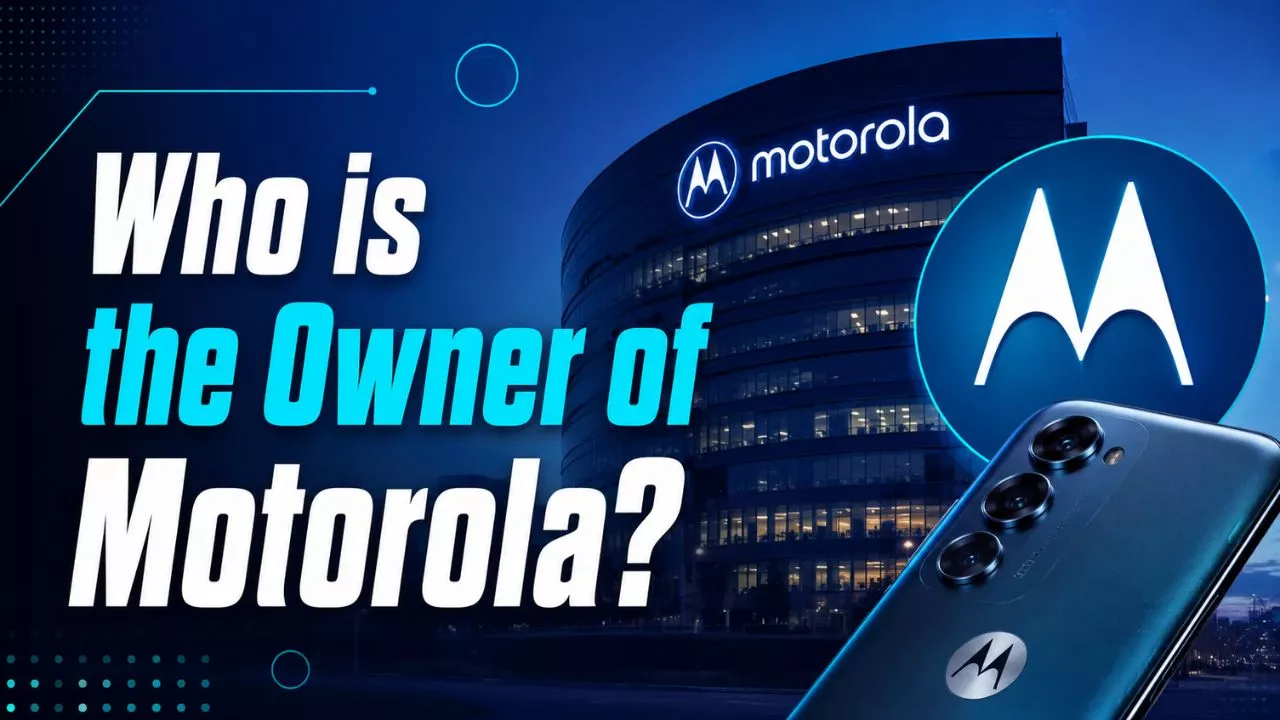
When someone mentions Motorola, different people picture different things. Some think of the original brick phone from 1983 — the DynaTAC 8000X — the world’s very first commercial handheld cellular phone. Others picture the legendary RAZR flip phone from the mid-2000s that became one of the best-selling phones in history. And a newer generation knows Motorola for its affordable, reliable Moto G and Razr foldable smartphones sold at a fraction of the price of iPhone or Samsung flagships.
But here is the thing most people do not realize: the Motorola you know today is not one company — it is actually two completely separate companies that share a famous name. One is owned by a Chinese multinational based in Beijing. The other is an American publicly traded company headquartered in Chicago focused entirely on public safety technology.
That split happened in 2011 — and the story of how one iconic American brand became two different entities with two different owners is one of the most fascinating tales in modern corporate history.
What Is Motorola?
Motorola, Inc. was an American multinational telecommunications company based in Schaumburg, Illinois. It was founded by brothers Paul and Joseph Galvin in 1928 as the Galvin Manufacturing Corporation and was renamed Motorola in 1947.
After having lost $4.3 billion from 2007 to 2009, Motorola was split into two independent public companies: Motorola Solutions (its legal successor) and Motorola Mobility (spun off), on January 4, 2011.
Today, when people talk about Motorola phones and Motorola petrol pumps, they are almost certainly referring to two very different corporate entities with two very different owners. Understanding who owns Motorola means understanding both.
Who Owns Motorola — The Direct Answer
Motorola today exists as two separate companies:
Motorola Mobility — the smartphone brand responsible for all Moto G, Moto Edge, and Razr phones — is a wholly owned subsidiary of Lenovo Group, a Chinese multinational technology company headquartered in Beijing, China. Lenovo acquired Motorola Mobility from Google in 2014 for approximately $2.91 billion.
Motorola Solutions — the public safety and enterprise technology company that makes two-way radios, emergency dispatch systems, body cameras, and software for police and government agencies — is a separate, independent publicly traded company on the New York Stock Exchange under the ticker symbol MSI. It is not owned by Lenovo or any parent company. It is owned by its public shareholders.
Ownership and Key Stakeholders Table
| Entity | Owner | Type | Key Detail |
|---|---|---|---|
| Motorola Mobility (Phones) | Lenovo Group | Wholly Owned Subsidiary | Lenovo acquired it from Google for $2.91 billion in 2014 |
| Lenovo Group | Legend Holdings (~25%) + public shareholders | Publicly Traded (HKG: 0992) | Chinese multinational; HQ in Beijing and Morrisville, NC |
| Legend Holdings | Largest single shareholder of Lenovo | Chinese State-linked holding company | Holds ~25% of Lenovo Group |
| Yang Yuanqing | Lenovo CEO & significant shareholder | Individual executive | Chairman and CEO of Lenovo since 2011 |
| Motorola Solutions (Public Safety) | Public Shareholders (NYSE: MSI) | Independent Public Company | Not owned by Lenovo; entirely separate company |
| Vanguard Group | Largest institutional shareholder of MSI | Passive Index Investor | One of the top institutional holders of Motorola Solutions stock |
| BlackRock, Inc. | Major institutional shareholder of MSI | Passive Index Investor | Second largest institutional holder of MSI |
| Greg Brown | CEO of Motorola Solutions | Executive Leader | CEO since 2008; led the 2011 split and all post-split strategy |
| Google (Historical) | Former owner of Motorola Mobility | Previous Owner | Bought for $12.5B in 2012; sold to Lenovo for $2.91B in 2014 |
The Origin Story: $565, Two Brothers, and a Battery Eliminator
The story of Motorola starts not in a gleaming tech campus but in a tiny rented space in Chicago, Illinois during the early years of the Great Depression — with just $565 in starting capital.
Galvin Manufacturing Corporation was founded on September 25, 1928, when brothers Paul V. Galvin and Joseph E. Galvin launched their company in Chicago to solve the problem of bulky batteries for early radios. Paul and Joseph Galvin used $565 to buy equipment from a bankrupt battery firm and built a device that let radios run on household electricity.
The name Motorola itself tells the story of what made the brand famous. The name cleverly combined “motor” — representing the automobile — and “ola” — meaning sound. Together: “sound in motion.” It captured exactly what the company’s first major hit product delivered.
In 1930, the company launched the Motorola car radio — a groundbreaking product that became one of the first commercially successful automotive radios. The first five letters “Motor” signify “automobile,” and “ola” means “sound.” The company sold its very first car radio to the Chicago Police Department.
From that small start, the Galvin brothers built something extraordinary. Motorola supplied the equipment that carried the first words from the Moon in 1969 — Neil Armstrong’s transmission during the Apollo mission used a Motorola-designed transponder. It introduced the Handie-Talkie in 1940 — the first handheld radio used by soldiers in World War II. And in 1983, it launched the DynaTAC 8000X — the world’s very first commercial portable cellular phone.
The Great Split of 2011: One Company Becomes Two
The most pivotal moment in Motorola’s modern ownership story happened not because of a merger or an acquisition, but because of failure.
After having lost $4.3 billion from 2007 to 2009, Motorola was split into two independent public companies. The continuous downturn in the mobile phone business led most directly to Motorola splitting into two separate companies in January 2011: Motorola Mobility, Inc. and Motorola Solutions, Inc.
Motorola Solutions kept the enterprise and government businesses — two-way radios, public safety systems, emergency communications. At the time of the split, Motorola Solutions had a market value of approximately $12.8 billion.
Motorola Mobility kept the smartphones, cable boxes, and consumer electronics. At the time of the split, Motorola Mobility had a market value of approximately $9 billion.
Greg Brown stayed with Motorola Solutions and has led it ever since — becoming the longest-serving CEO of Motorola after the Galvin family. He achieved 1,400% shareholder returns over 18 years and made 50+ acquisitions, earning recognition as Fortune’s No. 1 underrecognized CEO in 2024.
Google’s $12.5 Billion Gamble — and Its Quick Exit
Within months of the 2011 split, Motorola Mobility received the most surprising phone call in its history.
On August 15, 2011, Google announced that it had signed a definitive agreement with Motorola Mobility to acquire the company for $40 per share in cash, with a total value of approximately $12.5 billion — representing a premium of 63% over the previous closing price.
Why did Google pay $12.5 billion for a struggling phone company? The answer was largely about patents. Motorola held an enormous portfolio of wireless communications patents — technology that Google needed to protect its Android operating system from lawsuits by Apple and others. By buying Motorola, Google bought an enormous legal shield.
But Google was never truly interested in making phones. Google later sold Motorola Mobility in 2014 to the Chinese computer company Lenovo for $2.91 billion but retained many of the company’s patents. In less than three years, Google had spent $12.5 billion, used the patents it needed, and sold the business for $2.91 billion — a writedown of nearly $10 billion.
How Lenovo Came to Own Motorola Phones
Lenovo completed the full acquisition of Motorola Mobility from Google on October 30, 2014. The total purchase price at close was approximately $2.91 billion.
Lenovo will operate Motorola as a wholly-owned subsidiary. Motorola’s headquarters will remain in Chicago. Yang Yuanqing, chairman and CEO of Lenovo, said at the time: “Today we achieved a historic milestone for Lenovo and for Motorola — and together we are ready to compete, grow and win in the global smartphone market.”
Under Lenovo’s ownership, Motorola Mobility has become the smartphone-focused division responsible for designing and manufacturing all Moto and Motorola branded mobile handsets and solutions. As of April 2026, its portfolio includes the Moto G, Moto Edge, and foldable Razr series. The company targets a wide market — balancing affordability with premium innovation. Motorola maintains a strong presence in North America and Latin America and is also expanding in Europe and Asia.
In April 2026, Motorola announced the Moto G47 smartphone, and also introduced the Moto G37, Moto G37 Power, Moto G87, and three Razr 70 series foldable phones — showing the brand is as active in new product development as it has ever been.
Who Owns Lenovo — The Company Behind Motorola Phones?
Since Motorola Mobility is wholly owned by Lenovo, understanding who owns Motorola phones means understanding who owns Lenovo.
Lenovo is a global technology company headquartered in Beijing and Morrisville, North Carolina. Founded in 1984 as Legend, it has grown into one of the world’s leading PC and device manufacturers. As of April 2026, Lenovo operates in more than 180 markets.
Lenovo is not owned by a single individual or entity. Instead, it operates under a layered ownership structure where Legend Holdings remains the largest shareholder, while institutional investors and public shareholders hold a significant portion of the company. A large portion of ownership remains with public and retail investors, who collectively hold around 38%. Control is shared across layers: CEO Yang Yuanqing manages operations, while shareholders and the board influence strategy.
Legend Holdings — a Chinese state-linked investment holding company — is the single largest shareholder of Lenovo, holding approximately 25% of the company. Lenovo itself trades on the Hong Kong Stock Exchange under the ticker HKG: 0992.
Motorola Solutions: The Other Motorola Nobody Talks About
While most consumers focus on Motorola phones, Motorola Solutions (NYSE: MSI) is actually the more financially powerful of the two Motorola entities — and it has nothing to do with Lenovo.
Motorola Solutions’ business is safety and security. The company is a global leader in public safety and enterprise security — making two-way radios for police officers, emergency dispatch systems for fire departments, body-worn cameras, and software platforms that connect entire public safety ecosystems.
Motorola Solutions is publicly traded on the NYSE under MSI with a share price of approximately $438.32 as of March 27, 2026. The company declared regular quarterly dividends of $1.09 per share for each of the first three quarters of fiscal 2025, and $1.21 per share for the fourth quarter. Its 2026 Annual Meeting was scheduled for May 18, 2026.
The largest institutional shareholders of Motorola Solutions include Vanguard Group and BlackRock — the same institutional giants that dominate most large American public companies. There is no controlling individual or family shareholder. CEO Greg Brown has led the company since 2008 — overseeing the 2011 split, the transformation to a software-and-services-first model, and more than 50 acquisitions that have made MSI one of the most consistent wealth creators in American technology.
Frequently Asked Questions (FAQs)
Q1. Who owns Motorola in 2026?
Motorola Mobility (phones) is owned by Lenovo Group of China, while Motorola Solutions (public safety tech) is an independent publicly traded company on the NYSE: MSI.
Q2. Is Motorola a Chinese company?
The Motorola phone brand (Motorola Mobility) is owned by Lenovo, a Chinese company, but Motorola itself was founded in America in 1928 and its phone headquarters remain in Chicago.
Q3. When did Lenovo buy Motorola?
Lenovo completed the acquisition of Motorola Mobility from Google on October 30, 2014, for approximately $2.91 billion.
Q4. Why did Google sell Motorola to Lenovo?
Google bought Motorola Mobility in 2012 mainly for its patent portfolio to protect Android from lawsuits. Once it secured the key patents, it sold the phone business to Lenovo in 2014 for $2.91 billion — a significant loss from its $12.5 billion purchase price.
Q5. Who founded Motorola and when? Motorola was founded by brothers Paul V. Galvin and Joseph E. Galvin on September 25, 1928 in Chicago, Illinois as the Galvin Manufacturing Corporation, renamed Motorola in 1947.
Q6. What is the difference between Motorola Mobility and Motorola Solutions?
Motorola Mobility makes consumer smartphones (owned by Lenovo). Motorola Solutions makes public safety technology — radios, cameras, dispatch systems for police and government (owned by public shareholders, NYSE: MSI).
Q7. Is Motorola Solutions related to Lenovo?
No. Motorola Solutions (NYSE: MSI) is a completely independent American public company with no ownership connection to Lenovo. They only share the historic Motorola name from the 2011 split.
Q8. What are the latest Motorola phones in 2026?
In April 2026, Motorola launched the Moto G47, Moto G37, Moto G37 Power, Moto G87, and three models in the Razr 70 foldable series under Lenovo’s ownership.
Motorola in 2026 is two companies with one famous name. Motorola Mobility — the smartphone brand behind every Moto G, Moto Edge, and Razr phone — is a wholly owned subsidiary of Lenovo Group, acquired from Google in 2014 for $2.91 billion. Lenovo itself is controlled by Legend Holdings (~25%) and traded on the Hong Kong Stock Exchange.
Motorola Solutions — the public safety and enterprise technology company — is a completely separate, independent, publicly traded American company on the NYSE under the ticker MSI, owned by public shareholders with Vanguard and BlackRock as its largest institutional investors.
Both companies trace their roots to September 25, 1928 — the day brothers Paul and Joseph Galvin started Galvin Manufacturing Corporation in Chicago with just $565 and a determination to bring sound in motion to the world. From a car radio in 1930 to the Moon in 1969 to the first cellular phone in 1983 to a Chinese-owned global smartphone brand and an American public safety technology leader in 2026 — the Motorola story spans nearly a century of invention, reinvention, and transformation.