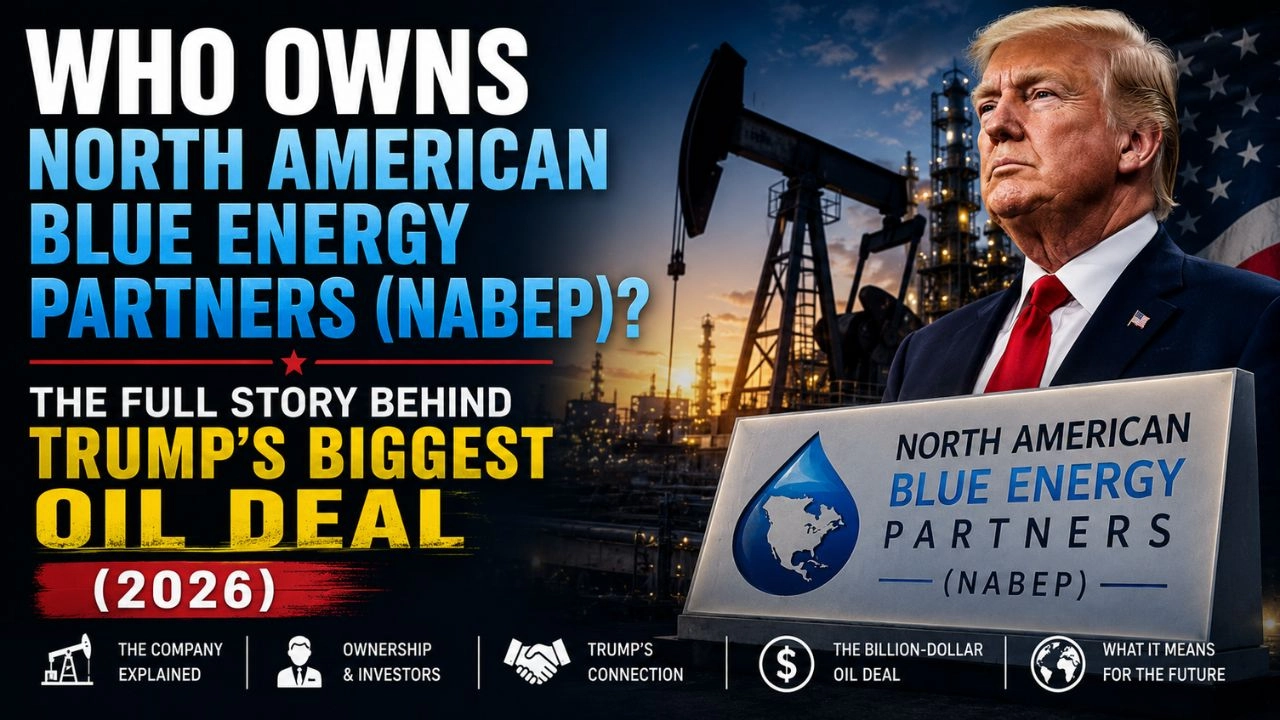
In the last 48 hours, one company has dominated global energy headlines in a way that no private oil producer ever has before. On August 31, 2026, President Donald Trump announced what he called “the biggest oil deal in world history” — a landmark agreement between the United States government and North American Blue Energy Partners (NABEP) to unlock Venezuela’s vast oil reserves. The deal has stunned energy markets, triggered geopolitical debate, and put one largely unknown Venezuelan businessman at the very center of American foreign policy.
So who actually owns NABEP — and how did this company end up at the heart of one of the most consequential energy deals in modern history?
What Is North American Blue Energy Partners?
North American Blue Energy Partners (NABEP) is an independent oil exploration and production company operating in North and Latin America, with offices in Caracas, Maracaibo, and Lechería, Venezuela. The company is headquartered in Barbados and is currently Venezuela’s second-largest private oil producer, behind only Chevron Corporation.
NABEP directly employs over 5,000 people and supports over 10,000 contractor employees across Venezuela. Under current leadership, the company scaled its production from approximately 18,000 barrels per day to more than 200,000 barrels per day through roughly $1 billion in company-funded investment — a dramatic growth story that ultimately caught the attention of the Trump administration.
Who Owns NABEP in 2026?
NABEP is currently controlled by Venezuelan businessman Alejandro Betancourt López, aged 46, who also serves as its CEO. NABEP was previously owned by U.S. oil tycoon Harry Sargeant III, a Florida oil magnate. A party close to Betancourt recently bought the minority stake in NABEP held by Harry Sargeant III, completing the transition of full control to Betancourt.
Following the landmark deal announced on August 31, 2026, the U.S. government — specifically the Pentagon’s Office of Strategic Capital — now holds a 35% equity stake in NABEP’s corporate parent through penny warrants, instruments that give the government equity without significant upfront capital. NABEP retains full operating control of the business.
Ownership and Key Stakeholders Table
| Owner / Party | Role | Stake | Key Detail |
|---|---|---|---|
| Alejandro Betancourt López | CEO & Controlling Owner | Majority controlling stake | Venezuelan businessman; 15+ years in Venezuela’s oil industry |
| U.S. Government (Pentagon’s Office of Strategic Capital) | Equity Stakeholder | 35% of NABEP’s corporate parent | Acquired via penny warrants; announced August 31, 2026 |
| Harry Sargeant III (exited) | Former Minority Stakeholder | Exited in August 2026 | U.S. Florida oil tycoon; stake bought out by Betancourt-aligned party |
| U.S. Department of State | Production Rights Holder | First refusal on 80% of production | Right to purchase all remaining oil output beyond the 20% guaranteed |
| Venezuelan Interim Authorities | Concession Grantor | No equity | Granted NABEP 100-year concessions on 17 oil fields |
| NABEP Employees | Operational Workforce | No equity stake | 5,000+ direct employees; 10,000+ contractors across Venezuela |
Who Is Alejandro Betancourt López?
Alejandro Betancourt López is a 46-year-old Venezuelan entrepreneur who has spent more than 15 years in the country’s oil industry. He built his early fortune through Derwick Associates, a firm that won contracts to build power plants under former Venezuelan President Hugo Chávez following an acute power crisis triggered by drought in the late 2000s.
Betancourt has been investigated by multiple countries, including the United States, over alleged money laundering, according to the Washington Post — though he was never charged. Despite his controversial background, Betancourt emerged as the Trump administration’s key partner in Venezuela, serving as a central figure helping the U.S. identify promising energy assets, assess operational bottlenecks, and make industry connections in the country.
Betancourt has been in the Venezuelan oil industry for more than 15 years with a consistent track record of success, most recently at the helm of NABEP, where he rapidly scaled production and turned the company into Venezuela’s second-largest private oil producer in just two years.
The Historic Deal: What Happened on August 31, 2026?
This is the deal that changed everything — and it happened just two days ago.
On August 31, 2026, the U.S. Departments of State and War announced a landmark agreement with NABEP to significantly expand oil production in Venezuela. Venezuelan interim authorities granted NABEP 100-year concessions for 17 oil fields — with proven reserves of approximately 65 billion barrels, roughly one-fifth of Venezuela’s total and the largest proven reserves in the world.
In return, the United States received three things. First, a 35% equity stake in NABEP’s corporate parent. Second, a guaranteed right to purchase 20% of all oil produced at cost. Third, the right of first refusal to buy the remaining 80% of production. President Trump called the agreement “the biggest oil deal in world history” on Truth Social, and Venezuela’s interim president Delcy Rodríguez backed it publicly, saying it could generate more than $200 billion in tax revenue for the country.
NABEP has also announced an ambitious plan to invest up to $100 billion in new oil infrastructure in Venezuela, with a near-term goal of increasing production to more than 1 million barrels of oil per day — up from the current 200,000 barrels per day. The new venture is expected to bring billions in U.S. supplier purchases, supporting thousands of manufacturing jobs in the United States.
Why Venezuela? The Reserves That Changed Everything
Venezuela holds the largest proven oil reserves in the world — larger than Saudi Arabia, larger than Canada, larger than Iran. For decades, those reserves were largely inaccessible to American companies due to sanctions, political instability, and the nationalization policies of former President Nicolás Maduro.
The Trump-NABEP deal represents a fundamental shift in that equation. By partnering with Betancourt — a Venezuelan operator who already had boots on the ground and established relationships — the U.S. government found a way to access those reserves without directly operating the fields itself. NABEP takes the operational risk. America takes the oil and the equity stake.
The 17 oil fields covered by the deal include fields previously controlled by Chinese companies and a Russian firm — making the deal geopolitically significant far beyond its economic dimensions. The Trump administration is essentially pushing Chinese and Russian energy interests out of Venezuela’s most productive fields and replacing them with a U.S.-backed operator.
The Controversy Surrounding the Deal
Not everyone is celebrating. The deal has drawn significant scrutiny from multiple directions.
Betancourt’s past investigations for alleged money laundering raised immediate questions from lawmakers and analysts about why the U.S. government would take a 35% equity stake in a company controlled by someone with such a complicated legal history. The Washington Post and other major outlets reported extensively on his background in the days following the announcement.
NABEP’s previous minority owner, Harry Sargeant III, had also come under fire from Venezuelan opposition figures and U.S. allies for allegedly propping up the Maduro government. His exit from NABEP — completed just before the major deal announcement — raises questions about timing and what exactly changed in the company’s ownership structure in the weeks leading up to August 31.
Additionally, the deal is structured under Venezuela’s hydrocarbons law — meaning NABEP operates within a legal framework still shaped by Maduro-era legislation, even as the political situation in Venezuela continues to evolve rapidly.
Frequently Asked Questions (FAQs)
Q1. Who owns North American Blue Energy Partners (NABEP) in 2026?
NABEP is controlled by Venezuelan businessman Alejandro Betancourt López, its CEO, with the U.S. government holding a 35% equity stake following the August 31, 2026 deal.
Q2. What is NABEP and where is it headquartered?
NABEP is an independent oil exploration and production company headquartered in Barbados, with operations and offices across Venezuela in Caracas, Maracaibo, and Lechería.
Q3. What was the U.S.-NABEP Venezuela oil deal announced on August 31, 2026?
The U.S. government granted NABEP 100-year concessions on 17 Venezuelan oil fields with 65 billion barrels of reserves, in exchange for a 35% equity stake and 20% of all production at cost.
Q4. Who previously owned NABEP before Alejandro Betancourt?
NABEP was previously owned by U.S. oil tycoon Harry Sargeant III of Florida, who sold his minority stake to a party aligned with Betancourt in August 2026, just before the landmark deal was announced.
Q5. How much oil does NABEP produce per day?
NABEP currently produces approximately 200,000 barrels of oil per day, scaled up from just 18,000 barrels per day through roughly $1 billion in company-funded investment over two years.
Q6. Is NABEP publicly traded?
No. NABEP is a private company and is not listed on any public stock exchange. Its ownership structure is private, with Betancourt as the controlling figure and the U.S. government as a 35% passive equity stakeholder.
Q7. Why did the U.S. government take a stake in NABEP?
The U.S. used penny warrants through the Pentagon’s Office of Strategic Capital to acquire a 35% stake in NABEP’s corporate parent — gaining equity in Venezuela’s massive oil reserves without significant upfront capital outlay.
Q8. What is NABEP’s production target going forward?
NABEP has announced plans to invest up to $100 billion in new oil infrastructure in Venezuela, with a near-term goal of exceeding 1 million barrels of oil per day — five times its current output.
North American Blue Energy Partners (NABEP) is an independent oil company headquartered in Barbados, operating across Venezuela from offices in Caracas, Maracaibo, and Lechería. It is currently controlled by Venezuelan businessman and CEO Alejandro Betancourt López, who bought out the previous minority stake held by U.S. oil tycoon Harry Sargeant III in August 2026. Following the landmark deal announced on August 31, 2026, the U.S. government — through the Pentagon’s Office of Strategic Capital — now holds a 35% equity stake in NABEP’s corporate parent.
NABEP holds 100-year concessions over 17 Venezuelan oil fields with proven reserves of approximately 65 billion barrels, produces 200,000 barrels per day, directly employs 5,000 people, and has announced plans to invest up to $100 billion in new oil infrastructure with a production target of over 1 million barrels per day. President Trump called it the biggest oil deal in world history — and by the numbers, it may well be.