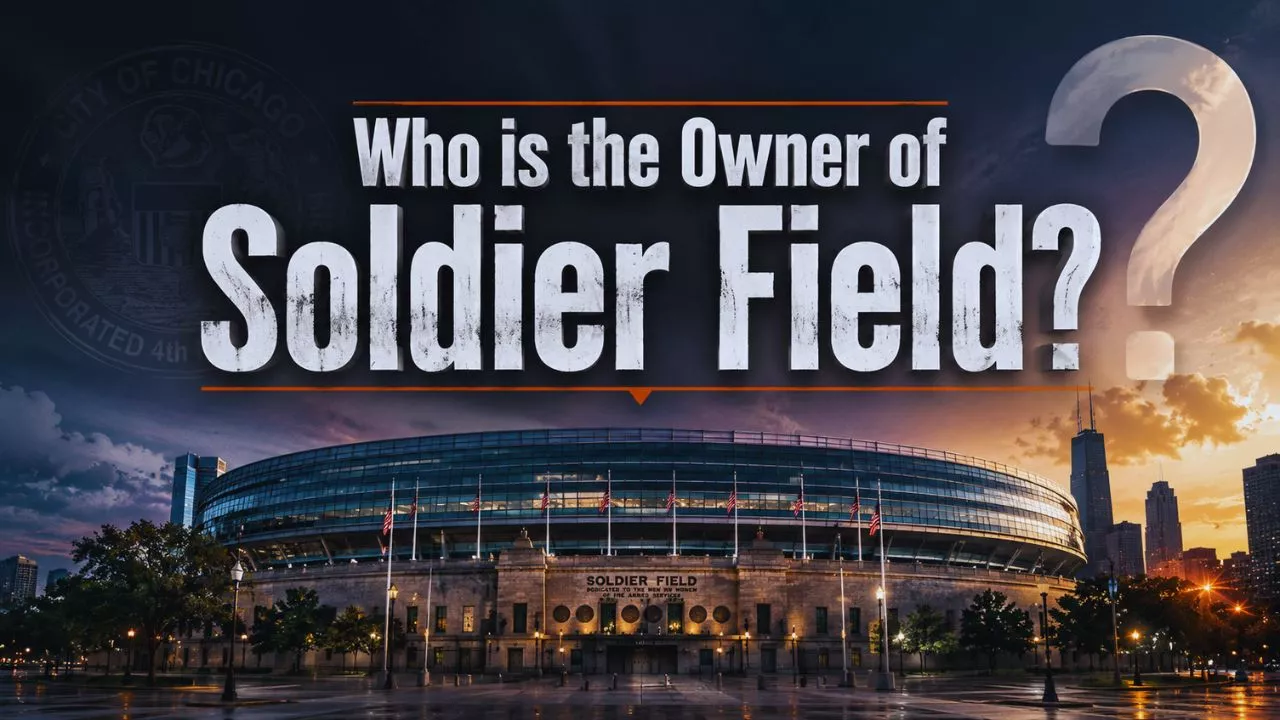
It sits right on the edge of Lake Michigan, with the Chicago skyline rising behind it and the water glittering in front. It has stood in the same spot for over 100 years, survived two World Wars, hosted a Jack Dempsey boxing match that drew more than 100,000 fans, witnessed the birth of the Special Olympics, and served as the home of one of the most storied franchises in professional football. Soldier Field is not just a stadium — it is a monument, a landmark, and a piece of living American history.
But right now, in 2026, Soldier Field is at the center of one of the most dramatic stadium controversies in NFL history. The Chicago Bears — the team that has called it home since 1971 — are actively exploring a move out of the city entirely. And the reason comes down to a single, surprising fact that most fans do not know: the Bears do not own Soldier Field. They never have.
So who does? Here is the complete ownership story.
Who Owns Soldier Field Right Now in 2026?
The answer is straightforward. Soldier Field is owned by the Chicago Park District and managed by ASM Global, the global leader in venue management.
The Chicago Park District is a government agency — it is not a private company, not a sports team, and not a corporation. It is a public body created by the State of Illinois to manage the parks, recreational facilities, and public venues of the city of Chicago. That means Soldier Field is, in the most literal sense, owned by the people of Chicago — a publicly funded, publicly owned landmark that has been under government stewardship since the day it was built over 100 years ago.
The public facility is home to the Chicago Bears and the Chicago Fire, and hosts an array of sporting, entertainment, and community events each year.
ASM Global, the private management company that operates the stadium day-to-day, handles everything from event scheduling and concessions to facilities management and security — but it does not own the building. The Chicago Park District holds the deed.
Soldier Field Ownership and Key Stakeholders Table
| Party | Role | Type | Key Detail |
|---|---|---|---|
| Chicago Park District | Owner | Government Agency | Public body; owns Soldier Field since its construction in 1922–1924 |
| ASM Global | Stadium Operator / Manager | Private Company | World’s largest venue management firm; runs day-to-day operations |
| City of Chicago | Government Oversight | Municipal Government | Park District operates under Illinois state law and city oversight |
| Chicago Bears (NFL) | Primary Tenant | Private Sports Franchise | Tenant since 1971; current lease runs through 2033 |
| Chicago Fire FC | Secondary Tenant | MLS Soccer Club | Returns to Soldier Field as a co-tenant; plays home MLS games here |
| Illinois Sports Facilities Authority (ISFA) | Financial Partner | State Agency | Involved in the 2003 renovation financing structure |
| George McCaskey | Bears Owner | Private Individual | Controls the Bears franchise; driving new stadium push |
The Origin Story: A Memorial Built for the People
Soldier Field did not begin life as an NFL stadium. It began as something much more meaningful — a tribute to the men and women who gave their lives in war.
In 1919, the South Park Commission (later reorganized as the Chicago Park District) held a design competition for what supporters hoped would be “the largest, most beautiful public arena in the world.” The stadium would also honor the city’s World War I veterans. Architects William Holabird and Martin Roche won with a design for a Greek Revival stadium that notably featured a pair of colonnades. In 1922, construction began along Lake Michigan and continued for more than a decade.
The original name was Municipal Grant Park Stadium, and it was changed to Soldier Field on November 11, 1925, as a memorial to U.S. soldiers who lost their lives in combat. The first event at Soldier Field was an athletic meet for Chicago police officers on October 9, 1924.
Construction started on August 11, 1922. It cost $13 million to build. On October 9, 1924, the stadium officially opened as “Grant Park Stadium.” The stadium’s design featured tall columns at the entrances. When it first opened, it could hold over 74,000 people. With extra seating, it could fit more than 100,000.
The first football game at the stadium came on November 22, 1924, when a capacity crowd watched Notre Dame edge Northwestern 13–6. The stadium was formally dedicated on November 27, 1927, with the Army–Navy game ending in a 21–21 tie before one of the largest crowds in American football history.
The Biggest Moments in Soldier Field History
Soldier Field has hosted some of the most remarkable events in 20th century American history — events that go far beyond football.
In 1968, Soldier Field hosted the first Special Olympics — the now-global athletic competition founded by Eunice Kennedy Shriver for athletes with intellectual disabilities. That first event attracted 1,000 athletes from 26 U.S. states and Canada, and it took place right here on the Soldier Field turf.
The stadium also hosted one of the most famous boxing matches ever contested on American soil. Soldier Field hosted the first boxing event which drew a gate of over $2.5 million — the legendary Dempsey–Tunney fight in 1927 — along with the all-time largest football crowd of 123,000 people.
On February 27, 1987, Soldier Field was designated a National Historic Landmark — one of only a small number of active sports venues in America to hold that distinction.
The Chicago Bears moved to Soldier Field in 1971 after spending 50 years at Wrigley Field. They previously played at Wrigley Field but were forced to move to a larger venue due to post-AFL–NFL merger policies requiring that stadium capacities seat over 50,000 spectators. In 1978, the Bears and the Chicago Park District agreed to a 20-year lease and renovation of the stadium.
The Controversial $632 Million Renovation of 2003
By the late 1990s, Soldier Field was showing its age badly. The Bears had been threatening to leave the city for years, and the Chicago Park District — still the owner — finally agreed to act.
The Chicago Park District, which owned the property, faced substantial criticism when it announced plans to alter the stadium with a design by Benjamin T. Wood and Carlos Zapata of Wood + Zapata in Boston. The renovation aimed to modernize Soldier Field while preserving its historic façade. Completed in 2003, the updated Soldier Field retained its classic colonnade while incorporating a bold and contemporary design. The addition of a glass and steel structure brought a jolt of modernity to the stadium.
Construction was completed in 2003 — at a cost of some $690 million — and the resulting stadium proved controversial, with much of the criticism directed at the modern seating bowl, which some compared to a spaceship. Another point of contention was the capacity. The number of seats dropped to 61,500, which failed to meet the NFL’s requirement of 70,000 to host a Super Bowl.
The renovation cost left a painful financial legacy. Chicago taxpayers are still paying off the last round of renovations. Renovations on the stadium in 2003 were supposed to be paid off with a tax on hotel stays, but the pandemic limited that revenue. The city has paid nearly $52 million since 2022 to cover the costs, and $356 million in debt still remains.
Why the Bears Don’t Own Soldier Field — And Why That Matters
This is the detail at the heart of the biggest stadium story in Chicago history.
Soldier Field is owned by the Chicago Park District, and the Bears play there as a tenant. That limits the team’s control and long-term revenue potential compared to teams that fully own their stadiums.
In modern NFL economics, stadium revenue is everything. When your team owns the building, you keep the money from naming rights, concerts, non-football events, sponsorship deals, and premium seating packages. When you are just a tenant — paying rent to a government agency — you are sharing that revenue or missing it entirely.
The Bears’ current lease at Soldier Field runs through 2033, but they can leave early. The fee for the Bears to leave could be around $90 million based on their current contract, but that is not enough to discourage the team from considering an exit.
The 2026 Stadium Crisis: Bears on the Verge of Leaving
This is where the ownership story gets urgent. As of June 2026, the Chicago Bears are on the verge of the most dramatic stadium move in NFL history.
The Chicago Bears have concluded that, under current terms, there is not a workable stadium deal on city-owned land in Chicago, effectively putting a century of lakefront football at Soldier Field at risk. The franchise is weighing a multibillion-dollar redevelopment in suburban Arlington Heights against a billion-dollar public financing package in Hammond, Indiana, roughly 20 miles from downtown.
The Bears’ board of directors voted to advance their stadium development in Hammond, Indiana, with the exact site still to be determined. This is the first time the Bears’ board has voted on any stadium site.
The Bears already own land nearby. In Arlington Heights, they already own 326 acres of land at the former Arlington International Racecourse, purchased for about $197.2 million in 2023. In Hammond, Indiana, a newly created Northwest Indiana Stadium Authority would own a new NFL stadium and lease it long term to the team — giving the Bears far more revenue control than they have ever had as tenants at Soldier Field.
If the Bears leave, Soldier Field — owned by the Chicago Park District — will still stand. But it will lose its anchor tenant, and a new future for the 100-year-old landmark will have to be written from scratch.
Frequently Asked Questions (FAQs)
Q1. Who owns Soldier Field in 2026?
Soldier Field is owned by the Chicago Park District, a public government agency of the City of Chicago.
Q2. Do the Chicago Bears own Soldier Field?
No. The Chicago Bears are tenants who rent Soldier Field from the Chicago Park District under a lease that runs through 2033.
Q3. Who manages and operates Soldier Field?
ASM Global, the world’s largest private venue management company, operates Soldier Field on behalf of the Chicago Park District.
Q4. When was Soldier Field built and why?
Soldier Field was built between 1922 and 1924 as a memorial to U.S. soldiers who died in World War I, originally named Municipal Grant Park Stadium.
Q5. How much did the 2003 Soldier Field renovation cost?
The 2003 renovation cost approximately $632 million, and Chicago taxpayers are still paying off the debt — with $356 million remaining as of 2026.
Q6. Are the Chicago Bears leaving Soldier Field?
As of 2026, the Bears’ board has voted to advance a new stadium plan in Hammond, Indiana, effectively signaling a departure from Soldier Field before or after their lease expires in 2033.
Q7. What is the capacity of Soldier Field?
Soldier Field has a current capacity of approximately 62,500 after the 2003 renovation reduced it from the original 74,000+ seats.
Q8. Is Soldier Field a National Historic Landmark?
Yes. Soldier Field was officially designated a National Historic Landmark on February 27, 1987.
Soldier Field is owned by the Chicago Park District — a public government agency — and has been since the day construction began in 1922. It was built for $13 million as a World War I memorial, opened in 1924, designated a National Historic Landmark in 1987, and completely renovated in 2003 for over $632 million — a debt that Chicago taxpayers are still paying off today. It is operated day-to-day by ASM Global, the world’s largest venue management company.
The Chicago Bears are tenants, not owners. Their lease runs through 2033, but the team’s board has already voted to pursue a new stadium in Hammond, Indiana — a move that could end over 50 years of professional football on the Chicago lakefront. Whatever happens next, Soldier Field itself remains the property of the City of Chicago and its people — just as it has been for every one of its 100-plus years of existence.