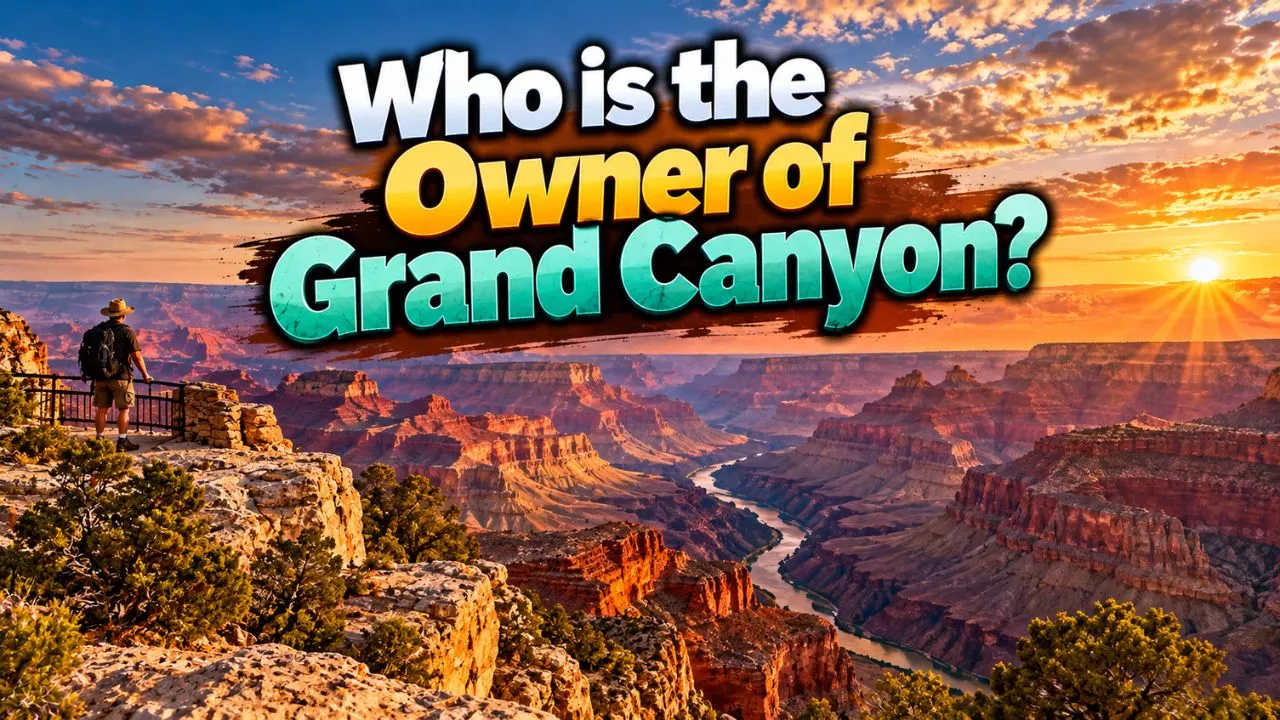
The Grand Canyon is one of the most awe-inspiring places on Earth — 277 miles long, up to 18 miles wide, and over 6,000 feet deep, carved by the Colorado River over more than 6 million years through the layered rock of the Colorado Plateau in Arizona.
Nearly 5 million people visit it every year. But a surprisingly small number of those visitors stop to ask a genuinely fascinating question: who actually owns the Grand Canyon?
The answer is layered — just like the canyon itself. It involves the United States federal government, multiple Native American tribes, a landmark 2023 monument designation, and a western rim that belongs to no federal agency at all.
Who Owns the Grand Canyon in 2026?
The vast majority of the Grand Canyon is owned by the United States federal government, held in trust for the American people and managed by a collection of federal agencies.
The centerpiece is Grand Canyon National Park, which covers 1,217,403 acres and is managed by the National Park Service (NPS), a bureau of the U.S. Department of the Interior.
No single private individual, corporation, or foreign government owns the Grand Canyon. It is public land — meaning it legally belongs to all American citizens collectively, with the federal government acting as its permanent caretaker and steward.
The current Superintendent of Grand Canyon National Park is Ed Keable, who leads the park’s management team under the authority of the National Park Service.
Grand Canyon Ownership and Land Management Table
| Land Area | Owner / Manager | Size | Key Detail |
|---|---|---|---|
| Grand Canyon National Park | U.S. Federal Government (NPS) | 1,217,403 acres | Established February 26, 1919; managed by National Park Service |
| Baaj Nwaavjo I’tah Kukveni National Monument | U.S. Federal Government (BLM & U.S. Forest Service) | 917,618 federal acres | Designated by President Biden on August 8, 2023; co-managed with 13 tribal nations |
| Grand Canyon-Parashant National Monument | U.S. Federal Government (BLM & NPS) | 1,021,030 acres | Established 2000; located north of Grand Canyon National Park |
| Havasupai Indian Reservation | Havasupai Tribe (sovereign nation) | ~188,077 acres | Tribal land within and adjacent to the canyon; home of Havasu Falls |
| Hualapai Tribal Land (Grand Canyon West) | Hualapai Tribe (sovereign nation) | ~108 miles of canyon rim | Self-funded; home of the famous Skywalk glass bridge |
| Navajo Nation | Navajo Nation (sovereign nation) | Borders eastern Grand Canyon | Largest Native American reservation in the U.S.; borders the park’s eastern edge |
| Arizona State Land | State of Arizona | Minor parcels | Small state-held parcels near park boundaries |
| Private In-Holdings | Various private owners | Very small parcels | Tiny historic private claims inside park boundaries; federally acquired over time |
The History of Grand Canyon Ownership
The story of who owns the Grand Canyon today cannot be told without understanding how it moved from its original Indigenous stewards to the federal government — a journey that took centuries, involved broken promises, and is still being corrected today.
For thousands of years before European contact, the Grand Canyon was home to numerous Native American peoples, including the Havasupai, Hualapai, Navajo, Hopi, Paiute, and many others.
These were not visitors — they were permanent residents who built civilizations, spiritual practices, and entire cultures around the canyon and the Colorado River that carved it. Stone tools found in the area date back more than 10,000 years.
As the United States expanded westward in the 1800s, federal land laws opened the region to settlers, miners, and speculators. Pioneers like Pete Berry and Ralph Cameron staked mining claims and private toll roads inside the canyon, restricting public access and profiting from the growing tourist interest.
The federal government spent decades buying back or condemning these private claims — the last major ones were acquired through eminent domain in 1939.
President Theodore Roosevelt first protected the Grand Canyon as a National Monument on January 11, 1908, famously saying: “Leave it as it is. You cannot improve on it.
The ages have been at work on it, and man can only mar it.” On February 26, 1919, Congress officially established Grand Canyon National Park through an act of legislation.
The Federal Agencies That Manage Grand Canyon Land
Ownership and management of the broader Grand Canyon region is split across several federal agencies, not just the National Park Service.
The National Park Service manages Grand Canyon National Park itself — the core of the entire protected area. The Bureau of Land Management (BLM) — the largest federal public land manager in the country, responsible for over 40% of all federal public land — manages the Grand Canyon-Parashant National Monument and large portions of the surrounding region.
The U.S. Forest Service manages the Kaibab National Forest, which borders the park on both its north and south rims. Together, these three agencies collectively protect millions of acres of land in and around the canyon.
The Three Native American Nations That Own Land Here
One of the most important and often misunderstood aspects of Grand Canyon ownership is the role of sovereign Native American nations. Three tribal nations own or control significant portions of land adjacent to — and in some cases within — the canyon itself.
The Havasupai Tribe — whose name means “people of the blue-green waters” — has lived in Havasu Canyon, a spectacular side canyon of the Grand Canyon, for centuries. Their reservation of approximately 188,077 acres lies within and directly adjacent to the national park.
The tribe’s famous turquoise waterfalls — Havasu Falls, Mooney Falls, and others — are on sovereign Havasupai tribal land, not federal land. Visiting requires a tribal permit, and the tribe controls all access.
The Hualapai Tribe — “People of the Tall Pines” — owns approximately 108 miles of the Grand Canyon’s western rim, an area known as Grand Canyon West. This is a completely sovereign tribal area that receives no federal funding from the National Park Service.
The Hualapai built the world-famous Grand Canyon Skywalk — a glass-bottomed horseshoe bridge extending 70 feet over the rim — which opened in 2007 and is entirely operated and owned by the tribe. Visitors to Grand Canyon West pay fees directly to the Hualapai Nation.
The Navajo Nation — the largest Native American reservation in the United States — borders the eastern edge of Grand Canyon National Park. From Navajo land, visitors can access unique eastern canyon viewpoints that are not accessible from the national park itself.
The 2023 National Monument: A Landmark Victory for 13 Tribes
One of the most significant developments in the recent history of Grand Canyon ownership and stewardship happened in August 2023 — and its effects are still being felt in 2026.
On August 8, 2023, President Joe Biden signed a presidential proclamation designating the Baaj Nwaavjo I’tah Kukveni — Ancestral Footprints of the Grand Canyon National Monument, protecting nearly 960,000 acres of federal public land surrounding Grand Canyon National Park.
The name combines two Indigenous phrases: Baaj nwaavjo means “where Indigenous peoples roam” in the Havasupai language, and I’tah kukveni means “our ancestral footprints” in the Hopi language.
The monument was the result of decades of advocacy led by a coalition of 13 tribal nations — including the Havasupai, Hopi, Hualapai, Navajo Nation, Pueblo of Zuni, and several Paiute bands. It is co-managed by the BLM and U.S. Forest Service in close partnership with these tribes — a recognition that Indigenous peoples are the original and most knowledgeable stewards of this land.
An Arizona Republican-led lawsuit challenging the monument was unanimously dismissed by a federal Appeals Court in 2026, and the monument’s protections remain fully intact.
All lands within the Baaj Nwaavjo I’tah Kukveni monument boundary are federal public lands — no state, tribal, or private lands are included. But the monument formally acknowledges the deep spiritual, cultural, and ancestral connections of tribal nations to the canyon landscape.
Can Anyone Privately Own Part of the Grand Canyon?
This is one of the most common questions people search about the Grand Canyon — and the answer is almost entirely no.
There are tiny historic private in-holdings — small parcels of land inside park boundaries that were privately owned before the national park was established and were never fully acquired. These are extremely rare, heavily restricted, and practically impossible to buy.
Any private land adjacent to the park that the federal government subsequently acquires automatically becomes part of the protected monument or park.
No mining, drilling, or uranium extraction is permitted within Grand Canyon National Park or the new Baaj Nwaavjo I’tah Kukveni monument.
Attempts to restart uranium mining on lands near the canyon have been a recurring political battle — with environmental groups and tribal nations consistently fighting to keep mining out of the watershed that feeds the Colorado River.
How Many People Visit the Grand Canyon Each Year?
The Grand Canyon is one of the most visited natural landmarks in the world. The National Park Service recorded approximately 4.5 million visitors to Grand Canyon National Park in recent years, making it consistently one of the top five most visited national parks in the United States.
When you add visitors to Grand Canyon West on Hualapai land and to the Baaj Nwaavjo I’tah Kukveni monument, the total number of people experiencing the broader Grand Canyon region every year is significantly higher.
The Grand Canyon is owned by the United States federal government, held in trust for the American people and managed primarily by the National Park Service across 1,217,403 acres of Grand Canyon National Park.
Surrounding the park, additional federal land is managed by the BLM and U.S. Forest Service, including the nearly 960,000-acre Baaj Nwaavjo I’tah Kukveni National Monument designated in 2023 in partnership with 13 tribal nations.
Three sovereign Native American nations own or control significant portions of land adjacent to the canyon — the Havasupai Tribe, the Hualapai Tribe (which owns and operates the famous Skywalk at Grand Canyon West), and the Navajo Nation. No private individual or corporation owns any meaningful part of the Grand Canyon, and federal law ensures it will remain that way permanently. The canyon belongs — as Theodore Roosevelt intended — to all of us.
Frequently Asked Questions (FAQs)
Q1. Who owns the Grand Canyon in 2026?
The Grand Canyon is owned by the U.S. federal government and managed primarily by the National Park Service as Grand Canyon National Park.
Q2. Does any private person or company own the Grand Canyon?
No. The Grand Canyon is federal public land and cannot be privately owned — it belongs to all American citizens collectively.
Q3. Do Native American tribes own any part of the Grand Canyon?
Yes. The Havasupai Tribe, Hualapai Tribe, and Navajo Nation own sovereign tribal lands adjacent to and along the canyon’s rims.
Q4. Who owns Grand Canyon West and the Skywalk?
Grand Canyon West and the famous Skywalk glass bridge are owned and operated by the Hualapai Tribe — a sovereign Native American nation that receives no federal park funding.
Q5. When did the Grand Canyon become a national park?
Grand Canyon National Park was officially established on February 26, 1919, through an act of Congress, after being designated a National Monument by President Theodore Roosevelt in 1908.
Q6. What is the Baaj Nwaavjo I’tah Kukveni National Monument?
It is a 917,618-acre national monument designated by President Biden on August 8, 2023, protecting lands surrounding the park and co-managed with 13 tribal nations.
Q7. Which federal agencies manage land around the Grand Canyon?
The National Park Service (NPS), Bureau of Land Management (BLM), and U.S. Forest Service collectively manage millions of acres in and around the Grand Canyon region.
Q8. Can uranium mining happen near the Grand Canyon?
Mining and drilling are prohibited within Grand Canyon National Park and the Baaj Nwaavjo I’tah Kukveni monument, though legal battles over nearby uranium extraction continue periodically.