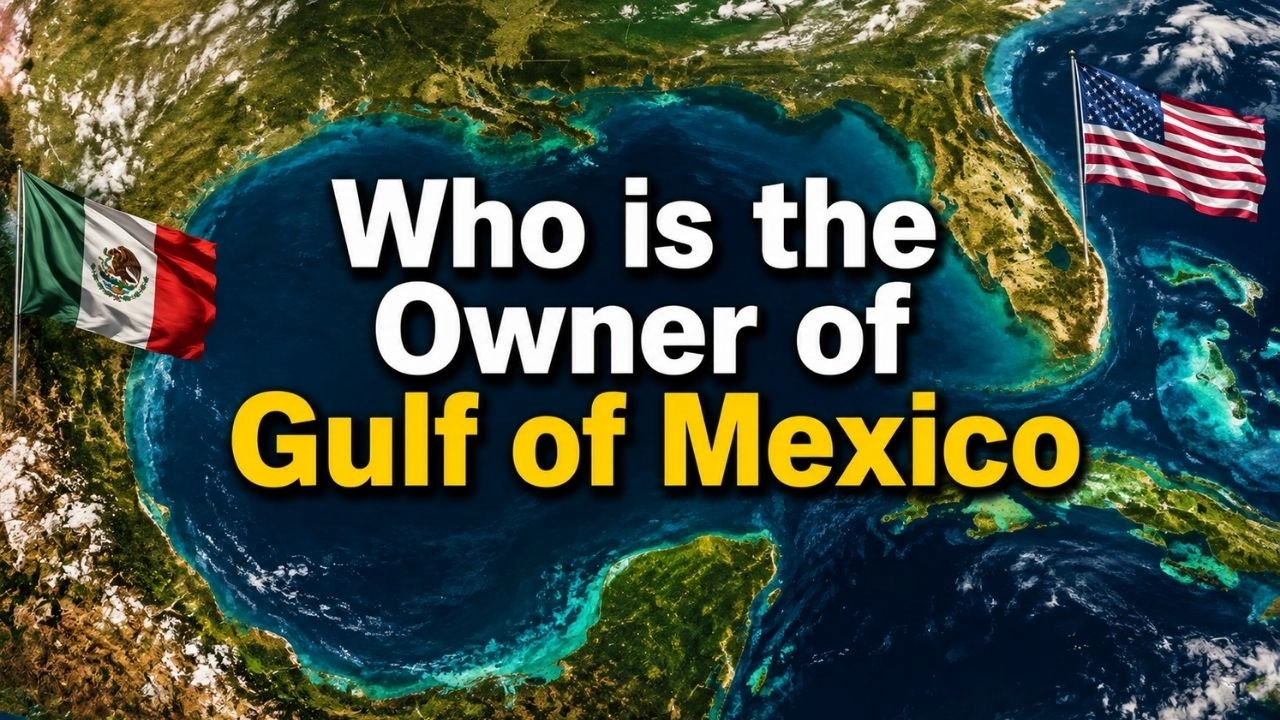
No single country, person, or company owns the Gulf of Mexico — and that is the most important thing to understand before anything else. What exists instead is a carefully negotiated division of maritime rights, resource zones, and territorial waters shared among three nations: the United States, Mexico, and Cuba. And right now in 2026, this ancient body of water is also at the center of one of the most politically charged naming disputes in modern history.
What Is the Gulf of Mexico?
The Gulf of Mexico — also officially called the Gulf of America in U.S. government documents since February 2025 — covers an area of approximately 600,000 square miles (1,550,000 square kilometers). It is a semi-enclosed ocean basin bordered by the United States to the north, Mexico to the west and south, and Cuba to the southeast.
Just over 2% of the Gulf’s total area is classified as international waters. The remaining 98% falls within the claimed maritime zones of the United States, Mexico, and Cuba — though none of them technically “own” the water in the way you would own a house or a piece of land.
Who Owns the Gulf of Mexico? The Legal Answer
No one literally owns the Gulf of Mexico. Three countries — Cuba, Mexico, and the United States — claim portions of it as their exclusive economic zones. Of these countries, Mexico claims the largest share.
The legal framework that governs all of this is the United Nations Convention on the Law of the Sea (UNCLOS), which came into force in 1994. Under UNCLOS, every coastal nation can claim two key maritime zones. The first is the Territorial Sea — extending 12 nautical miles from the coastline — where the country has full sovereignty, including control of the airspace above and the seabed below. The second is the Exclusive Economic Zone (EEZ) — extending 200 nautical miles offshore — where the country has exclusive rights to explore and exploit all natural resources, including oil, gas, and fish, but does not own the water itself.
Since the United States has territorial rights over portions of the Gulf, it can rename its territorial waters — and the Department of the Interior recognized that change when President Trump issued his executive order. However, under international law, renaming rights do not extend to international waters or to the maritime zones of other nations.
Ownership and Maritime Zones Table
| Country | Territorial Sea Control | Exclusive Economic Zone (EEZ) | Key Resource Rights |
|---|---|---|---|
| United States | 12 nautical miles from U.S. coastline | 200 nautical miles offshore | Controls oil, gas, fisheries in its EEZ including the deepwater Gulf |
| Mexico | 12 nautical miles from Mexican coastline | 200 nautical miles offshore | Largest single EEZ share; rich in deep-water oil and gas deposits |
| Cuba | 12 nautical miles from Cuban coastline | 200 nautical miles offshore | Has bilateral maritime boundary agreements with both the U.S. and Mexico |
| International Community | None | None | ~2% of Gulf is international waters open to all nations |
| United Nations (UNCLOS) | No ownership; international law body | Governs all maritime boundary disputes | Framework that defines how all countries divide ocean rights |
| Private Oil Companies | No ownership of water | Licensed exploration rights only | U.S., Mexican, and Cuban governments grant licenses for resource extraction |
The Trump Rename: Gulf of America
The biggest political story surrounding the Gulf of Mexico in recent history is President Donald Trump’s decision to rename it — and it is one of the most talked-about geographical controversies in years.
On his first day in office, President Trump issued an executive order directing the Secretary of the Interior to rename the Gulf of Mexico to the Gulf of America within 30 days. On February 9, 2025, Secretary of the Interior Doug Burgum announced the official name change and Trump declared that date “Gulf of America Day” as he flew over the renamed body of water aboard Air Force One on his way to Super Bowl LIX in New Orleans.
The federal Board on Geographic Names formally changed the name to “Gulf of America” in February 2025. Google Maps and Apple Maps updated the name to “Gulf of America” for American users on February 11, 2025. The Trump White House also reportedly pressured media outlets to use the new name.
Trump justified the move by saying the Gulf had long been “an integral asset to our once burgeoning Nation” and that the U.S. does most of the work there. He argued the name should celebrate American greatness.
Mexico and Cuba’s Response
The international reaction to the renaming was swift, pointed, and divided along exactly the lines you would expect.
Mexican President Claudia Sheinbaum stated clearly that Mexico would not recognize the name change. She wrote a formal letter to Google asking the company to rename the body of water “América Mexicana” instead of “Gulf of America” — arguing that Mexico actually borders the largest share of the Gulf. When Google did not comply, Mexico filed a formal lawsuit against Google in May 2025 over the relabelling.
The Associated Press (AP) stated on February 23, 2025 that it would continue to refer to the body of water as the Gulf of Mexico while acknowledging Trump’s chosen name. The AP was subsequently barred from attending White House press events and from flying on Air Force One as a result. The AP then sued Trump officials over this press access dispute on February 21, 2025.
The legal reality is clear: while the U.S. can officially call the waters within its own 12-nautical-mile territorial sea by any name it chooses, it has no authority under international law to rename international waters or waters within the maritime zones of Mexico and Cuba. The rest of the world simply does not have to recognize the new name — and most of it does not.
Who Controls the Oil and Gas?
The Gulf of Mexico is one of the most important oil and gas regions in the entire world — and the question of who controls those resources is entirely separate from the question of who “owns” the water.
Within its Exclusive Economic Zone, the United States government — specifically through the Bureau of Ocean Energy Management (BOEM) — grants licenses to private oil and gas companies to explore and drill in the U.S. side of the Gulf. Major companies including Shell, BP, ExxonMobil, Chevron, and Equinor operate wells and platforms there. These companies do not own the seabed — they pay the U.S. government royalties for the right to extract its resources.
Mexico controls its own side of the Gulf through Petróleos Mexicanos (Pemex), its national oil company. In recent years, Mexico has also opened parts of its Gulf zone to international private investment. Cuba controls its own maritime zone and has pursued deepwater exploration partnerships with various international energy companies.
The “Doughnut Hole” — an area in the Eastern Gap of the Gulf where the maritime boundaries of all three nations overlap and no clear owner existed — was the subject of long-running trilateral negotiations. The three countries reached a landmark agreement to resolve these overlapping claims, covering an area believed to be rich in oil and gas deposits.
Why the Gulf Matters So Much
The Gulf of Mexico is far more than a body of water. It is one of the most economically and ecologically important ocean basins on Earth.
The U.S. Gulf Coast alone accounts for approximately 17% of total U.S. crude oil production and 5% of natural gas production. The Gulf is home to some of the richest fishing grounds in the Western Hemisphere, supporting billions of dollars in annual commercial and recreational fishing. Its coastlines span five U.S. states — Texas, Louisiana, Mississippi, Alabama, and Florida — and hundreds of miles of Mexican and Cuban shoreline.
The Gulf also plays a critical role in U.S. hurricane dynamics, with warm Gulf waters fueling the storms that strike the American South almost every year. Its ecological and economic weight is enormous — which is exactly why the question of who controls it matters so deeply to so many people.
Frequently Asked Questions (FAQs)
Q1. Who owns the Gulf of Mexico?
No single country owns the Gulf of Mexico — it is shared among the United States, Mexico, and Cuba under international maritime law.
Q2. Which country has the largest share of the Gulf of Mexico?
Mexico claims the largest single Exclusive Economic Zone (EEZ) share of the Gulf of Mexico under international law.
Q3. Did Trump officially rename the Gulf of Mexico?
Yes. President Trump signed an executive order renaming it the “Gulf of America”, formally changed by the U.S. Board on Geographic Names in February 2025.
Q4. Does the rest of the world recognize the name “Gulf of America”?
No. Mexico, Cuba, and most international bodies continue to call it the Gulf of Mexico — international law does not require other nations to accept a unilateral name change.
Q5. What is an Exclusive Economic Zone (EEZ)?
An EEZ extends 200 nautical miles from a country’s coastline and gives that country exclusive rights to explore and exploit natural resources in that zone.
Q6. Who controls oil drilling in the Gulf of Mexico?
The U.S. Bureau of Ocean Energy Management (BOEM) licenses private companies like Shell, BP, and ExxonMobil for the U.S. side, while Mexico controls its side through Pemex.
Q7. What is the “Doughnut Hole” in the Gulf of Mexico?
The “Doughnut Hole” is an area in the Eastern Gap of the Gulf where the overlapping maritime claims of the U.S., Mexico, and Cuba created an unresolved zone rich in oil and gas deposits.
Q8. Can the U.S. legally rename the entire Gulf of Mexico?
No. The U.S. can only rename waters within its 12-nautical-mile territorial sea — it has no legal authority to rename international waters or zones belonging to Mexico or Cuba.
Nobody owns the Gulf of Mexico — not the United States, not Mexico, not Cuba, and certainly not any private individual or company. What exists instead is a legal framework under international law that divides the Gulf into maritime zones where each bordering country has specific, limited rights. Mexico holds the largest single EEZ share.
The United States controls the deepwater oil regions off its own coast and collects royalties from private energy companies that drill there. Cuba manages its own smaller coastal zone.
President Trump renamed the U.S. government’s designation of the body of water to the “Gulf of America” through an executive order in January 2025, formally changed by the Board on Geographic Names in February 2025.
Google Maps and Apple Maps reflect that change for American users. But Mexico, Cuba, and the international community at large continue to call it the Gulf of Mexico — because under international law, no single country has the authority to rename a shared body of water unilaterally.