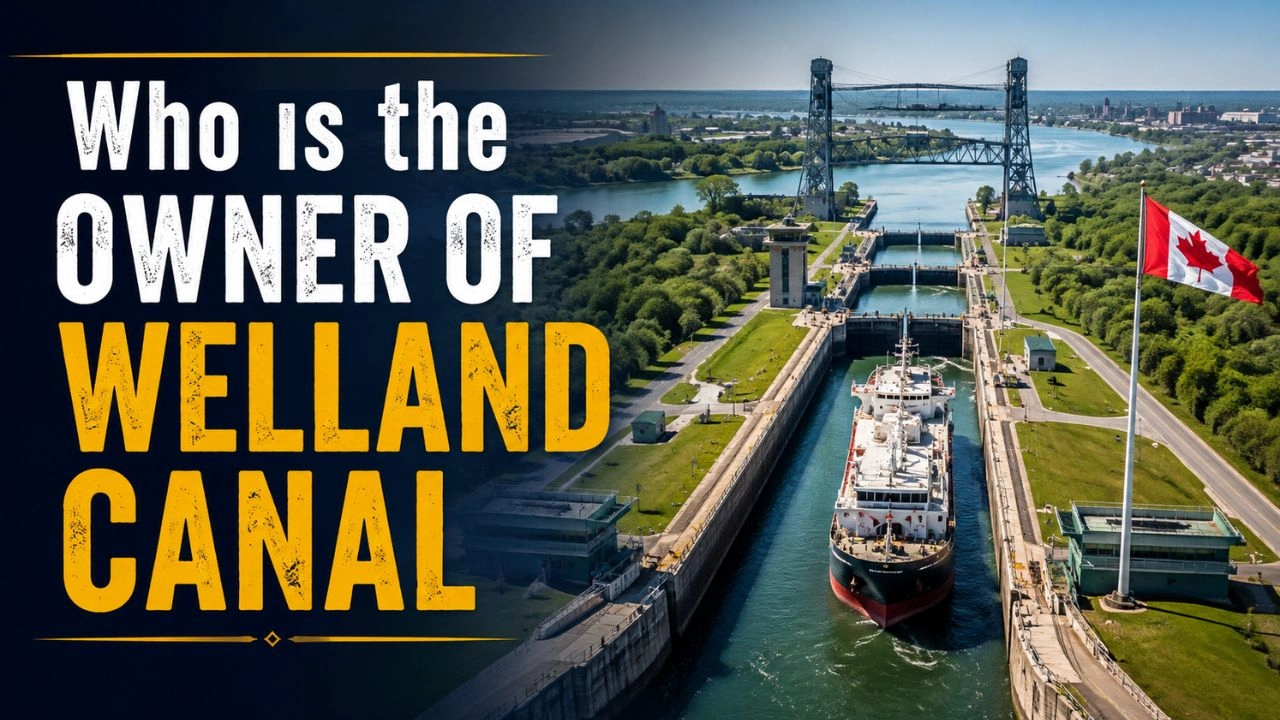
Every year, thousands of massive cargo ships quietly slip through a 43-kilometre stretch of water in Ontario, Canada — bypassing one of the most famous natural wonders on Earth. They carry grain, iron ore, steel, coal, and petroleum between the two largest freshwater lakes in the world. Most people watching from the bridge above have no idea who owns the waterway beneath them. The answer involves the Canadian federal government, a not-for-profit corporation, and a canal that has been rebuilt from scratch four separate times in nearly 200 years of continuous operation.
Lake Ontario and the Welland Canal
The Welland Canal connects directly to Lake Ontario as part of the Great Lakes shipping route. Read the full Lake Ontario ownership story.
More Music Label Ownership Stories
Interested in more music label ownership stories? Read about who owns Quality Control Music.
What Is the Welland Canal?
The Welland Canal is a ship canal located in Ontario, Canada, forming a critical part of the St. Lawrence Seaway and the Great Lakes Waterway. It stretches 27 miles (43 km) from Port Weller on Lake Ontario at St. Catharines to Port Colborne on Lake Erie, allowing massive ocean-going and lake vessels to bypass Niagara Falls entirely.
The canal features eight locks that lift or lower ships a total of 326.5 feet (99.5 metres) — the difference in elevation between Lake Ontario and Lake Erie. It is recognized as one of the steepest canal climbs anywhere on the planet and is considered one of the greatest feats of engineering in North American history. Ships up to 740 feet long and 78 feet wide can transit the canal, making it one of the most important commercial waterways in the world.
Who Owns the Welland Canal in 2026?
The Welland Canal is owned by the Government of Canada — specifically the federal government — and is operated and managed by the St. Lawrence Seaway Management Corporation (SLSMC), a Canadian not-for-profit corporation.
The distinction between ownership and operation is important. The Government of Canada retains full legal ownership of the canal and all its physical assets — the locks, the land, the infrastructure. But the day-to-day running, maintenance, and management of the canal was transferred in 1998 to the SLSMC under the Canada Marine Act. The SLSMC operates the canal under a framework agreement with the Minister of Transport and does not operate for profit — all revenues go directly back into maintaining and improving the waterway.
Ownership and Key Stakeholders Table
| Owner / Party | Role | Status | Key Detail |
|---|---|---|---|
| Government of Canada | Legal Owner | Full federal ownership | Owns all physical assets including locks, land, and infrastructure |
| St. Lawrence Seaway Management Corporation (SLSMC) | Operator and Manager | Not-for-profit; manages since 1998 | Operates under the Canada Marine Act via Transport Canada agreement |
| Transport Canada | Federal Oversight Body | Government department | Framework agreement with SLSMC governs canal operations |
| Canada Marine Act (1998) | Legal Framework | Active federal legislation | Enabled commercialization and transfer of management to SLSMC |
| United States (via USACE) | Bi-national Partner | Operates American Seaway portion | U.S. Army Corps of Engineers operates the two American locks in the Montreal-Lake Ontario section |
| Welland Canal Company | Original Private Owner | Historical; dissolved | Founded January 1824 by William Hamilton Merritt; built the first canal |
| Province of Upper Canada | Second Historical Owner | Historical | Took over the canal from private ownership in the 1840s |
| Federal Government of Canada | Third Historical Owner | Historical and ongoing | Has held ownership since Canadian Confederation in the late 1800s |
The Origin Story: One Businessman, One Big Idea
The Welland Canal was not built by a government. It was built by a determined St. Catharines merchant and mill owner who needed water.
William Hamilton Merritt owned several water-powered mills along Twelve Mile Creek in Thorold, Ontario. By the early 1820s, the creek was running too low to power his mills reliably. Merritt realized that if a canal could be cut across the Niagara Peninsula to connect Lake Erie and Lake Ontario, it would not only solve his water problem — it would also create one of the most important trade routes in North America.
On January 19, 1824, the legislature of Upper Canada officially formed the Welland Canal Company, with Merritt as its first general manager. He raised private funds from investors in Upper Canada, Lower Canada, the United States, and Great Britain. Construction began at Allanburg, Ontario on November 30, 1824, and the canal opened for its first trial run on November 30, 1829. The original canal had 40 wooden locks and connected with Chippawa Creek to reach Lake Erie.
It was not a government project — it was a private business venture that happened to be so strategically important that the government of Upper Canada eventually had to take it over.
The Four Versions of the Welland Canal
Most people do not realize that the canal they see today is actually the fourth Welland Canal to be built on the Niagara Peninsula. Each version was bigger and deeper than the last, responding to the ever-growing size of commercial ships.
The First Welland Canal (1829–1845) was a modest wooden-lock waterway with 40 locks running from Port Dalhousie to Port Robinson, connecting with Chippawa Creek before reaching Lake Erie. It had only 8-foot depth and could accommodate small schooners and barges. By 1833, an extension through Welland to Port Colborne was added, cutting out the dangerous Niagara River segment entirely.
The Second Welland Canal (1845–1887) replaced the wooden locks with stone locks and deepened the waterway to 10 feet. The government of Upper Canada took over ownership from the financially struggling Welland Canal Company during this period, marking the end of private ownership and the beginning of public control that continues to this day.
The Third Welland Canal (1887–1932) was a major upgrade that pushed depth to 14 feet and reduced the number of locks from 40 to 26, making transit far more efficient. It ran along a largely similar route and served for over 40 years as the backbone of Great Lakes trade.
The Fourth Welland Canal (1932–Present) is the current canal — rebuilt with eight massive concrete locks, a depth of 27 feet (8.08 metres), and a width capable of handling the largest ships on the Great Lakes. It was completed in 1932 and further integrated into the broader St. Lawrence Seaway system when the Seaway opened in 1959. This is the canal that exists and operates today.
The St. Lawrence Seaway Management Corporation: Who Actually Runs It?
While Canada owns the Welland Canal, the organization that actually runs it day-to-day is the St. Lawrence Seaway Management Corporation (SLSMC) — and it is worth understanding exactly what that organization is.
The SLSMC is a not-for-profit corporation established under the Canada Marine Act of 1998. Before 1998, the canal was operated directly by a federal Crown corporation called the St. Lawrence Seaway Authority. The 1998 commercialization transferred management to the SLSMC while keeping physical ownership firmly in the hands of the federal government. The SLSMC is responsible for all day-to-day operations, maintenance, infrastructure renewal, navigation safety, and capital investment programs.
The SLSMC invests heavily in maintaining the canal. In 2022 alone, it invested $32 million in infrastructure renewal work during the winter navigation pause. These investments ensure the canal’s 8 locks, its lifting bridges, its approach walls, and its navigation systems remain in top working condition for the shipping season — which typically runs from March to December each year.
How Important Is the Welland Canal to Trade?
The economic numbers behind the Welland Canal are staggering. The canal forms the central link of the St. Lawrence Seaway, which connects the Atlantic Ocean to the heart of North America — giving oceangoing vessels access to ports in Chicago, Detroit, Cleveland, Toronto, and Thunder Bay.
The St. Lawrence Seaway as a whole handles tens of millions of tonnes of cargo every year. The Welland Canal section handles the most critical bottleneck in that entire system — the elevation change between Lake Ontario and Lake Erie. Without the canal, every ship carrying grain from the Canadian Prairies, iron ore from Minnesota, or steel from Ohio would have no water route between the upper and lower Great Lakes.
Niagara Falls — which drops water approximately 57 metres between the lakes — makes natural navigation impossible. The Welland Canal is the engineering solution that makes an entire continental trade system work. The Welland Canal Corridor is recognized as one of North America’s busiest marine trade corridors, with lands alongside it described by local officials as having enormous potential for industrial development tied to the ongoing shipping traffic.
The 2026 Navigation Season
The Welland Canal is actively operating in the 2026 navigation season, with the St. Lawrence Seaway Management Corporation having issued formal navigation notices covering all eight locks in the canal. These notices outline operational procedures, personnel security requirements, vessel transit rules, and wharf draft limitations for ships using the canal throughout the year.
The 2026 season also continues the ongoing network upgrade program that began after VodafoneThree’s merger — though for the canal itself, infrastructure upgrades from the SLSMC’s annual winter investment program are rolling out as planned. Vessel traffic continues through all eight locks between Lake Ontario and Lake Erie, maintaining the canal’s role as the heartbeat of Great Lakes commerce.
Frequently Asked Questions (FAQs)
Q1. Who owns the Welland Canal in 2026?
The Welland Canal is owned by the Government of Canada and managed by the St. Lawrence Seaway Management Corporation (SLSMC), a not-for-profit corporation.
Q2. Who built the Welland Canal and when?
The Welland Canal was built by the privately funded Welland Canal Company, founded by William Hamilton Merritt in 1824, and completed on November 30, 1829.
Q3. What is the Welland Canal used for?
The Welland Canal allows cargo ships to bypass Niagara Falls and travel between Lake Ontario and Lake Erie, carrying goods like grain, iron ore, steel, and petroleum.
Q4. How many locks does the Welland Canal have?
The current Welland Canal has eight concrete locks that lift or lower ships a total elevation of 326.5 feet (99.5 metres) between the two Great Lakes.
Q5. Who operates the Welland Canal day-to-day?
The St. Lawrence Seaway Management Corporation (SLSMC) operates the canal under a framework agreement with Transport Canada, Canada’s federal transport ministry.
Q6. When was the current Welland Canal built?
The current fourth version of the Welland Canal was completed in 1932 and was integrated into the St. Lawrence Seaway system when the Seaway opened in 1959.
Q7. Is the Welland Canal privately owned?
No. The Government of Canada holds full legal ownership of the canal. It was privately owned only during the earliest years after its 1824 founding, before the government took it over in the 1840s.
Q8. How long is the Welland Canal?
The Welland Canal is 27 miles (43 kilometres) long, running from Port Weller on Lake Ontario to Port Colborne on Lake Erie in Ontario, Canada.
The Welland Canal is owned by the Government of Canada and operated by the St. Lawrence Seaway Management Corporation (SLSMC) — a not-for-profit corporation that took over management in 1998 under the Canada Marine Act. It was originally built by the privately funded Welland Canal Company, founded by William Hamilton Merritt in 1824, and completed in 1829. The Government of Canada has owned the canal since the mid-1800s, and today it operates as a critical national and international trade artery — connecting the Atlantic Ocean to the heart of North America through eight massive locks that lift ships nearly 100 metres between Lake Ontario and Lake Erie.
In 2029, the Welland Canal will celebrate 200 years of continuous operation — a remarkable milestone for one of the most important pieces of infrastructure ever built in North America.