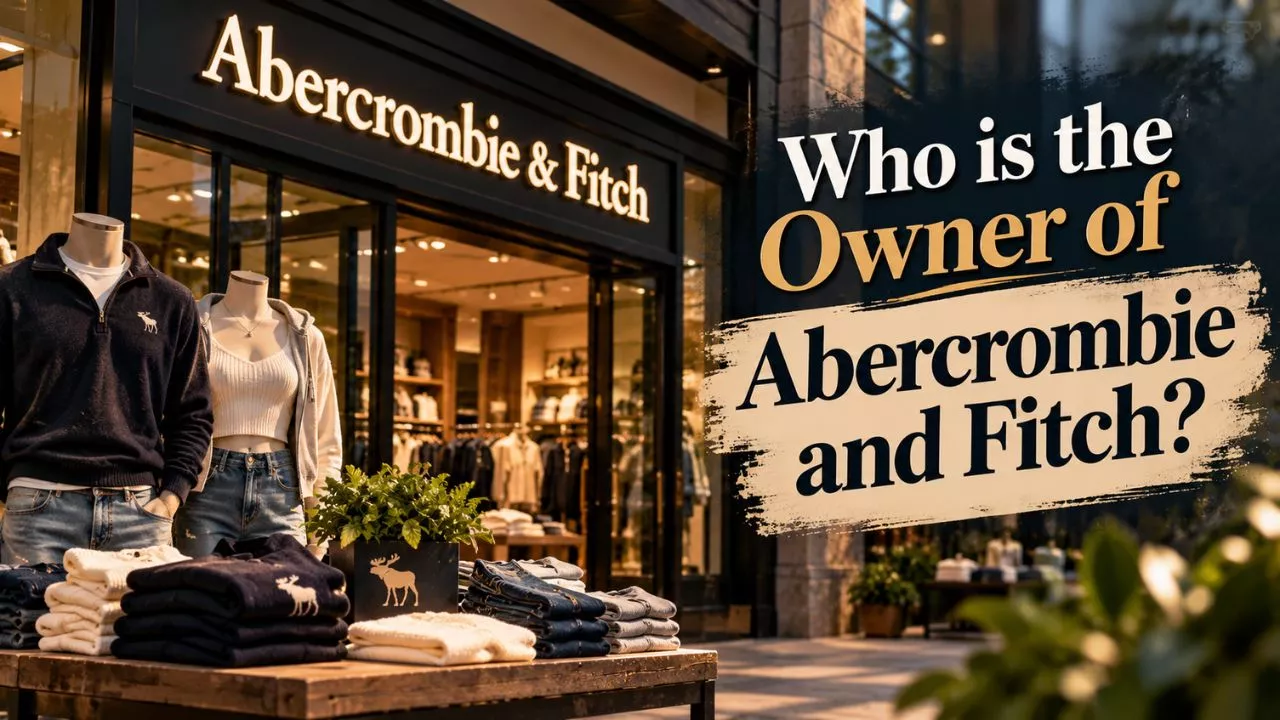
Abercrombie & Fitch is one of the most recognizable names in American fashion retail — a brand that has lived multiple lives in its 134-year history.
It started as a rugged outdoor outfitter for wealthy New York adventurers, transformed into a controversial teen fashion powerhouse that dominated mall culture in the 1990s, nearly collapsed under the weight of scandal and changing tastes, and then pulled off one of the most impressive retail comebacks of the past decade.
Today it is a publicly traded company with $1.1 billion in quarterly sales and a stock price that has risen nearly 1,000 percent since 2017. But who actually owns it?
Who Owns Abercrombie and Fitch in 2026?
Abercrombie and Fitch Co. is a publicly traded company listed on the New York Stock Exchange under the ticker symbol ANF. It has no single private owner, no controlling family, and no parent corporation above it.
Ownership is distributed across thousands of institutional investors, mutual funds, and public shareholders — with the largest stakes held by the world’s biggest asset managers.
The CEO and day-to-day leader of the company is Fran Horowitz, who has run Abercrombie & Fitch Co. since February 2017 and is widely credited with engineering its remarkable turnaround. The company’s Chairman of the Board is Nigel Travis, and the board recently added Mary Fox, President of The Lovesac Company, in August 2026.
Ownership and Key Stakeholders Table
| Shareholder / Party | Type | Ownership Stake | Key Detail |
|---|---|---|---|
| BlackRock, Inc. | Largest Institutional Shareholder | ~13.34% of ANF | World’s largest asset manager; biggest single shareholder of A&F |
| The Vanguard Group, Inc. | Second Largest Institutional Shareholder | ~10.43% of ANF | Passive index fund giant; second-biggest ANF holder |
| State Street Global Advisors | Institutional Investor | ~3.90% of ANF | Major index fund manager; consistent ANF holder |
| AQR Capital Management | Institutional Investor | ~3.48% of ANF | Quantitative investment firm |
| Dimensional Fund Advisors | Institutional Investor | ~3.03% of ANF | Long-term value-oriented institutional holder |
| FMR LLC (Fidelity) | Institutional Investor | ~2.73% of ANF | Fidelity’s parent; run by the Johnson family |
| Wellington Management | Institutional Investor | ~2.60% of ANF | One of the world’s largest active asset managers |
| Fran Horowitz | CEO & President | ~1.16% of ANF | Holds 517,793 shares as of April 2026 proxy filing |
| All Directors & Officers | Insiders | ~2.33% of ANF | Combined insider ownership per April 2026 proxy |
| Public & Retail Investors | Retail Shareholders | ~2.06% of ANF | Anyone can buy ANF stock on the NYSE |
The Origin Story: A Manhattan Waterfront Shop in 1892
The story of Abercrombie & Fitch starts not with a clothing brand but with a man who was deeply frustrated by the poor quality of outdoor gear available in New York City.
David T. Abercrombie was a former wilderness surveyor who opened Abercrombie Co. on June 4, 1892, in a small waterfront shop at 36 South Street in downtown Manhattan. He sold high-end camping equipment, fishing gear, hunting supplies, and sporting goods — not fashion — to the city’s wealthy outdoorsmen.
A wealthy Manhattan lawyer named Ezra Fitch became one of the store’s most devoted customers. In 1900, Fitch bought a major stake in the business and joined as co-founder, and the company was formally renamed Abercrombie & Fitch.
David Abercrombie eventually sold his stake and left in 1907, after reportedly growing tired of Fitch’s more extravagant ideas — including mailing out a 456-page catalog that the store could barely afford to print. The brand that Abercrombie built was now entirely under Fitch’s vision.
For decades, A&F was one of the most prestigious sporting goods destinations in America — outfitting expeditions for Theodore Roosevelt, Amelia Earhart, and Ernest Hemingway. It was the store where serious adventurers went.
Then came the Great Depression, and the company never quite recovered. A&F filed for Chapter 11 bankruptcy in August 1976 and shuttered its doors entirely in November 1977.
The L Brands Era and the Mike Jeffries Reinvention
The second life of Abercrombie & Fitch began in 1988, when The Limited — the retail conglomerate later known as L Brands — acquired the dormant brand and its trademark for a reported $1.5 million.
The Limited saw potential in the name and began rebuilding A&F from scratch as a casual, preppy clothing retailer rather than a sporting goods store.
The pivotal moment came in 1992, when The Limited hired Mike Jeffries as CEO. Jeffries transformed A&F into something the original founders would not have recognized — a provocative, sexuality-soaked teen fashion brand built around the concept of “cool kid” exclusivity.
He introduced dimly lit stores pumping loud music, hired shirtless male models to stand at entrances, and launched one of the most aggressive and controversial advertising campaigns in retail history.
Under The Limited, the brand was spun off as an independent publicly traded company in 1996, and by the late 1990s, Abercrombie and Fitch was one of the hottest youth fashion brands in America — with its distinctive eagle logo on the chest of what felt like every teenager in the country.
The rise was extraordinary. But the controversies mounted at the same pace as the profits.
The Mike Jeffries Scandal That Shook the Brand
Mike Jeffries ran Abercrombie and Fitch for 22 years, from 1992 to 2014, and left behind one of the most controversial legacies in American retail. In 2006, he told an interviewer that A&F only wanted “cool kids” wearing its clothes, and that the brand deliberately excluded overweight customers.
That quote went viral in 2013, triggering global boycotts and permanent reputational damage.
Jeffries resigned under board pressure in December 2014. But the worst was yet to come. In October 2024, federal authorities arrested Jeffries on charges related to sex trafficking and other serious criminal offenses connected to his personal conduct during and after his tenure at the company.
Abercrombie & Fitch Co. publicly stated it was “horrified and disgusted” by the allegations and made clear that the alleged conduct was entirely unknown to the company. The case marked one of the most dramatic post-CEO falls from grace in American corporate history.
The Fran Horowitz Turnaround: How A&F Came Back
The transformation of Abercrombie & Fitch from a struggling, scandal-tainted brand into a genuine growth story is one of the most compelling retail narratives of the past decade. The architect of that transformation is Fran Horowitz, who became CEO in February 2017 after serving as the brand president of Hollister.
Horowitz immediately set about dismantling everything Jeffries had built around exclusion. She expanded size ranges to be genuinely inclusive, diversified the marketing to feature models of different body types, ethnicities, and backgrounds, and reoriented the product around quality and comfort rather than logo-heavy branding.
“We moved from a place of fitting in to creating a place of belonging,” she said in a 2022 speech at Fordham University. The company pivoted hard into digital commerce and invested in a new store design format that felt warmer and more welcoming than the old darkened nightclub aesthetic.
The financial results have been extraordinary. Since Horowitz took over, ANF stock has risen nearly 1,000 percent. In its first quarter of fiscal 2026, Abercrombie & Fitch Co. reported record quarterly net sales of $1.1 billion — marking its 14th consecutive quarter of net sales growth.
The company is targeting full-year net sales growth of 3% to 5% and earnings per diluted share of $10.20 to $11.00 for the full year. It repurchased $105 million in shares in just the first quarter of 2026 alone.
What Brands Does Abercrombie and Fitch Co. Own?
Abercrombie & Fitch Co. is not just one brand — it is a portfolio of distinct fashion labels targeting different customer segments.
The Abercrombie brands include Abercrombie & Fitch itself — now repositioned as a premium casual wear brand for 20-something shoppers — and Abercrombie Kids, targeting children and tweens.
The Hollister brands include Hollister Co., which targets teenagers with a California surf and beach aesthetic, and Gilly Hicks, a gender-inclusive activewear and intimates brand sold within Hollister stores. Together these four brands operate approximately 840 stores across North America, Europe, Asia, and the Middle East, along with strong digital commerce businesses at abercrombie.com and hollisterco.com.
The global online fashion space is extraordinarily competitive right now. For comparison, see how a very different kind of fashion retailer is structured with the who owns ASOS story.
How A&F Compares to Other Major Retailers in 2026
Abercrombie & Fitch Co. is a mid-cap American retailer — significant and growing, but not in the same revenue league as the giants of American mass-market retail like Walmart or Amazon.
Its market capitalization sits at approximately $4.4 billion based on recent trading, making it one of the more valuable specialty apparel companies on the NYSE.
What makes A&F’s position in 2026 particularly interesting is its geography of growth. In Q1 2026, the Americas grew 3%, Asia Pacific grew a remarkable 24%, while Europe, the Middle East, and Africa (EMEA) declined 10% — partly reflecting macroeconomic pressures in European retail. The company is leaning into international expansion, particularly in Asia, as its next major growth driver.
Frequently Asked Questions (FAQs)
Q1. Who owns Abercrombie and Fitch in 2026?
Abercrombie & Fitch Co. is publicly traded (NYSE: ANF) with no single owner — BlackRock (~13.34%) and Vanguard (~10.43%) are the two largest institutional shareholders.
Q2. Is Abercrombie and Fitch still publicly traded?
Yes. A&F trades on the New York Stock Exchange under the ticker ANF and has been a public company since being spun off from The Limited in 1996.
Q3. Who founded Abercrombie and Fitch?
Abercrombie & Fitch was founded by David T. Abercrombie in 1892 in Manhattan, with Ezra Fitch joining as co-founder in 1900 after buying a major stake in the business.
Q4. Who is the CEO of Abercrombie and Fitch in 2026?
Fran Horowitz is the CEO and President of Abercrombie & Fitch Co., a role she has held since February 2017 after serving as president of the Hollister brand.
Q5. What happened to Mike Jeffries, the former CEO?
Mike Jeffries resigned as CEO in December 2014 after 22 years. In October 2024, he was arrested on federal sex trafficking and related charges — conduct the company said was entirely unknown to it during his tenure.
Q6. What brands does Abercrombie and Fitch Co. own?
The company owns four brands: Abercrombie & Fitch, Abercrombie Kids, Hollister Co., and Gilly Hicks, operating approximately 840 stores worldwide.
Q7. How much revenue does Abercrombie and Fitch make in 2026?
A&F reported record quarterly net sales of $1.1 billion in Q1 fiscal 2026 — its 14th consecutive quarter of net sales growth — with full-year guidance of 3% to 5% growth.
Q8. Did Abercrombie and Fitch go bankrupt?
Yes — once, decades ago. The original company filed for Chapter 11 bankruptcy in August 1976 and closed in 1977, before being acquired by The Limited in 1988 and rebuilt into the brand it is today.
Abercrombie & Fitch Co. (NYSE: ANF) is a publicly traded American fashion retailer owned by its shareholders, with no single controlling investor or parent company. The two largest shareholders are BlackRock (~13.34%) and Vanguard (~10.43%), followed by a range of institutional and retail investors.
The company was founded in 1892 by David Abercrombie and Ezra Fitch as a sporting goods store, reinvented as a teen fashion brand under the controversial Mike Jeffries in the 1990s, and has now been successfully rebuilt under CEO Fran Horowitz into a genuinely inclusive, profitable, and growing global fashion business.
With $1.1 billion in record quarterly revenue, 14 consecutive quarters of sales growth, and a stock price up nearly 1,000 percent since Horowitz took charge, the Abercrombie & Fitch of 2026 is a fundamentally different company from the one that made headlines for all the wrong reasons a decade ago.