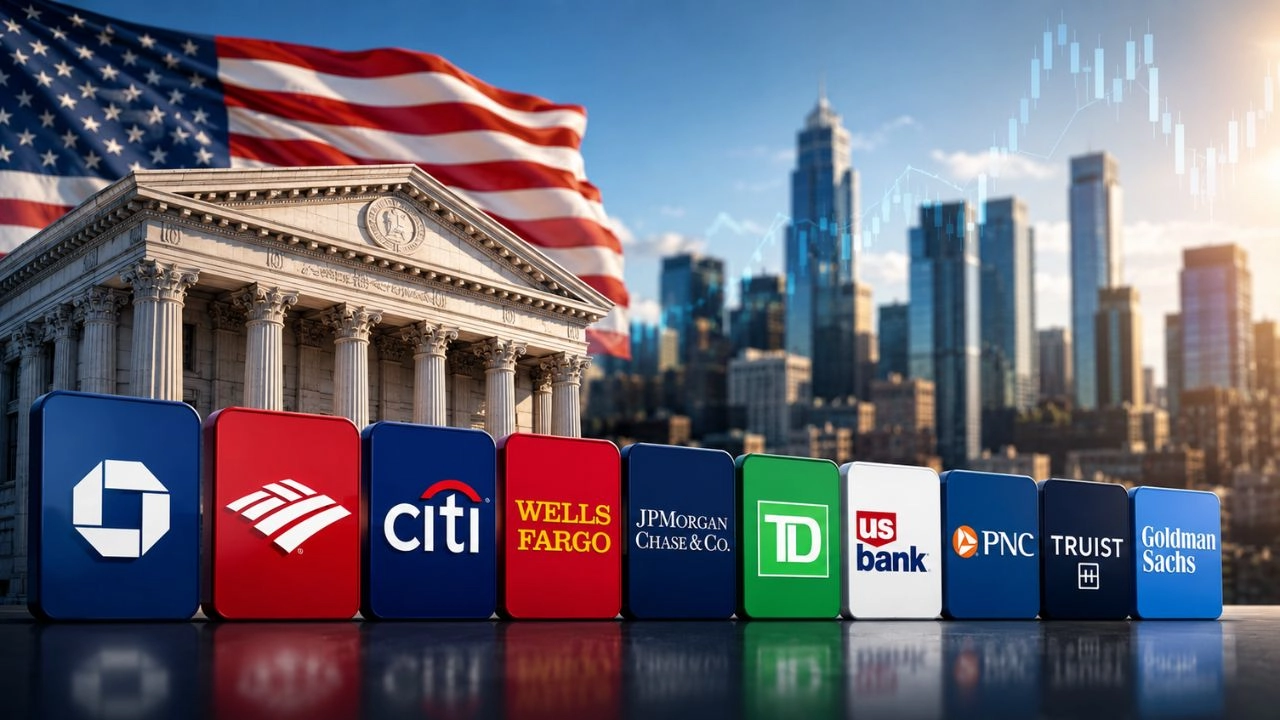
American banking is more concentrated than most people realize. The top 10 banks by assets control roughly 70% of the US banking system, and most of them have the same handful of institutional shareholders at the top of their cap tables. Look at the major shareholders of Bank of America and JPMorgan and you’ll see Vanguard, BlackRock, and State Street listed at almost identical percentages — which is part of why critics worry about coordinated ownership across the financial system. Here’s who actually owns the big US banks in 2026.
How we built this list
Ranking is by total US-headquartered assets at year-end 2025 (per FDIC and Federal Reserve consolidated reports). Major shareholders come from each bank’s DEF 14A proxy statement filed with the SEC. Where Warren Buffett’s Berkshire Hathaway is a top-five shareholder, I’ve called it out — Berkshire’s bank-stock positions are unusually large for a non-passive holder.
The Top 10
1. JPMorgan Chase — Vanguard ~9.6%, BlackRock ~7.5%, State Street ~4.7%
JPMorgan Chase is the largest US bank by assets ($4+ trillion). Jamie Dimon has been CEO since 2005 and is one of the longest-tenured bank executives in the world. The largest shareholders are passive institutional indexers, with Vanguard the single biggest at about 9.6%. Dimon himself holds approximately 0.4% of shares, which translates to several billion dollars.
2. Bank of America — Berkshire Hathaway ~13%, Vanguard ~8.7%, BlackRock ~7.2%
Bank of America is uniquely held — Berkshire Hathaway is the largest single shareholder at approximately 13%, the only major US bank where a single non-index investor is the top holder. Buffett began the position with $5 billion in preferred shares during the 2011 banking stress; he converted those to common stock in 2017 and has held since. Brian Moynihan is CEO.
3. Citigroup — Vanguard ~9.5%, BlackRock ~8.5%, State Street ~6.0%
Citi is the third-largest US bank by total assets. Jane Fraser became CEO in 2021, the first woman to lead a major Wall Street bank. The shareholder base is dominated by passive index investors. Citi has been the subject of activist agitation around break-up scenarios; ValueAct Capital and other activists have held positions of varying sizes through 2024–25.
4. Wells Fargo — Vanguard ~10.2%, BlackRock ~7.9%, State Street ~4.8%
Wells Fargo (NYSE: WFC) is the fourth-largest US bank. CEO Charlie Scharf joined in 2019 to lead the post-scandal recovery effort following the 2016 fake-accounts crisis. Berkshire Hathaway was Wells Fargo’s largest non-passive shareholder for decades; Buffett sold the entire position in 2020. Today, the cap table is dominated by Vanguard and BlackRock.
5. Goldman Sachs — Vanguard ~8.5%, BlackRock ~6.9%, State Street ~4.5%
Goldman is a global investment bank rather than a traditional retail bank. David Solomon has been CEO since 2018. The cap table is broadly institutional. Approximately 2% of shares are held by current and former Goldman partners — a vestigial element of the partnership era that ended with the 1999 IPO.
6. Morgan Stanley — Mitsubishi UFJ Financial Group ~20%, Vanguard ~7.8%
Morgan Stanley has a uniquely concentrated single-shareholder structure: Mitsubishi UFJ Financial Group (Japan’s largest bank) holds approximately 20% of common stock following a $9 billion investment during the 2008 financial crisis. James Gorman led the company from 2010 to 2024; Ted Pick took over as CEO in 2024.
7. U.S. Bancorp — Berkshire Hathaway ~3%, Vanguard ~9%, BlackRock ~6.5%
U.S. Bancorp (NYSE: USB) is the largest US regional bank by assets. Berkshire Hathaway holds approximately 3%, a position Buffett has trimmed but not exited. Andy Cecere is CEO. The bank emerged from the 2008 crisis with a strong balance sheet and has expanded through the MUFG Union Bank acquisition (2022) and other regional buys.
8. PNC Financial — Vanguard ~10%, BlackRock ~7.8%, State Street ~4.6%
PNC (NYSE: PNC) is one of the largest US regional banks, with strong commercial-banking presence on the East Coast and parts of the Midwest. The shareholder base is dominated by passive institutionals. William Demchak is CEO. PNC owned a 22% stake in BlackRock until 2020, when it sold the position for $14.4 billion to fund the BBVA USA acquisition.
9. Truist Financial — Vanguard ~10%, BlackRock ~7%, State Street ~4.5%
Truist was formed by the 2019 merger of BB&T and SunTrust, making it the sixth-largest US commercial bank at the time. Bill Rogers is CEO. The combined cap table is index-investor dominated. Truist sold a majority of its insurance subsidiary, Truist Insurance Holdings, to private equity in 2024 — one of the largest financial-services PE deals of recent years.
10. Capital One — Vanguard ~9.5%, BlackRock ~7.5%, State Street ~4.5%
Capital One (NYSE: COF) is the country’s third-largest credit-card issuer and one of the largest banks. Founder Richard Fairbank remains CEO after starting the company in 1994. Capital One acquired Discover Financial in 2024 for $35 billion, creating one of the largest payment-network-and-bank combinations in the US. Antitrust review delayed full closing until 2025.
At-a-glance comparison
| Rank | Bank | Largest Single Holder | % of shares |
|---|---|---|---|
| 1 | JPMorgan Chase | Vanguard | ~9.6% |
| 2 | Bank of America | Berkshire Hathaway | ~13% |
| 3 | Citigroup | Vanguard | ~9.5% |
| 4 | Wells Fargo | Vanguard | ~10.2% |
| 5 | Goldman Sachs | Vanguard | ~8.5% |
| 6 | Morgan Stanley | MUFG (Japan) | ~20% |
| 7 | U.S. Bancorp | Vanguard | ~9% |
| 8 | PNC Financial | Vanguard | ~10% |
| 9 | Truist Financial | Vanguard | ~10% |
| 10 | Capital One | Vanguard | ~9.5% |
My take
Look at this table and the same name appears nine times: Vanguard. That’s not a coincidence and it’s not a conspiracy — it’s the structural result of index-fund growth. Vanguard, BlackRock, and State Street together own roughly 20% of nearly every large public US company, including most major banks. The two exceptions on this list — Berkshire’s Bank of America stake and MUFG’s Morgan Stanley position — are interesting precisely because they remind us what active concentrated ownership looks like. For better or worse, common ownership of US banking by passive index funds is the single most important governance fact about American finance in 2026.
Related Ownership Profiles
For another data-rich ownership breakdown, see our list of Top 10 Founder-Controlled Tech Companies.
Frequently Asked Questions
Who is the largest shareholder of JPMorgan Chase?
Vanguard Group is the largest single shareholder of JPMorgan Chase, holding approximately 9.6% of common stock as of 2026. BlackRock is second at roughly 7.5%, followed by State Street at about 4.7%. CEO Jamie Dimon personally holds approximately 0.4% of shares.
Who owns Bank of America?
Berkshire Hathaway, Warren Buffett’s company, is the largest single shareholder of Bank of America at approximately 13% of common stock. This is unusual — Berkshire is the only major non-passive holder to be the top shareholder of a top-10 US bank. Vanguard is the second-largest holder at about 8.7%.
Why does Japan’s MUFG own 20% of Morgan Stanley?
Mitsubishi UFJ Financial Group invested $9 billion in Morgan Stanley during the 2008 financial crisis to help stabilize the firm. As part of the deal, MUFG received approximately 20% of common stock and certain governance rights. The two banks also operate a joint venture for Japanese investment banking. MUFG has not materially reduced its stake since.
Are US banks publicly owned?
Most major US banks are publicly traded on the NYSE or NASDAQ but they are not government-owned. During the 2008 financial crisis the US Treasury took emergency preferred-equity stakes in several large banks via the TARP program; those stakes were fully repurchased by 2013.
Why do Vanguard and BlackRock show up at almost every bank?
Vanguard and BlackRock are the world’s two largest passive index-fund managers. When investors buy S&P 500 index funds, the money flows into shares of S&P 500 companies — including the banks. Because such a large share of US retirement savings is in these index funds, the funds collectively own a substantial percentage of nearly every large publicly traded US company.