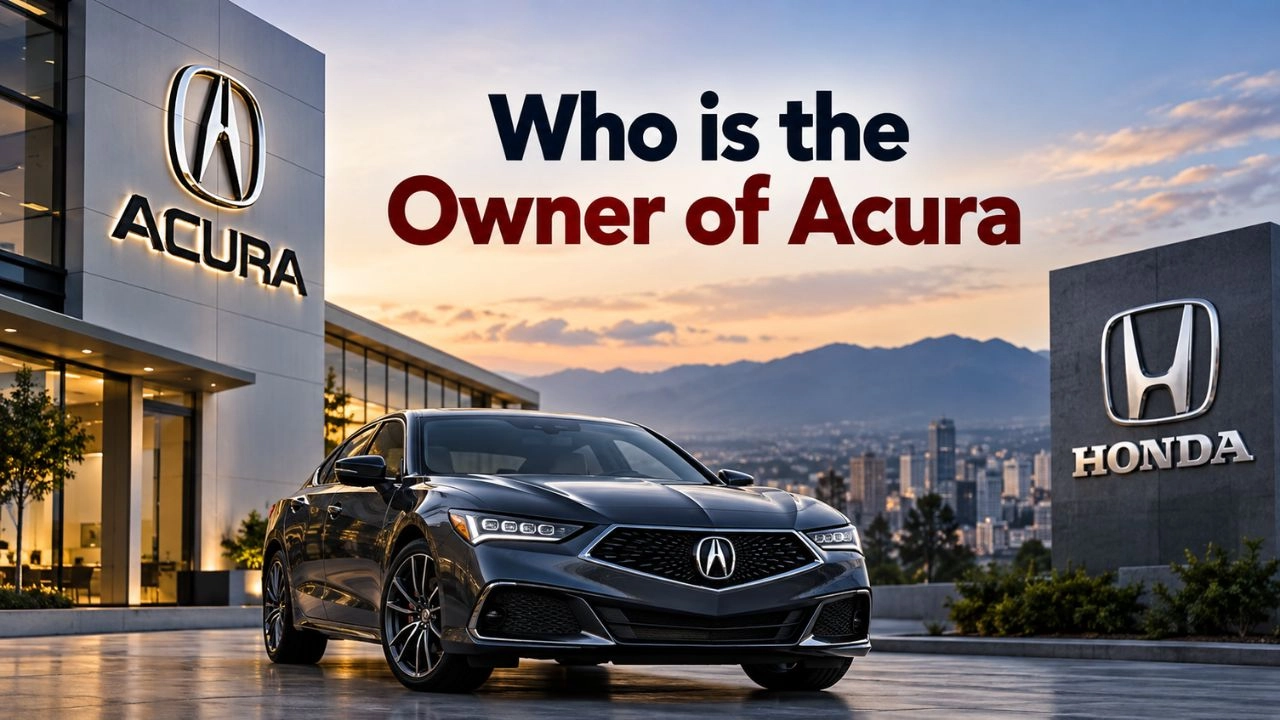
Acura is the face of Japanese luxury in North America — sleek, performance-focused, and built with engineering that has won loyalty from millions of drivers across the United States, Canada, and beyond. But walk into a dealership and you will notice something interesting: there is no Honda badge anywhere on the car.
So who actually owns Acura? The answer leads directly to one of the most powerful automotive companies in the world — and to a corporate drama involving a cancelled $60 billion merger that nearly changed the future of the entire Acura brand.
What Is Acura?
Acura is the luxury and performance vehicle division of Japanese automaker Honda, based primarily in North America. The brand was launched on March 27, 1986, making it the first Japanese luxury automotive brand ever introduced to the American market — beating both Lexus (Toyota’s luxury division) and Infiniti (Nissan’s luxury division) to the punch by several years.
Acura is headquartered in Torrance, California, under its immediate parent American Honda Motor Company. Current CEO of Acura is Jorge Cruz, with Mike Langel and Emile Korkor serving as Assistant Vice Presidents of Acura National Sales.
Who Owns Acura Right Now in 2026?
Acura is a wholly owned division of Honda Motor Co., Ltd. — the Japanese multinational corporation headquartered in Minato, Tokyo, Japan. Acura is not a separate company, not a subsidiary with outside investors, and not publicly traded on its own. It is a brand — a division that exists entirely within Honda’s corporate structure.
The ownership chain works like this: Honda Motor Co., Ltd. is the ultimate parent. Below it sits American Honda Motor Company, the U.S. arm of Honda, and Acura operates under American Honda Motor Company as a dedicated luxury brand division.
Every Acura vehicle is engineered on Honda platforms, built in Honda and Acura factories, and sold through a separate Acura-only dealer network.
Honda Motor Co., Ltd. itself is publicly traded on the New York Stock Exchange under the ticker HMC and on the Tokyo Stock Exchange. Its largest institutional shareholder is BlackRock, Inc., which held approximately 6.1% of Honda’s common stock as of June 30, 2025, according to a Schedule 13G filing with the SEC.
Ownership and Key Stakeholders Table
| Owner / Party | Role | Stake | Key Detail |
|---|---|---|---|
| Honda Motor Co., Ltd. | Ultimate Parent Company | 100% ownership of Acura brand | Japanese multinational; NYSE: HMC; Tokyo Stock Exchange: 7267 |
| American Honda Motor Company | Direct U.S. Parent of Acura | Subsidiary of Honda Motor Co. | U.S. operational arm; headquartered in Torrance, California |
| BlackRock, Inc. | Largest Institutional Shareholder of Honda | ~6.1% of Honda common stock | Filed Schedule 13G with SEC as of June 30, 2025 |
| JPMorgan Chase Bank, N.A. | ADS Depositary | Holds Honda ADS shares | Nominee holder representing U.S. ADS shareholders |
| Public Shareholders (NYSE & TSE) | Stock Market Investors | Remaining Honda shares | 4.533 billion total Honda shares as of March 31, 2026 |
| Jorge Cruz | CEO of Acura | Management role; no separate brand ownership | Leads Acura’s North American operations |
| Soichiro Honda | Founder of Honda (historical) | N/A | Founded Honda Motor Co. in 1948; created the foundation for Acura |
The Origin Story: Why Honda Created Acura
By the early 1980s, Honda had become one of the most respected car brands in America — known for reliable, fuel-efficient, well-built vehicles like the Civic and the Accord. But Honda’s image was solidly middle-market. It had no presence in the growing luxury segment that Mercedes-Benz, BMW, and Cadillac were profiting from.
Honda made a bold and calculated decision: instead of trying to push its existing brand upmarket — a strategy that often backfires by confusing consumers — it would create an entirely separate luxury brand with its own name, its own dealerships, and its own identity. That brand was Acura.
Acura was founded on March 27, 1986, with two debut models — the Legend and the Integra. The Legend immediately set a new standard for what a Japanese luxury sedan could be.
It was quiet, beautifully built, well-equipped, and priced significantly below comparable German competitors. The American car-buying public responded enthusiastically, and Acura was an immediate success.
The name Acura was designed from scratch — derived from the Latin word “acu”, meaning “done with precision” or “with exactness.” It was a deliberate brand-building move designed to signal engineering accuracy and craftsmanship without any direct reference to Honda, creating a perception of independence that the premium buyer required.
Acura’s Most Iconic Moments
Acura’s history is punctuated by several vehicles that defined what a Japanese luxury brand could accomplish.
The original NSX, launched in 1990, was one of the most revolutionary sports cars ever built. It was the first production car to feature an all-aluminum body and frame, and it was developed with direct input from legendary Formula 1 driver Ayrton Senna, who test-drove prototypes and provided feedback during its development.
The NSX proved that a Japanese manufacturer could build a supercar that competed directly with Ferrari — and in many ways beat it on reliability, usability, and value.
The TL sedan became Acura’s best-selling model in the 2000s, consistently ranking among the best-selling luxury sedans in North America. The MDX SUV — first launched in 2001 — has become one of the best-selling three-row luxury SUVs in American automotive history, with over 1 million units sold across its generations.
Today, Acura’s current lineup includes the Integra, TLX, MDX, RDX, and the next-generation NSX, along with high-performance Type S and sporty A-Spec variants that carry the performance torch forward.
The Honda-Nissan Merger Drama: What It Meant for Acura
One of the most significant corporate stories involving Acura’s parent company unfolded between December 2024 and early 2026 — and if it had gone differently, Acura might be sitting inside a very different corporate structure today.
In December 2024, Honda Motor Co. and Nissan Motor Co. announced they had entered formal talks to merge their operations into a combined holding company — a move that would have created the world’s third or fourth largest automaker by sales volume.
Mitsubishi Motors, a Nissan partner, was also invited to join. The combined entity would have had combined sales of over 30 trillion yen (approximately $191 billion) and would have brought Acura, Nissan, Infiniti, and Mitsubishi under one corporate roof.
However, the merger talks collapsed before completion. Honda proposed shifting from a joint holding company structure to a direct acquisition where Honda would become the parent and Nissan the subsidiary — a structure Nissan was unwilling to accept.
Both companies ultimately decided the deal was too complex to execute quickly enough to address the competitive pressures coming from Chinese EV manufacturers and Tesla. The Memorandum of Understanding (MOU) was formally cancelled.
As a result, Acura remains exactly where it has always been — fully inside Honda Motor Co., with no structural changes to its ownership. Honda and Nissan continue to explore strategic technology partnerships, but as separate companies.
What Is Acura’s Future in the EV Era?
Honda Motor Co. has committed to making Acura a central part of its electric vehicle future. The Acura ZDX — the brand’s first fully electric vehicle — launched in early 2024 as a luxury electric SUV built on a platform co-developed with General Motors. It represents Acura’s first serious step into the EV segment.
Honda has announced plans to invest over $40 billion in electrification and software-defined vehicle technologies through 2030, and Acura is positioned as the premium front of that push.
The brand’s combination of Honda’s engineering resources, an established luxury dealer network, and a loyal performance-oriented customer base gives it a strong platform to compete in the next generation of luxury electric vehicles.
Frequently Asked Questions (FAQs)
Q1. Who owns Acura in 2026?
Acura is a wholly owned division of Honda Motor Co., Ltd., the Japanese automotive company listed on the NYSE under ticker HMC.
Q2. Is Acura its own company?
No. Acura is a brand division of Honda, not an independent company — it operates under American Honda Motor Company in the U.S.
Q3. When was Acura founded?
Acura was founded on March 27, 1986, becoming the first Japanese luxury automotive brand ever launched in the American market.
Q4. Who is the current CEO of Acura?
Jorge Cruz serves as CEO of Acura in 2026, overseeing the brand’s North American operations and dealer network.
Q5. Who is the largest shareholder of Honda Motor Co.?
BlackRock, Inc. is the largest institutional shareholder of Honda Motor Co., holding approximately 6.1% of common stock as of June 30, 2025.
Q6. Did Honda merge with Nissan?
No. Honda and Nissan announced merger talks in December 2024, but cancelled the MOU after failing to agree on a corporate structure — leaving Acura fully under Honda’s ownership.
Q7. What is Acura’s most famous car?
The original Acura NSX (launched 1990) is considered Acura’s most iconic model — developed with input from F1 legend Ayrton Senna and the first all-aluminum production sports car.
Q8. Is Acura sold outside the United States?
Yes, but primarily in North America. Acura is available in the U.S., Canada, Mexico, Panama, and Japan, where it was re-introduced in 2014.
Acura is a wholly owned division of Honda Motor Co., Ltd. — the Japanese automotive giant listed on the NYSE under HMC and founded by Soichiro Honda in 1948.
Acura was created in 1986 as Honda’s dedicated luxury and performance brand for the North American market, and it has operated under American Honda Motor Company ever since.
The largest institutional shareholder in Honda Motor Co. is BlackRock, Inc., holding approximately 6.1% of common stock. A dramatic 2024–2025 merger attempt with Nissan that would have reshuffled Acura’s entire corporate future ultimately collapsed — leaving Acura firmly in Honda’s hands, as it has been for 40 years.