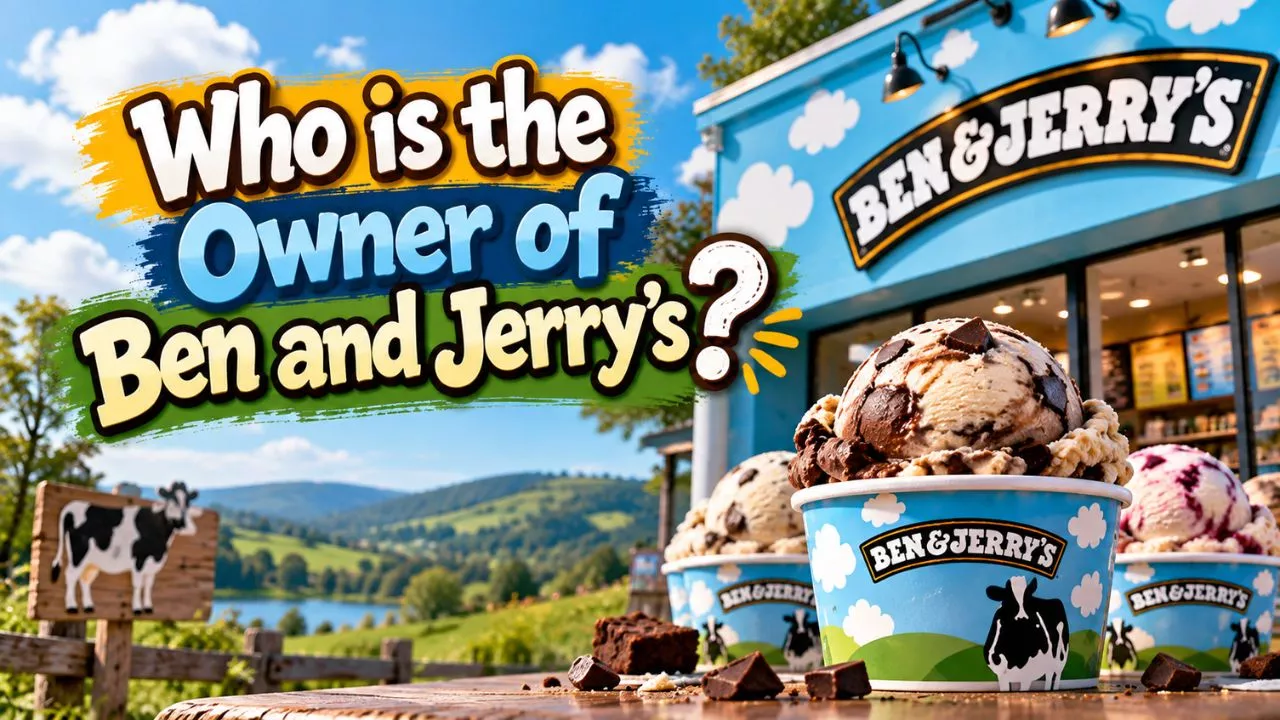
Ben & Jerry’s is not just an ice cream brand. It is a political statement, a cultural institution, and one of the most unusual corporate ownership stories in the history of American business.
Over its nearly 50-year life, it has been a scrappy Vermont startup, a reluctant corporate subsidiary, a global brand caught in the middle of international political conflicts, and right now in 2026, the subject of a potential private equity takeover worth billions.
The story of who owns Ben & Jerry’s — and who is fighting to take it back — is one of the most fascinating in all of food and beverage.
Who Owns Ben and Jerry’s Right Now in 2026?
Ben & Jerry’s is currently owned by The Magnum Ice Cream Company N.V. (TMICC) — a publicly traded company listed on three separate stock exchanges under the ticker symbol MICC (on the NYSE, Euronext Amsterdam, and the London Stock Exchange).
TMICC began trading on December 8, 2025, after completing its demerger from Unilever on July 1, 2025, at an initial valuation of €7.9 billion.
Unilever still holds a 19.85% minority stake in TMICC — but it has registered the entire stake for sale and no longer controls Ben & Jerry’s operationally or strategically.
The brand is now a subsidiary of an independent, publicly traded ice cream giant that also owns Magnum, Cornetto, Wall’s, Breyers, Klondike, Talenti, and Yasso.
Ownership and Key Stakeholders Table
| Owner / Party | Role | Stake | Key Detail |
|---|---|---|---|
| The Magnum Ice Cream Company N.V. (NYSE/EURONEXT/LSE: MICC) | Direct Parent & Current Owner | 100% of Ben & Jerry’s brand | Spun off from Unilever; began trading December 8, 2025; valued at €7.9B |
| Unilever plc | Minority Shareholder of TMICC | 19.85% of TMICC | Has registered entire stake for sale; no longer controls Ben & Jerry’s |
| Blackstone | Potential Acquirer | Exploring bid (as of May 2026) | PE giant in early-stage talks to bid for entire TMICC per Reuters report |
| Clayton Dubilier & Rice (CD&R) | Potential Acquirer | Exploring bid (as of May 2026) | PE firm also reportedly exploring a takeover bid for TMICC |
| Peter ter Kulve | CEO of TMICC | Management role | Leads The Magnum Ice Cream Company including Ben & Jerry’s |
| Abhijit Bhattacharya | CFO of TMICC | Management role | Chief Financial Officer of the combined ice cream company |
| Ben Cohen | Co-Founder (no ownership) | No current ownership stake | Actively campaigning for Ben & Jerry’s to become independent again |
| Jerry Greenfield | Co-Founder (no ownership) | No current ownership stake | Co-authored open letter to TMICC board demanding independence |
| Independent Board of Directors | Social Mission Governance | No ownership — governance role only | Created under 2000 Unilever deal; authority now disputed after most members removed |
The Origin Story: Two Friends and a Converted Gas Station
Ben & Jerry’s began not with a business plan or venture capital money but with a $5 correspondence course in ice cream making from Penn State University.
Ben Cohen and Jerry Greenfield were childhood friends from Merrick, New York. Neither had grand corporate ambitions. Ben had struggled to find direction after high school, working as a taxi driver, a pottery wheel craftsman, and a fast-food counter worker.
Jerry had applied twice to medical school and been rejected both times. In 1978, they pooled $8,000 (of which $4,000 was borrowed) and opened their first ice cream scoop shop inside a converted gas station in Burlington, Vermont.
The name Ben & Jerry’s was simply their names. The flavors were chunky, creative, and irreverent — names like Cherry Garcia, Chocolate Chip Cookie Dough, and Phish Food reflected a playful personality that no other ice cream company had.
The business grew through word of mouth, genuine community engagement, and a social mission philosophy that treated the company as a tool for positive change, not just a vehicle for profit.
By 1984, Ben & Jerry’s was selling $4 million in ice cream annually. By the 1990s, it was a national brand beloved for both its product and its politics.
The company donated 7.5% of pre-tax profits to charity, used only family-farm dairy, and took public positions on everything from nuclear weapons to living wages. It was the original conscious capitalism brand — before the phrase even existed.
The $326 Million Sale to Unilever — and the Promise That Was Made
In 2000, Ben Cohen and Jerry Greenfield made a decision that would define the next two decades of their company’s history: they sold Ben & Jerry’s to Unilever for $326 million.
The founders did not want to sell. They resisted corporate acquisition for years, even exploring an employee buyout and a public stock offering as alternatives.
But when Unilever came with a $326 million offer — valuing the company far above what any other buyer had proposed — the board of directors voted to accept it, over the founders’ objections.
The one thing Cohen and Greenfield insisted on was a contractual guarantee that protected everything they had built beyond the ice cream itself.
The 2000 merger agreement created an independent board of directors with legally enforceable authority over Ben & Jerry’s social mission and brand integrity — independent of whoever owned the company.
Unilever committed that this board would have the power to protect the brand’s values, make statements on social issues, and maintain the company’s progressive identity, regardless of what Unilever wanted.
It was an extraordinary provision — one that legal experts said was virtually unprecedented in corporate acquisition history. And for years, it mostly worked. Ben & Jerry’s continued speaking out on political issues, donating to progressive causes, and maintaining its identity even inside one of the world’s largest consumer goods conglomerates.
Until it did not.
The Years of Conflict: Israel, Gaza, Trump, and the Breaking Point
The relationship between Ben & Jerry’s and Unilever began fracturing publicly in 2021 — and the fracture has never healed.
In 2021, Ben & Jerry’s independent board voted to end sales of Ben & Jerry’s products in Israeli-occupied Palestinian territories, calling it “inconsistent with our values.”
The move was condemned internationally by Israel and caused enormous controversy for Unilever, which was caught between a subsidiary asserting its contractual independence and its own global business relationships. Unilever ultimately sold its Israeli ice cream business to a local producer — a compromise that satisfied almost nobody.
The conflict deepened in 2024, when Ben & Jerry’s filed a lawsuit against Unilever, accusing it of silencing the brand’s statements in support of Palestinians in the Gaza war, blocking social media posts critical of President Donald Trump, and threatening to dismantle the independent board that was supposed to protect its social mission forever.
Unilever moved to dismiss the claims, arguing the independent board’s rights were more limited than the brand believed.
Jerry Greenfield eventually resigned from his connection to the company entirely. His resignation letter was blunt: “It’s profoundly disappointing to come to the conclusion that that independence — the very basis of our sale to Unilever — is gone.”
The lawsuits, the political controversies, and the reputational headaches were a significant factor in Unilever’s decision to spin off its entire ice cream business — which it announced in March 2024 as part of a larger strategic pivot toward health and wellness products.
The Magnum Spinoff: A New Owner From December 2025
Unilever completed the demerger of its ice cream division on July 1, 2025, creating The Magnum Ice Cream Company N.V. (TMICC) as a fully independent company. TMICC listed its shares on Euronext Amsterdam, the London Stock Exchange, and the New York Stock Exchange on December 8, 2025, at an initial valuation of €7.9 billion.
TMICC is the world’s leading ice cream company — home to four of the world’s five largest ice cream brands: Magnum, Ben & Jerry’s, Cornetto, and the Heartbrand (which includes Wall’s and Breyers in different markets). It operates in 80 markets with 18,000 employees, 32 factories, and a fleet of 3 million freezer cabinets globally. Revenue for 2025 came in at €7.91 billion.
Ben & Jerry’s is now a subsidiary of this new, standalone ice cream giant — no longer connected to Unilever’s broader consumer goods portfolio. And by January 2026, TMICC had removed virtually all of Ben & Jerry’s independent board directors except for one Unilever-appointed director and CEO — effectively dissolving the governance structure that was supposed to protect the brand’s social mission forever.
Ben Cohen’s Fight to Buy Back the Brand
The most dramatic subplot of 2026 is Ben Cohen’s very public campaign to reclaim the company he co-founded.
Co-founder Ben Cohen staged a protest outside TMICC’s offices in April 2026 — his latest action in a years-long campaign to make Ben & Jerry’s an independent company again.
He has been vocal that the brand is worth between $1.5 billion and $2 billion and has expressed interest in leading a buyout backed by “socially-aligned investors” who would preserve the brand’s progressive mission.
In September 2025, both Cohen and Greenfield wrote an open letter to the TMICC board, urging them to allow Ben & Jerry’s to operate once again as an independently owned company, “supported by socially-aligned investors and free to honor its mission without compromise.”
TMICC’s response has been firm and consistent: Ben & Jerry’s is a “proud part” of the Magnum Ice Cream Company and is not for sale.
For another ownership story where the founder lost control of what they built and has been fighting to reclaim influence, see who owns Interscope Records — where Jimmy Iovine built something extraordinary and eventually had to walk away from it.
The Private Equity Threat: Blackstone and CD&R Circle TMICC
Just as Ben Cohen was fighting for independence, an even bigger threat to Ben & Jerry’s identity emerged from a very different direction.
In May 2026, Reuters reported that Blackstone and Clayton Dubilier & Rice (CD&R) — two of the largest private equity firms in the world — are in early-stage talks to explore a takeover bid for the entire Magnum Ice Cream Company, which would of course include Ben & Jerry’s.
A Blackstone or CD&R acquisition would take TMICC private and put Ben & Jerry’s under even more aggressive profit-focused ownership than it has experienced under Unilever or TMICC.
For a brand built on the idea that business can be a force for social good, being owned by one of the world’s largest private equity firms would represent the ultimate irony.
The outcome of these takeover talks — and whether any deal actually materializes — remains one of the most watched stories in the consumer goods world in 2026.
Private equity firms reshaping iconic brands is a pattern seen across many industries — much like who owns Barnes and Noble, where Elliott Management acquired a struggling retail icon and rebuilt it completely.
What Other Brands Does TMICC Own?
Understanding who owns Ben & Jerry’s means understanding the vast ice cream empire it now sits inside.
The Magnum Ice Cream Company owns some of the most recognized frozen dessert brands in the world. Alongside Ben & Jerry’s, its portfolio includes Magnum (the premium bar brand), Cornetto, Wall’s (sold as Algida, Kibon, and Streets in different markets), Breyers, Klondike, Talenti, and Yasso — among dozens of others.
TMICC holds a 21% share of the global ice cream market — an extraordinary concentration of frozen dessert brands under one roof, spanning every price point from mass-market to super-premium.
Frequently Asked Questions (FAQs)
Q1. Who owns Ben and Jerry’s in 2026?
Ben & Jerry’s is owned by The Magnum Ice Cream Company N.V. (NYSE: MICC) — a publicly traded company spun off from Unilever that began trading in December 2025.
Q2. Does Unilever still own Ben and Jerry’s?
No. Unilever spun off its ice cream business on July 1, 2025. It retains a 19.85% minority stake in TMICC but has registered the entire position for sale and no longer controls Ben & Jerry’s.
Q3. Who founded Ben and Jerry’s and when?
Ben Cohen and Jerry Greenfield founded Ben & Jerry’s in 1978, opening their first scoop shop inside a converted gas station in Burlington, Vermont with $8,000 in startup capital.
Q4. How much did Unilever pay for Ben and Jerry’s?
Unilever acquired Ben & Jerry’s in 2000 for $326 million — a deal the founders resisted but ultimately accepted after the board voted to approve it.
Q5. What is The Magnum Ice Cream Company worth?
The Magnum Ice Cream Company (TMICC) was valued at €7.9 billion at its December 2025 listing and generated revenue of €7.91 billion in 2025.
Q6. Are Blackstone and CD&R buying Ben and Jerry’s?
As of May 2026, Reuters reported that Blackstone and Clayton Dubilier & Rice are in early-stage talks exploring a takeover bid for the entire Magnum Ice Cream Company — which includes Ben & Jerry’s.
Q7. Is Ben Cohen trying to buy back Ben and Jerry’s?
Yes. Ben Cohen has publicly campaigned for Ben & Jerry’s to become independent again, estimating the brand is worth $1.5 to $2 billion, but TMICC has repeatedly said it is not for sale.
Q8. What brands does the owner of Ben and Jerry’s also own?
TMICC also owns Magnum, Cornetto, Wall’s, Breyers, Klondike, Talenti, and Yasso — holding a 21% share of the global ice cream market across 80 countries.
Ben & Jerry’s is currently owned by The Magnum Ice Cream Company N.V. (NYSE/EURONEXT/LSE: MICC) — a publicly traded ice cream giant spun off from Unilever that began trading in December 2025 at an initial valuation of €7.9 billion. Unilever still holds a 19.85% minority stake in TMICC but has registered the entire position for sale.
Ben Cohen and Jerry Greenfield sold the company to Unilever in 2000 for $326 million with a legally enforceable promise that an independent board would protect its social mission forever. That promise has been broken.
The independent board has been effectively dissolved. The founders are fighting publicly for independence. And two of the world’s biggest private equity firms — Blackstone and CD&R — are reportedly circling the entire TMICC company for a potential takeover.
From a converted gas station in Burlington, Vermont in 1978 to the center of a multibillion-dollar corporate drama in 2026 — the story of who owns Ben & Jerry’s is as rich and layered as the ice cream itself.