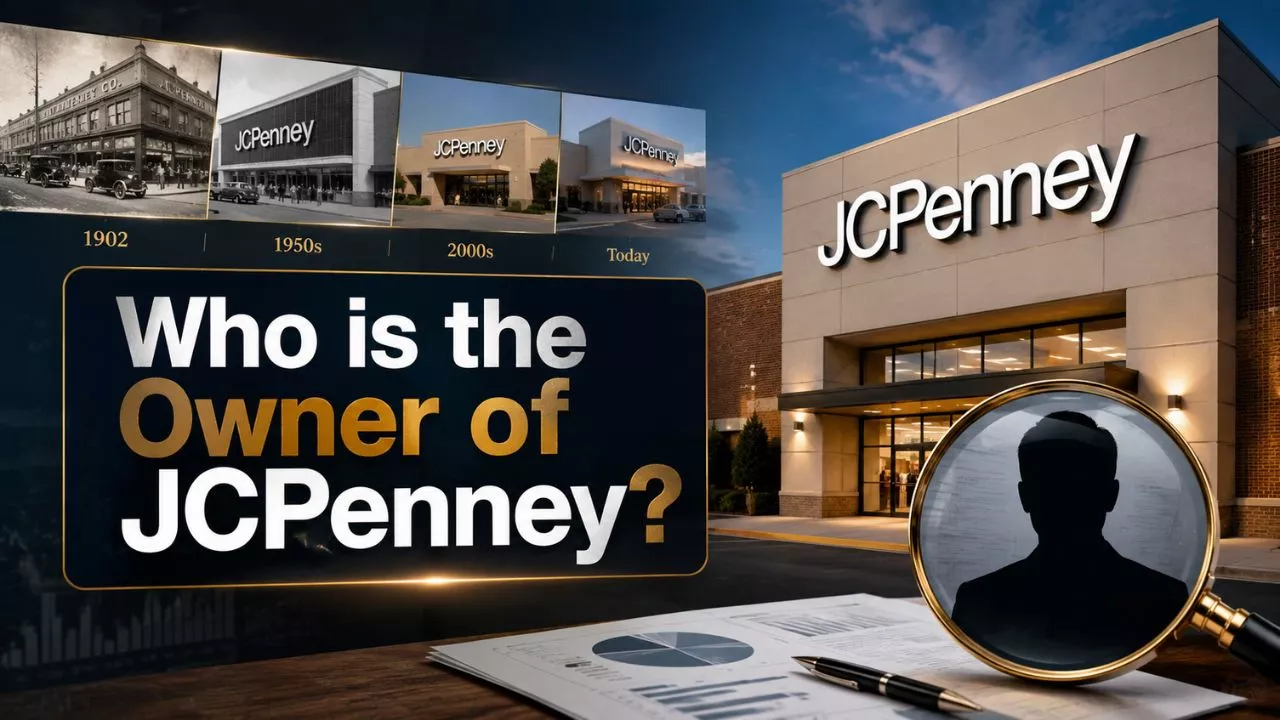
Walk through any major American mall today and you will likely still see a JCPenney sign anchoring one of its corners. The brand has survived two bankruptcies, the rise of Amazon, the death of the mall era, and a global pandemic. But the company that exists today looks nothing like the one that James Cash Penney built from a small dry goods store in Wyoming back in 1902. So who actually owns JCPenney in 2026? The answer involves two of the biggest real estate companies in North America, a Chinese fashion giant, one of the most aggressive brand licensing firms in the world, and a brand-new holding company that was created just last year.
Here is the complete, verified story.
What Is JCPenney?
JCPenney is an American department store chain founded in 1902 by James Cash Penney. It is headquartered in Plano, Texas, and currently operates 643 locations across the United States and Puerto Rico as of 2026.
At its peak, JCPenney operated over 1,100 department stores across the country, making it one of the most recognizable retail brands in American history. It sold everything from clothing and jewelry to home furnishings and beauty products — and it was the anchor tenant in hundreds of shopping malls from coast to coast.
Who Owns JCPenney Right Now in 2026?
JCPenney is owned by Catalyst Brands, a joint venture between Authentic Brands Group, Brookfield Corporation, Shein, and Simon Property Group, since 2025.
Catalyst Brands LLC was formed in 2025 by the merger of Sparc Group and JCPenney. Brookfield Corporation and Simon Property Group are the primary structural owners of Catalyst Brands, each holding approximately 50% of the parent entity.
In plain terms — two giant real estate companies (Simon and Brookfield) control JCPenney, a brand management company (Authentic Brands Group) owns the intellectual property, and Shein is a strategic partner with a financial stake. JCPenney is no longer a public company. It is fully private, and the founding Penney family has had no ownership stake for decades.
JCPenney Ownership and Key Stakeholders Table
| Owner / Party | Role | Stake / Detail | Key Note |
|---|---|---|---|
| Catalyst Brands LLC | Direct Parent Company | 100% ownership of JCPenney | Formed January 2025 via merger of JCPenney and Sparc Group |
| Simon Property Group | Co-Owner of Catalyst Brands | ~50% of Catalyst Brands | World’s largest mall REIT; NYSE: SPG |
| Brookfield Corporation | Co-Owner of Catalyst Brands | ~50% of Catalyst Brands | Global real estate and asset management giant |
| Authentic Brands Group (ABG) | IP Owner & Strategic Partner | Owns JCPenney brand trademarks | Manages brand licensing; also owns Brooks Brothers, Nautica |
| Shein | Strategic Investor | Minority stake in Catalyst | Chinese fast-fashion giant; digital commerce partner |
| Marc Rosen | CEO of Catalyst Brands | No major ownership stake | Former JCPenney CEO; now leads all of Catalyst Brands |
| Michelle Wlazlo | Brand CEO of JCPenney | No major ownership stake | Runs JCPenney operations day-to-day under Catalyst |
The Origin Story: A Golden Rule Store in Wyoming
JCPenney traces its origins back to April 14, 1902, when founder James Cash Penney and his partners opened the Golden Rule dry goods store in Kemmerer, Wyoming. Over the next two years, they expanded to other Wyoming frontier towns.
James Cash Penney Jr. was born on September 16, 1875, on a farm outside of Hamilton, Missouri, the seventh of twelve children. He founded the JCPenney stores in 1902.
The name “Golden Rule” was not just a brand — it was a business philosophy. Penney believed in treating customers with honesty, selling at fair fixed prices, and never running on credit. That model was revolutionary for the time, when most merchants haggled over every transaction.
In 1907, Penney bought out his original partners and began a journey that would shape the retail landscape for decades to come. When it was incorporated on January 17, 1913, as J. C. Penney Company, the chain had already spread well beyond Wyoming. By 1917, JCPenney had expanded to 175 stores.
By the 1970s and 1980s, JCPenney had become the defining anchor tenant of the American shopping mall — one of the most powerful retail brands in the country.
The Bankruptcy That Changed Everything
The story of how JCPenney went from 1,100 stores at its peak to a private subsidiary of a real estate joint venture is one of the most dramatic collapses in American retail history.
JCPenney posted net losses of $4.2 billion between 2011 and 2019. Revenue had been declining for nearly a decade as online shopping eroded department store traffic and a failed turnaround strategy under CEO Ron Johnson in 2011–2013 accelerated the decline.
In May 2020, the 118-year-old department store filed for Chapter 11 bankruptcy protection, slammed by years of dwindling sales, a huge debt burden, and a pandemic that had closed its stores for weeks.
In September 2020, JCPenney was acquired by Simon Property Group and Brookfield Asset Management in a cash and debt deal worth around $800 million.
The logic behind the purchase was straightforward and coldly practical. Simon and Brookfield are two of the largest mall owners in North America. JCPenney was their biggest anchor tenant — the store that anchored foot traffic in hundreds of their malls. If JCPenney liquidated and closed all its stores, the knock-on effect on the value of those malls would have been catastrophic. So they bought it not because they wanted to be in the retail business, but because losing JCPenney as a tenant would have hurt them far more.
What Is Catalyst Brands and Why Does It Matter?
The 2025 creation of Catalyst Brands is the most important development in JCPenney’s recent ownership history — and it fundamentally changed how the company is structured.
JCPenney merged with Sparc Group — a management company that operates such once-dominant retailers as Aéropostale, Brooks Brothers, and Eddie Bauer — to form Catalyst Brands. Sparc’s owners — Authentic Brands Group, mall operators Simon Property Group and Brookfield Corporation, and Shein — continued as owners of Catalyst.
Marc Rosen, formerly JCPenney’s CEO, is now CEO of Catalyst Brands. The new combination has relationships with more than 60 million customers and deep consumer data across all its brands.
The brands that now sit inside Catalyst Brands alongside JCPenney include Brooks Brothers, Lucky Brand Jeans, Nautica, and Aéropostale. Each brand’s intellectual property is owned by Authentic Brands Group, while Catalyst handles the day-to-day operations, the stores, the employees, and the supply chain.
Shein’s involvement as a strategic partner is especially significant. The Chinese fast-fashion giant brings digital commerce capabilities, global supply chain expertise, and access to a younger consumer demographic that JCPenney has long struggled to attract.
JCPenney Today: How Is It Doing in 2026?
The honest answer is that JCPenney’s recovery has been difficult. Last year the retailer’s total net sales fell 8.6% to $6.3 billion. The company swung to a $177 million loss, from $30 million in net income the previous year. Consolidated adjusted EBITDA fell more than 45% to $172 million.
The creation of Catalyst Brands in 2025 is partly a response to these challenges. By consolidating multiple retail brands under one operational roof, the new company can share distribution infrastructure, marketing costs, buying power, and technology — giving each brand a better chance of survival than it would have flying solo.
JCPenney is focusing on private brand expansion and exclusive partnerships, including JCPenney Beauty replacing the prior Sephora partnership, to drive margin improvement and customer differentiation. The company is also investing in its loyalty program to increase active loyalty members and frequency of visits among core customers.
With 643 stores still operating across the U.S. and Puerto Rico as of 2026, JCPenney remains one of the largest department store chains in America — even if it is a shadow of what it once was.
JCPenney started as a single $2,000 investment by a farmer’s son from Missouri who opened a fair-pricing dry goods store in a Wyoming mining town in 1902. It grew into one of the greatest retail empires in American history — and then slowly collapsed under the weight of debt, failed leadership decisions, online competition, and a global pandemic.
Today, JCPenney is owned by Catalyst Brands — a private company formed in 2025 — which is itself jointly owned by Simon Property Group and Brookfield Corporation (approximately 50% each), with Authentic Brands Group holding the brand’s intellectual property and Shein as a strategic investor. The company is no longer publicly traded and operates 643 stores under the day-to-day leadership of Brand CEO Michelle Wlazlo, with Marc Rosen running all of Catalyst Brands as its overall CEO.
Related Ownership Profiles
For another major American consumer platform, see who owns Lyft.
Frequently Asked Questions (FAQs)
Q1. Who owns JCPenney in 2026?
JCPenney is owned by Catalyst Brands, a joint venture controlled by Simon Property Group and Brookfield Corporation, with Authentic Brands Group and Shein as partners.
Q2. Is JCPenney still in business in 2026?
Yes. JCPenney operates 643 stores across the United States and Puerto Rico as of 2026.
Q3. Who founded JCPenney and when?
JCPenney was founded on April 14, 1902 by James Cash Penney and William Henry McManus in Kemmerer, Wyoming, as The Golden Rule dry goods store.
Q4. Why did JCPenney go bankrupt?
JCPenney filed for Chapter 11 bankruptcy in May 2020 after accumulating $4.2 billion in losses between 2011–2019, worsened by the COVID-19 pandemic shutting down its stores.
Q5. What is Catalyst Brands?
Catalyst Brands is a private retail holding company formed in 2025 by merging JCPenney and Sparc Group, housing brands like Brooks Brothers, Nautica, Aéropostale, and Lucky Brand.
Q6. Does Shein own JCPenney?
Not outright. Shein is a strategic investor and partner in Catalyst Brands — it holds a minority stake but does not control JCPenney.
Q7. Is JCPenney publicly traded in 2026?
No. JCPenney is a fully private company. Its stock was delisted from the NYSE in 2020 when it filed for bankruptcy and has not returned to public markets.
Q8. How many JCPenney stores are there in 2026?
JCPenney operates 643 store locations across the United States and Puerto Rico as of 2026.