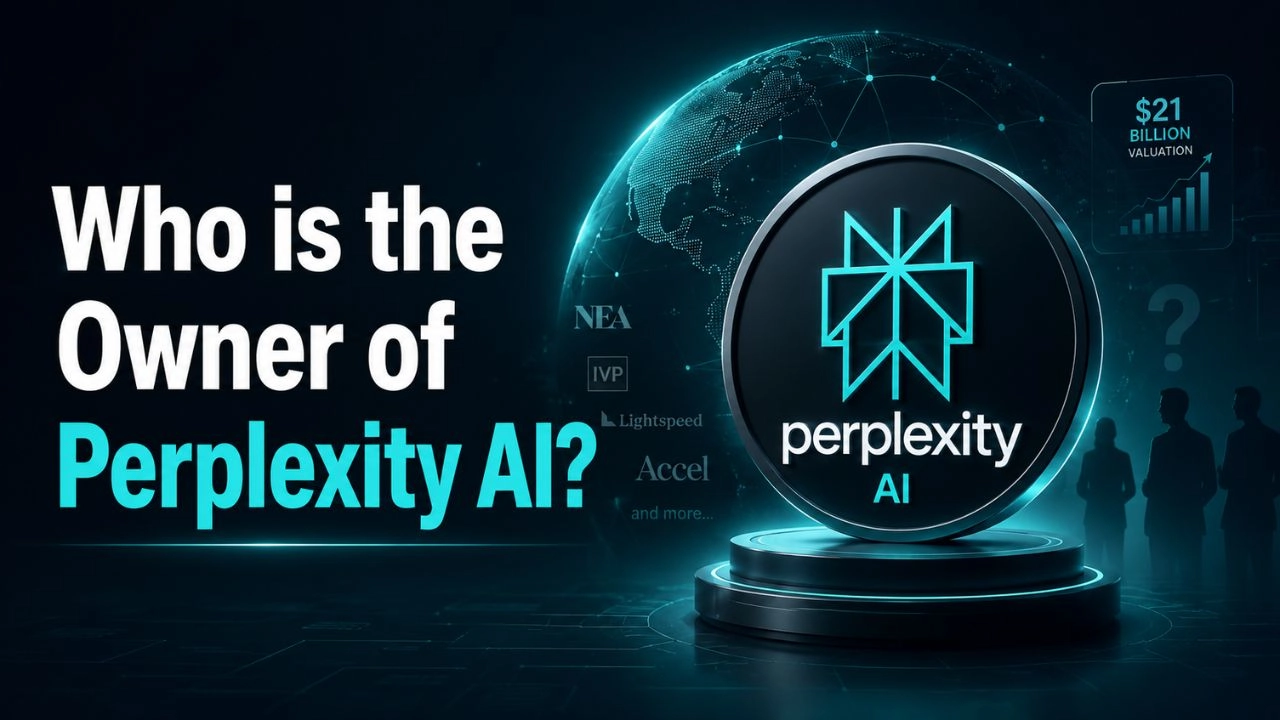
In less than four years, Perplexity AI transformed from a seed-stage startup to a $21 billion privately held company. But behind that valuation lies a more nuanced ownership story: a founding team that retained operational control, a venture ecosystem spanning from chip makers to billion-dollar funds, and a roster of backers ranging from Amazon’s Jeff Bezos to professional athletes.
THE FOUR FOUNDERS: ENGINEERS WITH AI PEDIGREE
Perplexity AI was founded in August 2022 by four engineers who shared a common frustration with how traditional search engines operated. Rather than deliver direct, sourced answers, Google and other giants returned link lists. The founders saw an opportunity: combine large language models with real-time web data to build something fundamentally different.
Aravind Srinivas, who serves as Chief Executive Officer, holds a PhD in computer science from UC Berkeley. He spent formative years at OpenAI, Google Brain, and DeepMind. His background in machine learning and reinforcement learning proved essential in architecting Perplexity as a citation-driven platform rather than a pure chatbot. Under his leadership, the company expanded into Perplexity Pro subscriptions and developer APIs.
Denis Yarats, the Chief Technology Officer, came from Meta’s AI research division, where he pioneered techniques in natural language processing and model optimization. His technical expertise shaped Perplexity’s architecture to handle millions of concurrent queries while maintaining answer quality.
Johnny Ho, Chief Strategy Officer, brought a different lens—previously an engineer at Quora and a quantitative trader at Tower Research Capital. This background positioned him to think strategically about how Perplexity could compete for user attention and engagement in the crowded AI space.
Andy Konwinski, President and Board Member, co-founded Databricks—a venture-backed data analytics platform that raised over $1.3 billion. His experience scaling enterprise infrastructure informed Perplexity’s approach to handling large-scale data pipelines and cloud deployment.
Together, these four founders retained operational control and continue to guide Perplexity’s product direction as of mid-2026. This founder-centric ownership structure is significant: unlike many venture-backed startups where the cap table becomes fragmented, Perplexity’s founding team has maintained influence.
THE $1.7 BILLION FUNDING JOURNEY: FROM SEED TO UNICORN
Perplexity’s funding trajectory reads like an accelerated venture success story. Since its first round in September 2022, the company has raised $1.72 billion across 11 funding rounds from 62 investors, according to recent financing data.
The Series A round, led by NEA (New Enterprise Associates), provided early validation and capital ($26 million) that enabled the launch of Perplexity’s mobile application. This was crucial: mobile access transformed Perplexity from a web-only research tool into something users could access anywhere.
By January 2024, the Series B round valued Perplexity at approximately $520 million, with IVP (Institutional Venture Partners) leading a $73.6 million investment. At this stage, the company had already reported annual recurring revenue (ARR) between $5 million and $10 million and claimed ten million active monthly users—metrics that justified the valuation.
The real inflection came in late 2024 and early 2025. SoftBank Vision Fund 2 led a major Series C round around $500 million, signaling that Perplexity was no longer just a venture bet—it was becoming infrastructure. Major chip manufacturers and tech conglomerates began paying attention. By March 2025, Reuters reported a possible $18 billion valuation round supported by Nvidia and SoftBank.
By early 2026, Perplexity’s valuation had climbed to $21.21 billion, making it worth more than most public software companies. This valuation reflected not investor euphoria alone, but a substantive thesis: answer engines—AI systems that synthesize web sources into direct responses—could capture a meaningful portion of Google’s $150+ billion search revenue pool.
MAJOR INVESTORS: VENTURE CAPITAL & STRATEGIC BACKERS
Perplexity’s investor base is unusually diverse, mixing traditional venture capital with strategic players across chips, cloud, commerce, and founder capital.
Venture Capital Heavy Hitters:
- Accel led the Series E and remains a prominent board-level investor
- IVP (Institutional Venture Partners) led both Series B and co-led Series D
- Bessemer Venture Partners has participated in later rounds
- NEA backed the company early and benefited from the valuation climb
Strategic & Chip Investors:
- Nvidia took a significant position, aligning Perplexity with the world’s dominant supplier of AI computing chips. As Perplexity scales inference, it requires enormous GPU capacity—making Nvidia both a technical dependency and strategic investor.
- SoftBank Vision Fund 2 brought $500 million+ and a global perspective on backing ambitious AI companies. SoftBank has backed OpenAI, Anthropic, and other frontier labs, making Perplexity a complementary bet on the AI ecosystem.
- Databricks, the data analytics platform co-founded by Konwinski, also invested—reinforcing the data-intensive nature of answer engine development.
Individual & Founder Capital: The investor roster includes recognizable tech figures:
- Jeff Bezos (via Bezos Expeditions) became an early and ongoing backer, reportedly investing millions. Bezos’ interest signals his belief in answer engines as a competitive threat to Google—or as an acquisition target.
- Elad Gil, prolific angel investor and former VP at Google, backed Perplexity
- Nat Friedman, ex-GitHub CEO, invested as Perplexity raised
- Paul Buchheit, Gmail creator and early Google employee, backed the round
- Tobias Lütke, Shopify CEO, took an investor position
- Dylan Field, Figma founder, participated in later rounds
- Cristiano Ronaldo reportedly became an angel investor in 2024, adding celebrity-level visibility
This mix is telling: Perplexity attracted not just VCs chasing returns, but operators who understand search, AI, and infrastructure intimately.
OWNERSHIP STRUCTURE & GOVERNANCE
As of mid-2026, Perplexity remains a privately held company with no announced IPO date. However, Reuters reported in June 2026 that Perplexity is targeting a 2028 potential exit, regardless of what happens with Anthropic or OpenAI.
Ownership is distributed among:
- Founders: Retain substantial equity and operational control via dual-class share structures
- Early Venture Investors: NEA, IVP own significant stakes from lower valuation rounds
- Later-Stage Investors: SoftBank, Nvidia, Accel own equity at higher valuations
- Employees: Hold stock options, incentivizing retention and mission alignment
- Angel Investors: Bezos, Friedman, and others hold minority positions
The exact cap table breakdown is not public, but the structure reveals a coalition: founders maintain influence, venture firms provide governance and network, and strategic investors (Nvidia, SoftBank) ensure alignment with long-term technology trends.
WHY OWNERSHIP MATTERS: PRODUCT DIRECTION & FUTURE
Perplexity’s ownership structure directly impacts how the company competes. Unlike Google, which answers to public shareholders and advertiser interests, Perplexity has flexibility to prioritize user experience and accurate sourcing over ad revenue—at least for now. The presence of Nvidia and SoftBank suggests patience: both firms are long-term tech players, not financial engineers seeking quick exits.
The presence of Bezos raises acquisition speculation: Amazon has invested heavily in Alexa and AI, and Perplexity’s answer engine could integrate into Amazon’s broader ecosystem. Similarly, whispers of Microsoft or Apple acquisition linger, though Perplexity’s founders have consistently emphasized independence.
LOOKING AHEAD: IPO, ACQUISITION, OR ANSWER ENGINE DOMINANCE?
Perplexity’s ownership could shift dramatically by 2027-2028. An IPO at $25 billion or higher is plausible if answer engine adoption accelerates. Alternatively, acquisition by a tech giant (Microsoft, Apple, Amazon) would liquidate investor positions while allowing founders to retain influence via protective share structures—a common outcome in founder-friendly exits.
What’s clear: ownership of Perplexity AI isn’t about a single controlling figure. It’s a coalition of interests aligned around the thesis that AI-powered search is the next platform shift. The founders set direction, venture firms provide governance, chip makers ensure infrastructure, and strategic investors signal belief in the category itself.
In 2026, as Google loses search share to ChatGPT and Perplexity, understanding who owns Perplexity—and why they own it—offers a window into where Silicon Valley believes the future of information access is heading.
FREQUENTLY ASKED QUESTIONS
Q: Who are the four founders of Perplexity AI?
A: The four founders are Aravind Srinivas (CEO), Denis Yarats (CTO), Johnny Ho (Chief Strategy Officer), and Andy Konwinski (President). All four remain in active leadership roles and retain significant equity in the company.
Q: How much has Perplexity raised in total funding?
A: Perplexity has raised $1.72 billion across 11 funding rounds from 62 investors since September 2022. The company’s valuation reached $21.21 billion by early 2026.
Q: Who are the major investors in Perplexity?
A: Major investors include venture firms (Accel, IVP, Bessemer, NEA), strategic investors (Nvidia, SoftBank Vision Fund 2, Databricks), and individual backers including Jeff Bezos, Elad Gil, Nat Friedman, Paul Buchheit, Tobias Lütke, Dylan Field, and Cristiano Ronaldo.
Q: Is Perplexity a publicly traded company?
A: No, Perplexity remains privately held as of mid-2026. However, Reuters reported that the company is targeting a potential 2028 exit, which could be an IPO or acquisition.
Q: What makes Perplexity different from Google?
A: Unlike Google, which answers to public shareholders and advertisers, Perplexity prioritizes user experience and accurate sourcing through citation-driven answers synthesized from web sources. The company is positioned as an “answer engine” rather than a traditional search engine.
Q: Could Perplexity be acquired?
A: Yes, acquisition speculation surrounds the company. Potential acquirers mentioned include Amazon (Bezos is an investor), Microsoft, and Apple. However, Perplexity’s founders have consistently emphasized the company’s independence.
Q: What is Perplexity’s business model?
A: Perplexity offers a freemium model with Perplexity Pro subscriptions for advanced features and a developer API. The company has reported annual recurring revenue (ARR) between $5-10 million as of early 2024, though recent figures have not been publicly disclosed.
Q: Why did Nvidia and SoftBank invest in Perplexity?
A: Nvidia invested because Perplexity’s AI infrastructure relies heavily on GPU computing capacity. SoftBank invested as part of its broader bet on frontier AI companies and answer engine technology as the next major platform shift beyond traditional search.
Q: What is the significance of having Aravind Srinivas as CEO?
A: Srinivas brings direct experience from OpenAI, Google Brain, and DeepMind—institutions at the forefront of AI research. His background in machine learning and reinforcement learning shaped Perplexity’s vision of building a citation-driven answer engine rather than a conversational chatbot.
Q: When might Perplexity go public?
A: Reuters reported in June 2026 that Perplexity is targeting a potential 2028 exit. An IPO valuation could reach $25 billion or higher if answer engine adoption accelerates, though the company has made no official announcement about timing or method of exit.