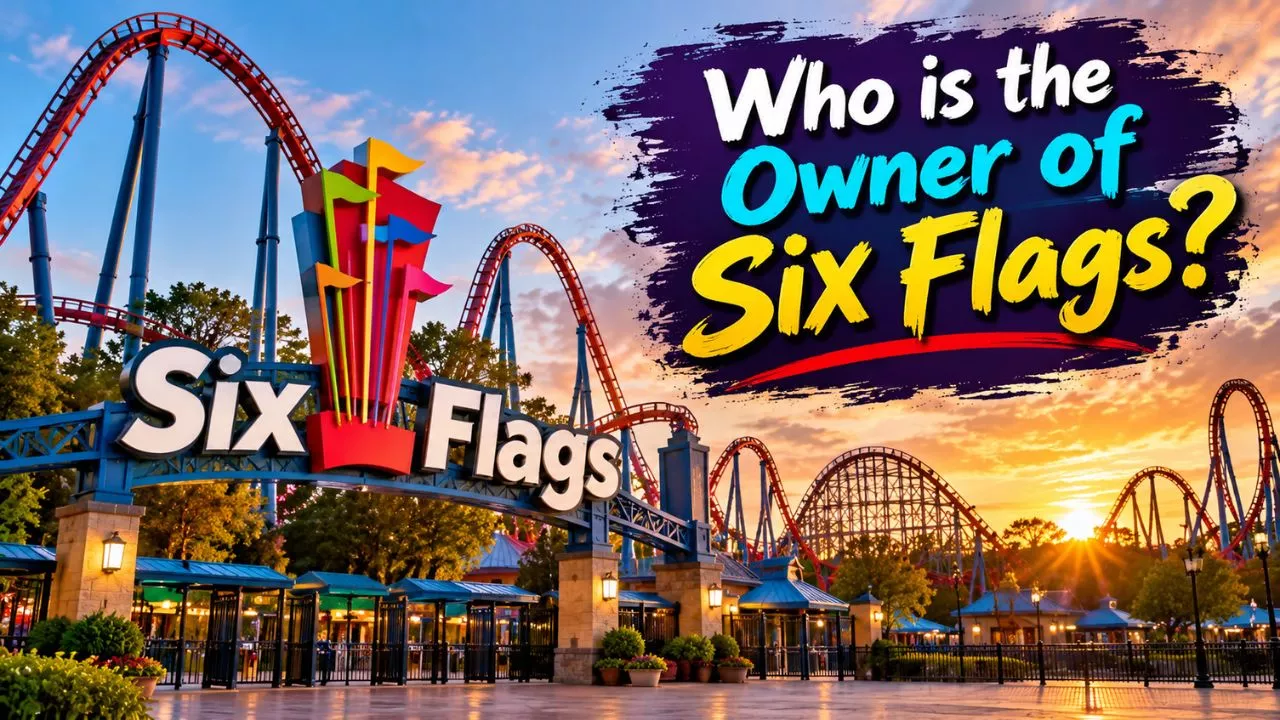
Six Flags is one of the most recognized names in the American amusement park world. The brand stretches from massive roller coasters in Texas and Georgia to water parks scattered across North America — and to a management deal for a park all the way in Saudi Arabia.
But the company behind the name today is not the same one that built the original park over 65 years ago. It is the product of one of the largest theme park mergers in history, and it is currently in the middle of a dramatic leadership overhaul and portfolio restructuring that is reshaping everything about how the business operates.
Who Owns Six Flags Right Now in 2026?
Six Flags Entertainment Corporation is a publicly traded company listed on the New York Stock Exchange under the ticker symbol FUN — yes, literally FUN. Since it is publicly traded, no single person or private entity owns it outright. Ownership is spread across institutional investors, mutual funds, and public shareholders.
The largest single shareholder is BlackRock, Inc. with approximately 14.04% of shares outstanding, followed by The Vanguard Group at approximately 9.95%, and Darlington Partners Capital Management at approximately 5.85%. The same two firms — BlackRock and Vanguard — that appear as dominant shareholders in companies like Disney and DraftKings sit at the top here too. That is simply the reality of how public company ownership works in modern America.
Ownership and Key Stakeholders Table
| Shareholder / Party | Type | Stake | Key Detail |
|---|---|---|---|
| BlackRock, Inc. | Largest Institutional Shareholder | ~14.04% of FUN shares | World’s largest asset manager; top holder across most public companies |
| The Vanguard Group | Second Largest Institutional Shareholder | ~9.95% of FUN shares | Passive index fund giant; consistent large-cap holder |
| Darlington Partners Capital Management | Activist / Hedge Fund | ~5.85% of FUN shares | Filed Schedule 13G in March 2025; activist-leaning investor |
| Cedar Fair unitholders (post-merger) | Structural Majority | ~51.2% of combined company | Received shares 1:1 in the July 2024 merger; form the majority block |
| Former Six Flags shareholders | Structural Minority | ~48.8% of combined company | Received 0.58 shares per former SIX share at merger close |
| John Reilly | President & CEO | Minimal insider stake | Appointed December 2025; leading the current turnaround |
| Richard Haddrill | Executive Chairman | Minimal insider stake | Appointed 2026; founder of The Groop LLC and Generator Partners |
| Ash Walia | CFO | Minimal insider stake | Appointed June 2026; previously held CFO roles in retail |
| No private controlling owner | N/A | N/A | Fully publicly traded; no single founder or family controls the company |
The Origin Story: One Man Inspired by Disneyland
The story of Six Flags begins with a World War II veteran named Angus G. Wynne Jr. — a Texas real estate developer who visited Disneyland in Anaheim, California shortly after it opened in 1955 and came home with a plan to build something similar in Texas.
Wynne and other investors formed the Great Southwest Corporation and spent roughly $10 million building a theme park on a hillside in Arlington, Texas, between Dallas and Fort Worth.
The park was named Six Flags Over Texas — a reference to the six nations whose flags had historically flown over Texas: Spain, France, Mexico, the Republic of Texas, the Confederacy, and the United States.
It opened on August 5, 1961, and became an immediate success, drawing crowds from across the region. The very name of the company that would eventually grow into a $4 billion enterprise came from those six flags.
Wynne originally intended the site to eventually become an industrial complex. That plan was abandoned the moment he saw how popular the park was.
From Texas to North America: The Expansion Years
After the success of Six Flags Over Texas, Wynne opened a second park — Six Flags Over Georgia — in 1967, and a third — Six Flags Over Mid-America in Missouri — in 1971. The brand grew steadily through the 1970s and 1980s through a mix of new builds and acquisitions.
In 1998, a company called Premier Parks — previously named Tierco Group — acquired the original Six Flags Theme Parks for $1.86 billion. Premier Parks subsequently renamed itself Six Flags, Inc. in 2000, inheriting not just the parks but the debt that came with rapid expansion.
That debt load became unsustainable, and in 2009, Six Flags filed for Chapter 11 bankruptcy protection — one of the most high-profile corporate collapses in the history of the American amusement park industry.
The company emerged from bankruptcy in 2010 as a reorganized entity and gradually rebuilt itself over the next decade, eventually sitting at 27 properties across North America before its most consequential event yet.
The Cedar Fair Merger: A $8 Billion Combination
The single biggest turning point in Six Flags’ modern history was not a new park opening or a bankruptcy filing — it was a merger of equals announced in November 2023 and completed on July 1, 2024.
Six Flags Entertainment Corporation merged with Cedar Fair, L.P. — the Ohio-based amusement park company whose flagship property was the legendary Cedar Point on the shores of Lake Erie — in a deal valued at approximately $8 billion.
Both the original Six Flags shares and Cedar Fair units were delisted from the NYSE on July 1, 2024. A new combined company, retaining the Six Flags Entertainment Corporation name, began trading under the ticker FUN on July 2, 2024 — keeping Cedar Fair’s beloved old ticker symbol as a tribute to the merged entity’s purpose.
Under the merger terms, Cedar Fair unitholders received one share of the new company for each unit they held. Former Six Flags shareholders received 0.5800 shares for each share they owned.
The result was that Cedar Fair unitholders held approximately 51.2% of the combined company, with former Six Flags shareholders holding the remaining 48.8% — making Cedar Fair the accounting acquirer despite both companies framing it as a merger of equals.
At the time of the merger, the combined company operated 42 properties — making it by far the largest regional amusement park operator in North America, larger than anything Disney or Paramount operates in the regional park space.
Leadership Overhaul: A Company in Transition
The Six Flags of 2026 is a company that looks very different from the one that completed the Cedar Fair merger just two years ago — particularly in its leadership structure.
In December 2025, John Reilly was appointed President and CEO, replacing the previous leadership team that had overseen the merger integration. Reilly took over with a clear mandate: improve performance, reduce debt, and sharpen the company’s focus on its best-performing assets.
In 2026, the leadership changes continued at pace. Ash Walia was appointed Chief Financial Officer in May 2026, effective June 17, 2026. Mark Pauls was appointed Chief Operating Officer in July 2026, succeeding Tim Fisher.
And in May 2026, Richard Haddrill — founder of investment firm The Groop LLC and alternative energy company Generator Partners — was appointed Executive Chairman of the Board, the seventh new director added to the board since the summer of 2025.
The pace of change at the board and executive level signals a company undergoing genuine structural transformation, not cosmetic adjustment.
Selling Parks to Focus on the Best
One of the most striking moves of John Reilly’s early tenure has been a deliberate decision to sell off underperforming parks and concentrate resources on the strongest properties in the portfolio.
On March 5, 2026, Six Flags announced definitive agreements to sell seven parks to EPR Properties (NYSE: EPR) — a real estate investment trust — for $331 million in total cash.
The six U.S. parks included in the deal were Valleyfair (Minnesota), Worlds of Fun (Missouri), Michigan’s Adventure (Michigan), Schlitterbahn Waterpark Galveston (Texas), Six Flags St. Louis (Missouri), and Six Flags Great Escape (New York). Six Flags La Ronde in Montreal, Canada was also sold separately, to a company owned by Kieran Burke.
The transaction closed for the six U.S. parks, and Six Flags now operates a remaining collection of approximately 34 parks — a leaner, more focused portfolio that CEO Reilly believes offers stronger long-term returns and greater operational clarity.
“This divestiture reflects Six Flags’ disciplined approach to portfolio optimization,” said Reilly at the time of the closing. “We are concentrating our capital and operational focus on properties with the greatest long-term growth potential.”
What Does Six Flags Look Like in 2026?
After the divestitures, Six Flags Entertainment Corporation operates approximately 20 amusement parks, 14 water parks, and manages one additional park in Saudi Arabia — making it still the largest regional amusement-resort operator in North America by park count, even after the sales.
The company is headquartered in Charlotte, North Carolina, with administrative offices in Sandusky, Ohio (the legacy Cedar Fair base) and Arlington, Texas (the original home of Six Flags).
The brand portfolio includes both the iconic Six Flags name — attached to parks like Six Flags Over Texas, Six Flags Great Adventure in New Jersey, Six Flags Magic Mountain in California, and Six Flags Over Georgia — and the Cedar Fair legacy properties including Cedar Point, Knott’s Berry Farm, Kings Island, Carowinds, and Canada’s Wonderland.
Just like collectible brand companies that depend on licensing deals — similar to how Funko built a billion-dollar business on pop culture licensing — Six Flags’ brand power is one of its most durable assets, licensing the name and operating model to third-party operators internationally.
Frequently Asked Questions (FAQs)
Q1. Who owns Six Flags in 2026?
Six Flags Entertainment Corporation (NYSE: FUN) is publicly traded with BlackRock (~14.04%) and Vanguard (~9.95%) as the largest institutional shareholders — no single private owner controls it.
Q2. When did Six Flags and Cedar Fair merge?
The merger closed on July 1, 2024, creating the current Six Flags Entertainment Corporation and combining both companies into North America’s largest regional amusement park operator.
Q3. Who founded Six Flags?
Six Flags was founded by Angus G. Wynne Jr., a Texas real estate developer who opened Six Flags Over Texas in Arlington on August 5, 1961, inspired by his visit to Disneyland in 1955.
Q4. Who is the CEO of Six Flags in 2026?
John Reilly serves as President and CEO of Six Flags Entertainment Corporation, appointed in December 2025 to lead a turnaround strategy for the combined company.
Q5. How many parks does Six Flags own in 2026?
After selling seven parks to EPR Properties in 2026, Six Flags operates approximately 20 amusement parks and 14 water parks in North America, plus manages one park in Saudi Arabia.
Q6. Did Six Flags go bankrupt?
Yes. The original Six Flags, Inc. filed for Chapter 11 bankruptcy in 2009 under the weight of acquisition debt, emerging as a reorganized company in 2010 before eventually merging with Cedar Fair in 2024.
Q7. What stock ticker does Six Flags trade under?
Six Flags Entertainment Corporation trades on the New York Stock Exchange under the ticker symbol FUN — retained from Cedar Fair’s pre-merger ticker symbol.
Q8. What is the biggest park in the Six Flags portfolio?
Cedar Point in Sandusky, Ohio — the legacy Cedar Fair flagship — is widely considered the crown jewel of the portfolio, consistently voted one of the best amusement parks in the world.
Six Flags Entertainment Corporation (NYSE: FUN) is a publicly traded company with no single private owner. Its two largest institutional shareholders are BlackRock (~14.04%) and Vanguard (~9.95%).
The company was created in its current form on July 1, 2024, through the $8 billion merger of the original Six Flags and Cedar Fair — becoming North America’s largest regional amusement park operator almost overnight.
Under new CEO John Reilly, appointed in December 2025, the company has been restructuring aggressively — selling seven parks in 2026 for $331 million and installing an almost entirely new executive team.
The brand itself traces back to 1961, when Angus G. Wynne Jr. turned a $10 million real estate project in Arlington, Texas into a theme park that would eventually define regional amusement in America for generations.