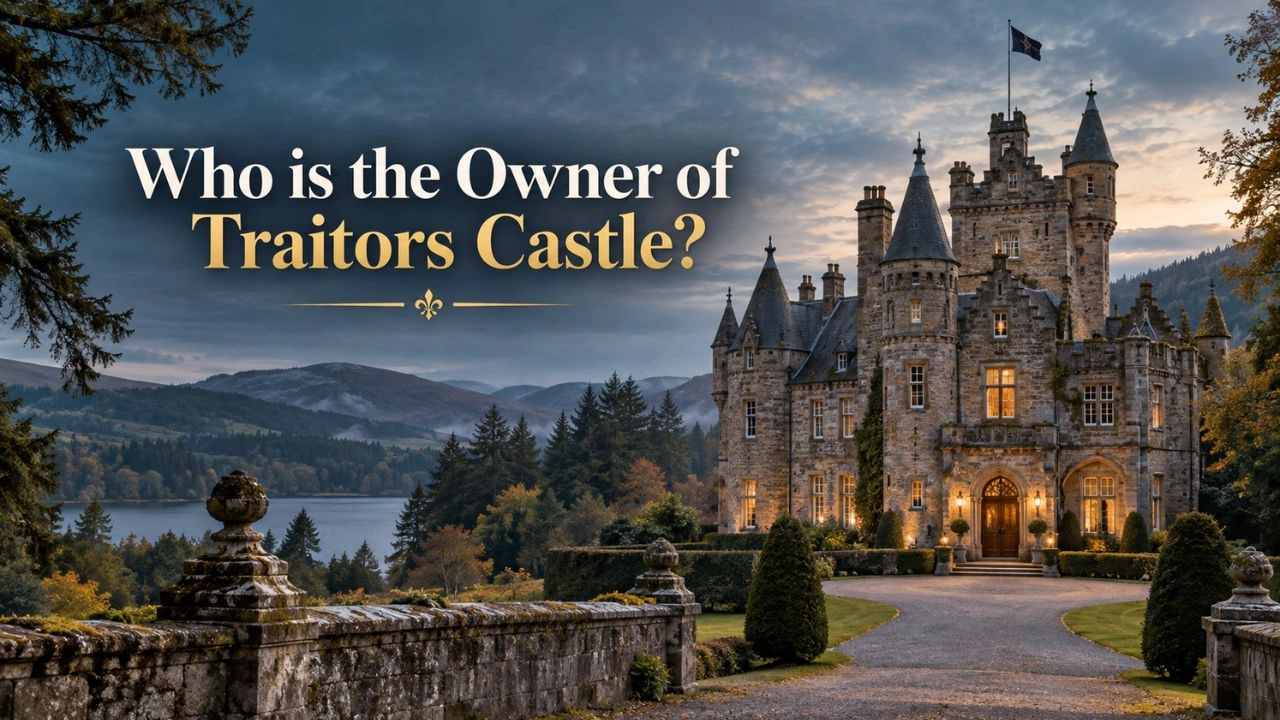
Every time The Traitors airs — whether the BBC UK version hosted by Claudia Winkleman or the Peacock US version hosted by Alan Cumming — millions of viewers ask the same question: who actually owns that extraordinary castle?
The turrets, the fog rolling across the Scottish Highlands, the lavish interiors where faithful contestants and scheming traitors face each other across a candlelit table — it is genuinely one of the most atmospheric settings in modern television history.
The answer is a private Scottish family who have owned it quietly since 1983 — long before any television cameras arrived.
What Is The Traitors Castle Called?
The castle used in The Traitors is called Ardross Castle. It is a genuine, privately owned Scottish Baronial mansion located near the town of Alness in Ross-shire, in the Scottish Highlands, approximately 30 miles north of Inverness. It is not a set or a replica — it is a real historic castle set within around 100 acres of gardens, parkland, and woodland.
Ardross Castle is a Category A-listed building — the highest level of heritage protection in Scotland, equivalent to a Grade I listing in England. Its current structure covers approximately 22,000 square feet and is valued at just under £3 million for the castle building alone.
Who Owns The Traitors Castle in 2026?
Ardross Castle is owned by the McTaggart family, who purchased the estate in 1983 and still own it today. The family is known for their involvement in business, property development, and philanthropy across Scotland and the wider UK.
Notable members of the McTaggart family include Sir John Mactaggart, 4th Baronet — a Scottish businessman and philanthropist educated at Shrewsbury School and Trinity College, Cambridge — and his sister Fiona Mactaggart, who served as a Labour MP for Slough from 1997 to 2017. The castle’s day-to-day management is handled through a company called Ardross Castle Enterprises Limited.
Ownership and Key Details Table
| Owner / Party | Role | Period | Key Detail |
|---|---|---|---|
| McTaggart Family | Current Private Owner | 1983 — Present | Scottish family; business, property, and philanthropy background |
| Sir John Mactaggart, 4th Baronet | Notable Family Member | Current | Scottish businessman and philanthropist; educated at Cambridge |
| Fiona Mactaggart | Notable Family Member | Current | Former Labour MP for Slough (1997–2017); sister of Sir John |
| Ardross Castle Enterprises Ltd | Operating Company | Current | Manages events, weddings, and filming at the estate |
| Austin & Mrs Mardon | Previous Owner | Late 1930s – 1983 | Bought after the 1937 breakup sale; held until 1983 |
| C.W. Dyson Perrins | Previous Owner | 1898 – 1937 | Heir to Lea & Perrins Worcestershire Sauce fortune |
| Sir Alexander Matheson | Previous Owner & Builder | 1845 – 1898 | Built the castle as we know it; made fortune in tea and opium trading |
| 2nd Duke of Sutherland | Previous Owner | Early 1800s – 1845 | Sold estate to Matheson for £90,000 in 1845 |
| 1st Duke of Sutherland | Original Estate Owner | Late 1700s | Built the original hunting lodge on the land |
| BBC / Peacock / Studio Lambert | TV Production Tenant | 2022 – Present | Hires the castle as a filming location; does not own it |
The Remarkable History Behind the Castle
The land at Ardross has a history stretching back over 200 years — and the story of how it became what it is today is genuinely extraordinary.
In the late 1700s, the estate was owned by George Granville Leveson-Gower, the 1st Duke of Sutherland — one of the most controversial figures in Scottish Highland history, closely associated with the Highland Clearances in which communities were forcibly removed from their ancestral land. He built a hunting lodge on the site where the castle stands today.
In 1845, the 2nd Duke of Sutherland sold the 60,000-acre Ardross Estate to Sir Alexander Matheson for £90,000 — approximately £68 million in today’s money.
Sir Alexander Matheson was a merchant banker, an MP, and a founder of the Matheson & Co. trading house — a firm that made its fortune in tea and opium trading in China, which later became part of Jardine Matheson.
He hired Scottish architect Alexander Ross to completely redesign the original hunting lodge as a grand castle in the Gothic Scots Baronial style, adding around 30 extra rooms and laying out 700 acres of pleasure grounds including the lawns, pond, and fountain still visible on the show today. Around 400 workers were employed during construction from 1847 onward, with the total renovation costing £7,000.
After Sir Alexander’s death in 1898, the estate passed to Charles William Dyson Perrins — a businessman whose grandfather had co-created the recipe for Worcestershire Sauce with John Wheeley Lea, making the family famous as the force behind Lea & Perrins.
The Perrins family modernized the castle, adding electricity, and spent several months there each year for parties, hunting, and fishing. In 1937, the estate was broken up and sold in separate parcels. Mr and Mrs Austin Mardon eventually purchased Ardross Castle along with Lealty Farm and over 80 acres, and lived there until 1983.
In 1983, the McTaggart family acquired the entire estate and began an extensive program of restoration — bringing the formal garden, walled garden, shrubberies, and lawns back into proper management, planting additional trees, and eventually transforming the castle into the events and filming venue it is today.
How The Traitors Ended Up Here
Ardross Castle was not always on television producers’ radar. It operated quietly for years as a private family home and exclusive hire venue — available for weddings, corporate events, and private gatherings, but largely unknown outside of those circles.
The Traitors UK first filmed at Ardross in 2022 for its debut series on the BBC. The show was an immediate hit, and the castle became as much a star of the series as the contestants themselves.
The US version of The Traitors, produced for Peacock and hosted by Scottish actor Alan Cumming, also films at Ardross Castle — making it the shared home of both the British and American franchises.
A key detail that surprises many viewers: contestants do not stay at the castle. They are accommodated at hotels in Inverness and driven to Ardross each day for filming. As Alan Cumming revealed to The Daily Beast, even the host himself did not get to stay there.
The daytime challenges take place on the grounds, while the discussions, roundtable confrontations, and dramatic banishments are filmed inside the castle’s historic interiors.
In 2023, Loukas Tsarmaklis, a director of Ardross Castle Enterprises, told The Press and Journal: “We try to keep a low profile… but there is no chance now.” The castle’s appearance on The Traitors sent searches for “Ardross Castle” up 4,500% compared to the previous five years.
Can You Visit or Stay at Ardross Castle?
This is one of the most common questions fans of The Traitors ask — and the honest answer is: not as a hotel guest.
Ardross Castle is not open to the public for individual stays or tours. The castle grounds are private, and the estate does not operate as a public attraction. The only way to stay at Ardross Castle is to hire the entire property for a private event.
The estate offers an exclusive two-night hire package for weddings and private events accommodating up to 130 guests, with prices starting at approximately £45,000. Guests must bring their own caterers, bar, cooking facilities, flatware, tableware, and glassware — the castle provides the extraordinary setting and that is it.
For fans in the area, the castle can be glimpsed from nearby public roads, and the North Coast 500 driving route passes reasonably close. A short detour via Alness from Inverness offers a view of the exterior — the closest most people will ever get to experiencing The Traitors’ dramatic backdrop in person.
Frequently Asked Questions (FAQs)
Q1. Who owns The Traitors castle in 2026?
Ardross Castle is owned by the McTaggart family, who purchased the estate in 1983 and still own it today.
Q2. What is The Traitors castle actually called?
The castle is called Ardross Castle, located near Alness in Ross-shire, approximately 30 miles north of Inverness in the Scottish Highlands.
Q3. Who are the McTaggart family?
The McTaggart family is a Scottish family known for business, property development, and philanthropy, including Sir John Mactaggart, 4th Baronet and former Labour MP Fiona Mactaggart.
Q4. When did Ardross Castle first appear in The Traitors?
Ardross Castle was first used as a filming location for The Traitors UK in 2022 for the show’s debut series on the BBC.
Q5. How much does it cost to hire Ardross Castle?
Hiring Ardross Castle for a private event starts at approximately £45,000 for a two-night exclusive stay accommodating up to 130 guests.
Q6. Can you stay overnight at Ardross Castle as a regular guest?
No. Ardross Castle is not a hotel. The only way to stay there is to hire the entire estate for a private wedding or corporate event.
Q7. How much is Ardross Castle worth?
The Category A-listed castle building alone is currently valued at just under £3 million, covering approximately 22,000 square feet of historic space.
Q8. Do The Traitors contestants actually stay in the castle during filming?
No. Contestants stay at hotels in Inverness and are driven to Ardross Castle each day — neither the cast nor the hosts stay inside the castle during production.
Ardross Castle — the castle at the heart of The Traitors on both BBC and Peacock — is privately owned by the McTaggart family, who purchased it in 1983 and continue to own it today. The family has owned it for over 40 years, managing it through Ardross Castle Enterprises Limited as an exclusive events, wedding, and filming venue.
The castle was built in its current Scots Baronial form by Sir Alexander Matheson from 1847 onward, with money made from tea and opium trading. It then passed through the hands of a Worcestershire Sauce heir before the McTaggarts acquired it.
The Traitors began filming there in 2022 and continues to do so — but the show is a tenant, not an owner. The McTaggart family alone holds the keys to one of the most iconic locations in modern British television.